
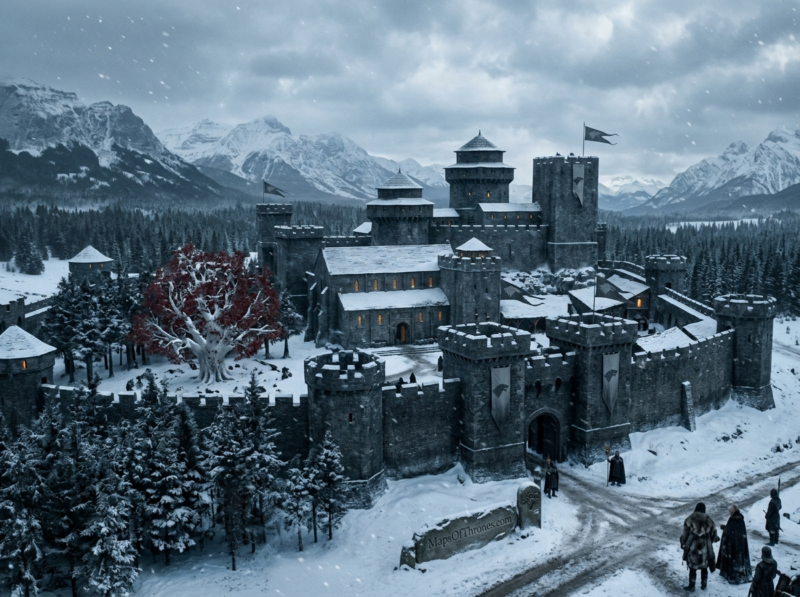
Winterfell
Ancient seat of House Stark, capital of the North, and one of the most formidable castles in all of Westeros — a fortress of stone, secrets, and eight thousand years of history.
Winterfell is the ancient seat of House Stark and the administrative capital of the North — the largest of the Seven Kingdoms of Westeros. Built over 8,000 years ago by the legendary Bran the Builder, it sits at the center of the North along the Kingsroad, heated by natural hot springs that run through its walls. Winterfell serves as both a military stronghold and the cultural heart of Northern identity, housing the Stark crypts, a sacred godswood with an ancient weirwood heart tree, and centuries of the realm’s most consequential history.
What Is Winterfell?
The great stronghold of the North — its history, geography, and enduring power
Winterfell stands as one of the oldest and most storied fortresses in Westeros. Raised by Bran the Builder at the close of the Long Night — when the first men drove back the Others and the Wall rose to seal the North — the castle has served as the seat of the Stark family for nearly eight millennia. Stone upon stone, generation after generation, it has grown into a vast complex of towers, halls, and passages that no single person alive knows in its entirety.
Positioned at the heart of the North, Winterfell commands the Kingsroad at the critical junction between the wilderness above and the settled kingdoms below. To rule here is to rule a land larger than all the southern kingdoms combined — cold, unforgiving, and loyal only to those who earn it. The castle is not merely a home; it is a statement of dominion over the world’s harshest terrain.
“A man can be brave, or he can be a Stark, but he can’t be both. Winterfell has a way of making clear which you are.”
— Northern Saying, as recorded in ASOIAF loreWhat makes Winterfell remarkable even by the standards of the Known World is its internal heating system — a network of channels carrying warm water from natural hot springs beneath the castle through the very walls. In a region where winters can last a decade and kill unprepared travelers within days, this makes Winterfell uniquely habitable, a warm heart in a frozen land. The godswood within its walls contains one of the last great weirwood heart trees still tended by the old religion, making it a sacred site for those who follow the Old Gods of the Forest.
Throughout the events of A Song of Ice and Fire and HBO’s Game of Thrones, Winterfell functions as far more than a backdrop. It is the narrative origin point — where the Starks first receive word of Jon Arryn’s death, where Bran’s fall sets the entire story in motion, and where the final battle against the Night King determines the fate of the living world. Its crypts, its godswood, and its long halls absorb the weight of every great moment that passes through them.

Old Gods
One of Westeros’s last sacred godswoods
Hot Springs
Natural geothermal heating through the walls
Strategically
Controls all Kingsroad traffic northward
Layout of Winterfell
A spatial guide to the castle’s key structures and zones
Schematic layout — not to scale. Full interactive map: View Westeros Map
Key Locations Within Winterfell
The structures, spaces, and secrets that define the castle’s identity
The Godswood
A three-acre forest within the castle walls, home to one of Westeros’s oldest weirwood heart trees — a living oracle carved with a face that has watched the North for thousands of years.
Explore Old Gods LoreThe Crypts
Deep beneath the castle lie the tombs of the Kings of Winter and Lords of Winterfell, their stone effigies seated with iron swords across their laps — swords placed, legend says, to keep their spirits from walking.
Enter the CryptsThe Great Keep
The oldest part of the castle, housing the lord’s chambers and the primary living quarters of House Stark. Its walls run warm from the hot springs channeled through them.
Read MoreThe Library Tower
Home to the maester’s collection of histories, maps, and correspondence. Among the oldest castle libraries in the North, it holds records stretching back to the Age of Heroes.
Maester’s LoreThe Great Hall
Where the lords of the North gather, where banquets are held, and where proclamations ring out across assembled bannermen. One of the great ceremonial spaces of Westeros.
The North OverviewHot Springs System
Running beneath the castle and channeled through hollow walls, these natural hot springs give Winterfell its remarkable warmth — a miracle of ancient engineering that keeps stone habitable through decade-long winters.
Castle ArchitectureThe Armory
Stocked with enough weapons and armor to equip a sizable host. During the conflict with the Night King’s army, it became the staging ground for the defense of the living.
Battle of WinterfellThe Yards
The training yards where Stark children practiced swordsmanship, where Jon Snow sparred under the eye of Ser Rodrik Cassel, and where Arya Stark’s unconventional talents first emerged.
Arya StarkThe Outer & Inner Walls
Two concentric rings of fortification make Winterfell exceptionally difficult to breach. The space between the walls forms a killing ground, with towers positioned to cover every approach.
Westeros FortificationsWinterfell — Political, Geographic & Strategic Breakdown
Understanding the castle through four lenses of power

- Great Keep: Center of lordly authority and family residence
- Great Hall: Public governance — feast, trial, proclamation
- Maester’s Tower: Intelligence network via ravens across the North
- Gatehouse: Controls access, receives guests, enforces protocol
- Lord’s Solar: Private counsel and strategic war planning
- The North: Largest region in Westeros; Winterfell is its center
- Kingsroad Junction: Controls northern passage between south and the Wall
- Wolfswood: Ancient forest flanking the castle’s western approach
- White Knife River: Major northern waterway feeding surrounding lands
- Winter Town: The settlement outside the walls that swells in winter
- Godswood: Sacred heart of Northern spiritual life and Old Gods worship
- The Crypts: Ancestral memory and House Stark’s identity
- Training Yards: Where Northern martial tradition is forged
- Library Tower: Repository of Northern history and knowledge
- Sept: Minor concession to the Faith of the Seven for southern guests
- Outer Wall: First line of defense, tower-reinforced perimeter
- Inner Wall: Secondary fortification creating a kill zone between rings
- Armory: Weapons stores capable of equipping a full Northern host
- Stables & Kennels: Cavalry and hound support for rapid response
- Hot Springs Network: Ensures year-round habitability regardless of season
Winterfell — Key Structures Reference Table
A comprehensive look at the castle’s structures for quick reference and research
| Structure | Type | Position | Known For | Importance |
|---|---|---|---|---|
| Great Keep | Residence | Inner Ward, Central | Lord’s chambers; oldest stonework in the castle | Critical |
| The Godswood | Sacred Site | Inner Ward, East | Ancient weirwood heart tree; Old Gods worship; warging | Critical |
| The Crypts | Tomb / Secret | Beneath the Castle | Stark kings entombed here; possible deeper mysteries | Critical |
| Great Hall | Civic / Feast | Inner Ward, West | Banquets, assemblies, bannermen gatherings | Critical |
| Library Tower | Knowledge | Inner Ward, North | Raven correspondence; historical records | High |
| Maester’s Tower | Administrative | Inner Ward, East | Healing; ravens; castle communication network | High |
| Armory | Military | Outer Ward | Weapons storage; smithing; war preparation | High |
| Training Yards | Military | Inner Ward | Swordsmanship; Stark children’s martial training | High |
| Hot Springs Network | Infrastructure | Throughout Castle | Wall heating; greenhouses; year-round habitability | Critical |
| Outer Wall | Fortification | Castle Perimeter | First defensive ring; watchtowers at intervals | Critical |
| Inner Wall | Fortification | Inner Castle | Secondary defense; creates kill zone with outer wall | Critical |
| Winter Town | Settlement | Outside Castle Walls | Civilian refuge in winter; castle’s economic hinterland | Notable |
| The Sept | Religious | Outer Ward | Concession to the Faith of the Seven for southern guests | Notable |


Winterfell — Questions & Answers
Answering the most searched questions about Westeros’s most iconic stronghold
Winterfell is located at the center of the North, the largest of the Seven Kingdoms of Westeros. It sits where the Kingsroad — the great north-south highway running from King’s Landing to Castle Black — passes through the heart of the Northern wilderness. This position makes it both the political capital of the North and the strategic chokepoint controlling all overland movement between the Wall and the southern kingdoms.
According to Northern legend, Winterfell was built approximately 8,000 years ago by Bran the Builder — the same First Man credited with constructing the Wall with the aid of the Children of the Forest. This would place its foundation at the end of the Long Night, when the Others were driven back beyond the Wall. Whether all parts of Bran the Builder’s legend are historically accurate remains debated by maesters, but the age of Winterfell’s oldest stonework is genuinely extraordinary.
“Winter is Coming” — possibly the most consequential words in all of A Song of Ice and Fire. Unlike most house words, which are aspirational or boastful, the Stark motto is a warning. It speaks to the Northern philosophy of vigilance: comfort is temporary, hardship is inevitable, and only the prepared survive. The words have a literal resonance — winters in Westeros can last years or decades — and a metaphorical one that shapes every choice House Stark makes.
The godswood of Winterfell is a three-acre forest enclosed within the castle walls, ancient and untouched by axe, centered on a massive weirwood tree carved with a weeping face — one of the sacred heart trees of the Old Gods. Unlike most southern godswoods, which were cleared when the Faith of the Seven spread through Westeros, Winterfell’s was preserved intact because the Starks never converted. It is a living temple, and Bran Stark used it as a portal for his greenseeing visions.
The crypts of Winterfell are larger than most people realize — far deeper than the levels where recent Stark lords are interred. The upper crypts contain tombs of lords within living memory. But below, the passages descend through levels holding the Kings of Winter, and possibly much further. Characters throughout both the books and show sense that something ancient and important lies at the deepest levels — a mystery that may connect to the identity of the Stark bloodline, the Long Night, and the origins of the war against the dead.
Winterfell was seized by Theon Greyjoy during the War of the Five Kings while Robb Stark was campaigning in the south. Unable to hold it, Theon had it burned rather than surrender it intact — leaving it a ruin that the Boltons later occupied. The castle remained damaged throughout much of the conflict until Jon Snow and Sansa Stark retook it from Ramsay Bolton following the Battle of the Bastards.
Winterfell was built directly above a network of natural hot springs that flow beneath the castle. These geothermal springs were channeled by its original builders through hollow spaces within the castle walls, creating a passive heating system that keeps the stone warm even in the worst winters. This ancient engineering achievement is one of the reasons the Starks could maintain a viable stronghold in a climate that would otherwise make prolonged occupation nearly impossible.
Explore the Winterfell Knowledge Graph
Every node connected — navigate the full ASOIAF world from here
The North Remembers. Do You Know Its Map?
Chart every stronghold, river, and region of Westeros — from Winterfell’s hot springs to the shores of the Sunset Sea.