
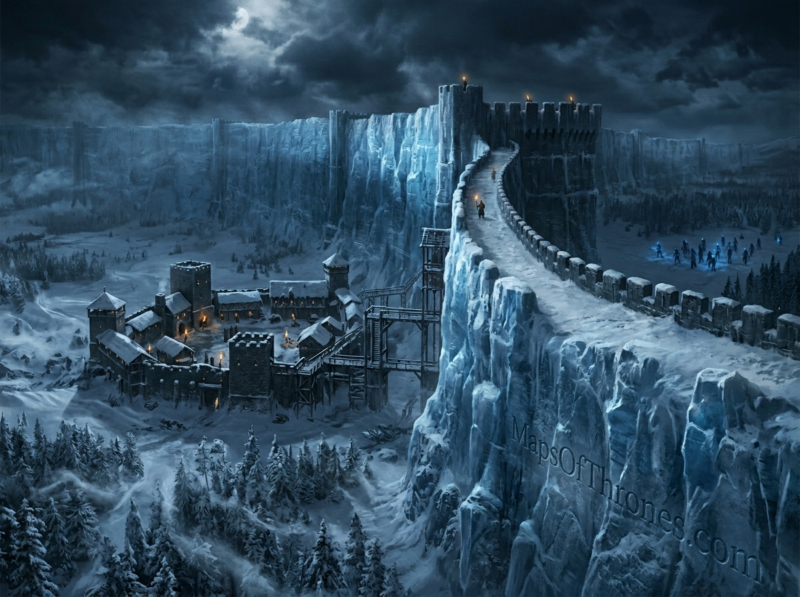
The Wall
Seven hundred feet of ancient ice and old magic — the last defence between the realm of men and the endless dark beyond.
The Wall is a colossal fortification of ice and magic stretching 300 miles across the northern border of Westeros, standing approximately 700 feet tall. Built roughly 8,000 years before the events of Game of Thrones by Bran the Builder after the Long Night, it is manned by the Night’s Watch and serves as the last barrier separating the Seven Kingdoms from the White Walkers, wildlings, and other supernatural threats of the Far North. Its three active castles — Castle Black, Eastwatch-by-the-Sea, and the Shadow Tower — form the front line of civilisation’s final stand.
What Is The Wall?
The Wall stands at the northernmost edge of Westeros, a monument to the terror that once swept across the known world. It is not merely stone and ice — it is memory made physical, the fossilised wound left by the Long Night, when darkness and cold descended for a generation and the dead walked the earth. When Bran the Builder raised it with the aid of giants and, allegedly, the magic of the Children of the Forest, he embedded within the ice something older than steel: a ward against the dead.
Stretching from the Gorge in the west — where the haunted Frostfangs drain into an impassable chasm — to the frozen shores of the Bay of Seals in the east, The Wall bisects the continent at its narrowest viable latitude. It is the reason the North endures. Without it, every kingdom south of Moat Cailin would have long since been silenced by winter’s deepest spite.
In terms of the world’s knowledge graph, The Wall functions as a critical boundary entity — a threshold between two entirely different ontologies. South of The Wall lies feudal politics, dynastic ambition, and human folly. North lies something else entirely: the vast, unpeopled wilderness called the Land Beyond the Wall, populated by the Free Folk (wildlings), giants, direwolves, and the ancient horror of the White Walkers.
From a strategic standpoint in the story of A Song of Ice and Fire, The Wall is both the most important structure in Westeros and the most neglected. The Night’s Watch — once a great order of warriors and scholars — had dwindled to a few hundred men by the time Jon Snow joined its ranks, leaving 300 miles of fortification to be held by a skeleton crew.
The Wall also sits at the heart of the show’s greatest thematic argument: that the petty wars of men — the struggle for the Iron Throne, the chess games of House Lannister, House Stark, and House Baratheon — are rendered meaningless by the existential threat lurking beyond its frozen face. The Wall does not care for crowns. It cares only for survival.
The Wall — Geographical Map
The Castles & Key Points of The Wall
Of the nineteen castles originally built along The Wall, only three remained garrisoned by the time of the main story. The rest stand as hollow ruins — testament to the Night’s Watch’s centuries-long decline. Each active castle served a distinct strategic function, while the abandoned ones became haunted shells scavenged by the desperate and the damned.
Castle Black
The central and most fortified garrison on The Wall, housing the Lord Commander, the maester, and the bulk of the Night’s Watch. Seat of power, strategy, and the great Gate beneath the ice.
Explore Castle Black →Eastwatch-by-the-Sea
Where The Wall meets the Bay of Seals. The easternmost active castle, critical for sea-borne threats. Tragically, the first section breached by the Night King and Viserion’s blue flame.
Explore Eastwatch →The Shadow Tower
The westernmost garrisoned castle, where The Wall abuts the Gorge and the Frostfang Mountains. Commanded by Ser Denys Mallister during the main story. A lonely, wind-scoured post.
Explore Shadow Tower →Craster’s Keep (Ruin)
North of The Wall, this isn’t a castle proper — but it served as a way-station for rangers, a grim homestead run by the infamous Craster, who offered daughters to the White Walkers.
Explore Location →Mole’s Town
A small, ramshackle settlement just south of Castle Black in the Gift, serving as an unofficial supply and pleasure town for the Night’s Watch — and the site of a devastating wildling raid.
Explore Location →The Gate (Black Gate)
A weirwood door at the base of The Wall at Castle Black, passable only by a sworn brother of the Night’s Watch. A piece of old magic that bypasses the Wall’s wards — and its horrors.
Learn About the Gate →The Gift
A wide strip of land immediately south of The Wall, donated to the Night’s Watch by House Stark to sustain the order. Long since farmed out or abandoned, leaving the Watch dependent on southern charity.
Explore The Gift →The Haunted Forest
The vast, ancient forest stretching north of The Wall for hundreds of miles. Home to the Free Folk, giants, and worse. Jon Snow’s ranging missions brought him deep into this primeval dark.
Explore Location →The Frostfangs
The icy mountain range beyond the western end of The Wall, where the Free Folk tribes shelter in hidden valleys. The Frostfangs also hide the Skirling Pass — scene of a catastrophic Night’s Watch ambush.
Explore Location →The Wall — Zones of Power & Significance
The Wall cannot be understood as a single entity. It is a system — political, geographic, cultural, and strategic — whose complexity deepens the further one examines it. Here, four core zones define its role in the world of ASOIAF.
⚔ Political Zones
- Castle Black serves as the de facto capital of all Night’s Watch operations, with the Lord Commander holding supreme jurisdiction over the order.
- The Gift — donated by the Starks — is technically Night’s Watch territory, though it has been politically neglected for generations.
- The New Gift, granted by Queen Alysanne Targaryen, extended the Watch’s landholdings further south — an act of generosity that outlasted the political will to defend it.
- Wildling raids and Night’s Watch rangings both operate outside the remit of any southern king — a political grey zone that made The Wall a law unto itself.
- Jon Snow‘s election as Lord Commander, and his subsequent assassination, reflect the dangerously fractured politics within the Watch itself.
🌍 Geographic Zones
- The Gorge forms The Wall’s natural western anchor — an impassable chasm carved by an ancient river, making flanking impossible from that direction.
- The Bay of Seals at the eastern end provides Eastwatch with both a naval resupply route and an observation post for sea-borne threats.
- The Gift, immediately south, is flatlands with the Long Lake and Queenscrown — strategic landmarks that feature in Jon and Bran’s parallel journeys north.
- The Haunted Forest directly north presents the wildest, most dense landscape in Westeros — terrain that swallows armies and silences rangers.
- The Milkwater River drains from the Frostfangs northward into the Shivering Sea — a geographic thread connecting the mountains to the open ocean north of the known world.
🕯 Cultural Zones
- To the Night’s Watch, The Wall is sacred duty — an oath forged in the fire of the Long Night and carried through eight millennia of vigilance.
- To the Free Folk beyond it, The Wall is an act of imprisonment: a structure that stole their ancestral lands and branded them enemies of civilization.
- To the people of the Seven Kingdoms, The Wall is a comforting myth — real enough to ignore, distant enough to dismiss. The stories of White Walkers had become children’s tales.
- In the lore of the Children of the Forest, The Wall represents their own last act of cooperation with men — magic woven into stone and ice as a final gift and final warning.
🗡 Strategic Zones
- The three active castles — Castle Black, Eastwatch, Shadow Tower — form a triangle of coverage that is, in practice, deeply inadequate for 300 miles of fortification.
- The nineteen abandoned castles represent chokepoints along The Wall that any sufficiently motivated force could exploit — and which the Night King’s army ultimately did not need, bypassing the problem entirely by going through Eastwatch.
- The Gate beneath Castle Black is both a strategic asset (allowing rapid movement north) and a vulnerability (a known crossing point that cannot be destroyed).
- The Wall’s magical ward against the dead was its supreme strategic advantage — one that became its most critical weakness once a reanimated dragon was deployed against it.
The Wall — Key Locations Reference Table
| Location | Type | Position | Known For | Status |
|---|---|---|---|---|
| Castle Black | Fortress | Centre of The Wall | Night’s Watch HQ; Lord Commander’s seat; the Gate | Active |
| Eastwatch-by-the-Sea | Coastal Castle | Eastern terminus | Sea supply; first castle breached by the Night King | Destroyed |
| Shadow Tower | Mountain Castle | Western terminus | Western flank guard; abutting the Gorge | Active |
| The Gift | Territory | Immediately south | Night’s Watch farmland; Mole’s Town | Occupied |
| The Haunted Forest | Wilderness | Immediately north | Free Folk territory; beyond the Ward | Contested |
| Mole’s Town | Settlement | South of Castle Black | Night’s Watch supply village; wildling raid site | Abandoned |
| The Frostfangs | Mountain Range | Northwest beyond the Wall | Skirling Pass ambush; wildling shelter | Wilderness |
| The Black Gate | Magical Feature | Beneath Castle Black | Weirwood door; passable only by Night’s Watch oath | Active |
| Land of Always Winter | Region | Far north | White Walker origin; the Night King’s seat of power | Unknown |
Frequently Asked Questions About The Wall
What is The Wall in Game of Thrones?
The Wall is a massive fortification of ice and ancient magic that runs 300 miles across the northern border of Westeros, standing roughly 700 feet tall. Built approximately 8,000 years before the main story by the legendary Stark ancestor Bran the Builder, it was raised in the aftermath of the Long Night — a generation-long winter during which the White Walkers first attacked the living. The Wall is manned by the Night’s Watch, an order sworn to guard the realm from whatever threats exist beyond it. Crucially, it also contains a magical ward that, while it stands, prevents the dead from crossing south.
How long and tall is The Wall?
The Wall is approximately 300 miles (roughly 480 kilometres) long, stretching from the Gorge in the west to the Bay of Seals in the east. It stands approximately 700 feet (213 metres) tall — making it by far the largest structure in the known world. For scale, The Wall would tower over the Empire State Building (1,454 feet to antenna, but ~1,250 feet to roof). In the books, its sheer scale is described as so overwhelming that it seems to lean overhead when viewed from its base, a trick of perspective driven by its enormous face.
Who built The Wall, and why?
The Wall was built by Bran the Builder — the legendary founder of House Stark and one of the most mythologised figures in Westerosi history — roughly 8,000 years before the main story. He raised it following the Long Night, a catastrophic winter during which the White Walkers invaded from the Far North and the first great War for the Dawn was fought. With the White Walkers defeated, the Wall was constructed to ensure they could never return unchecked. Giants allegedly helped in its construction, and the Children of the Forest are believed to have woven powerful magic into its foundations — magic that created the Ward against the dead.
What are the three active castles on The Wall?
Of The Wall’s original 19 castles, only three were actively garrisoned during the events of Game of Thrones and A Song of Ice and Fire: Castle Black (the headquarters, positioned in the centre), Eastwatch-by-the-Sea (at the eastern terminus, on the Bay of Seals), and the Shadow Tower (at the western terminus, near the Gorge). The remaining sixteen castles stand abandoned — eerie husks staffed only by wind and ghost stories. The Night’s Watch’s inability to fill those castles is the story’s clearest indicator of how close civilisation had come to forgetting its greatest threat.
What magic does The Wall contain?
The Wall is imbued with ancient magic believed to have been set into its foundations by the Children of the Forest. This magic creates a ward or barrier that prevents the dead — wights and White Walkers — from crossing south as long as The Wall stands. This is why the Night King needed to destroy a section of it rather than simply march his army through or around it. The magic is also embedded in the Night’s Watch vows themselves: a brother of the Watch can pass through the Black Gate (the weirwood door beneath Castle Black), while others cannot. Melisandre and other magical practitioners sense power in The Wall, describing it as dense with old spells and forgotten purpose.
When and how does The Wall fall in Game of Thrones?
The Wall falls at the end of Season 7 (Episode 7, “The Dragon and the Wolf”). After the failed wight hunt beyond The Wall, the Night King captures and reanimates Daenerys‘s dragon Viserion, transforming it into an ice dragon that breathes blue flame. The Night King rides Viserion to Eastwatch-by-the-Sea and uses the undead dragon’s fire to destroy the eastern section of The Wall, allowing the Army of the Dead to finally march south into Westeros. The episode ends with the Wall coming down in a cascade of ice and rubble as the Night King’s forces stream through the breach — one of the series’ most visually devastating moments.
What is the Night’s Watch and how does it relate to The Wall?
The Night’s Watch is an ancient military order sworn to man and defend The Wall. Its brothers take lifelong vows of celibacy, relinquishment of land and title, and perpetual service — vows enforced by death for deserters. The Watch was originally composed of knights, lords, and warriors; by the time of the main story, it had declined to a ragtag collection of criminals, rejects, and volunteers, numbering fewer than a thousand men for the entire length of The Wall. Jon Snow rose through its ranks to become Lord Commander — only to be assassinated by his own brothers before being resurrected by Melisandre and released from his vows.
Explore The Wall’s Connected World
🗺 Map Hubs
📍 Key Locations
The Wall in the Lore of Ice and Fire
To approach The Wall purely as a physical structure is to miss its deeper function in the mythology of A Song of Ice and Fire. It is a memory device — a civilisation’s most extreme act of communal remembering. The Long Night lasted a generation. Its survivors, traumatised and depleted, chose not simply to rebuild: they chose to build something that could never be forgotten. Something that could never be demolished by the slow erosion of comfortable living.
And yet, by the time of the main narrative, that is precisely what has happened. The Wall still stands; the memory it was designed to preserve has dissolved. Seven kingdoms play their power games far to the south, and the men on The Wall are mostly those the south no longer wants. The Wall’s tragedy is not its fall — it is the centuries of willful forgetting that made its fall inevitable.
The relationship between House Stark and The Wall is perhaps the most enduring thematic thread in the saga. The Starks were wardens of the North, and in that role they were always the closest to The Wall’s truth. “Winter is coming” is not merely a house words — it is a warning that the men of Castle Black understood and the men of King’s Landing chose to mock. When Jon Snow — Stark by name and Targaryen by blood — became Lord Commander and then the primary force against the Night King, it was a mythological fulfilment: the heir of Bran the Builder completing the circle the Builder had begun.
In the books, there are persistent theories that The Wall itself is alive in some sense — that the consciousness of its builders is somehow embedded within it, that its periodic creaking and shuddering is not structural stress but something stranger. Whether this holds true in George R.R. Martin’s final volumes remains to be seen.
The Known World Awaits
From the frozen edge of The Wall to the fire-scorched ruins of Valyria — every location in Westeros and Essos mapped, analysed, and brought to life.