The Great War · The Long Night
Battle of Winterfell
Long Night
The apocalyptic clash at the gates of Winterfell — where the living and the dead fought for the fate of all mankind. A battle unlike any in the history of Westeros, decided not by armies, but by a single assassin’s blade in the dark.
⚡ Quick Answer
The Battle of Winterfell Long Night was the decisive engagement of the Great War, fought at Winterfell in the North of Westeros between the allied living forces — led by Jon Snow, Daenerys Targaryen, and Sansa Stark — and the undead Army of the Dead, commanded by the Night King. The living were victorious when Arya Stark plunged a Valyrian steel dagger into the Night King in the Godswood, causing every wight and White Walker to shatter simultaneously. It stands as the largest and most consequential battle in Westerosi history.
Date
~299 AC
Location
Winterfell, The North
Result
Victory — The Living
Belligerents
Living vs Army of the Dead
Casualties
Catastrophic — Thousands
The War for the Dawn
Entity context — what, where, when, and why it shattered the world
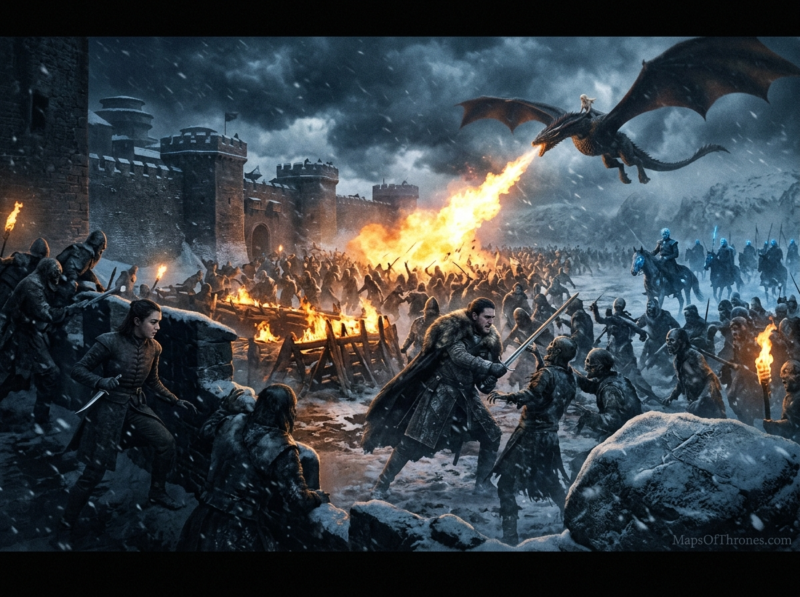
The Battle of Winterfell Long Night was not merely another conflict in Westeros’s long chronicle of war. It was an existential reckoning — the moment the world of men stood at the precipice of annihilation and somehow survived. Set against the walls of Winterfell, the ancestral seat of House Stark, the battle was fought under a sky choked with supernatural darkness as the Night King and his Army of the Dead descended upon the last great stronghold of the living.
The strategic consolidation at Winterfell was itself a gamble of monumental proportions. Rather than dispersing forces across the realm, Jon Snow — King in the North and secret heir to the Iron Throne — and Daenerys Targaryen of House Targaryen committed the full combined might of the North, the Free Folk, the Unsullied, the Dothraki, the Knights of the Vale, and two living dragons to a single defensive stand. Their objective: lure the Night King to the Godswood by using Bran Stark — the Three-Eyed Raven — as bait, then destroy the Night King before his army could overwhelm the continent.
The battle took place in near-total darkness, a supernatural storm conjured by the Night King swallowing both moonlight and dragonfire alike. What followed was one of the most chaotic and catastrophically costly engagements in Westerosi military history — a night of horror that nearly consumed every defender before Arya Stark’s intervention rendered the entire enemy force inert in a single heartbeat. The Long Night, as it came to be known, had come — and ended — with the thrust of a Valyrian steel blade.
Battlefield Disposition
Troop deployments, terrain, and tactical layout at Winterfell
⚔ Battle of Winterfell — Tactical Overview
Key Commanders & Combatants
The figures whose fates — and choices — decided the Long Night
House Stark · The Living
Jon Snow / Aegon Targaryen
Supreme Commander of the Living Forces
Commanding from dragonback aboard Rhaegal, Jon coordinated the aerial assault against Viserion and attempted to reach the Night King directly. His strategic vision unified the disparate forces at Winterfell.
View CharacterHouse Targaryen · The Living
Daenerys Targaryen
Dragon Rider · Queen of the Andals
Riding Drogon, Daenerys provided critical fire support throughout the battle, burning swathes of wights and briefly confronting Viserion. Her decision to abandon the Dothraki charge sealed the battle’s opening phase.
View CharacterHouse Stark · The Living
Arya Stark
Assassin · Decisive Agent of Victory
The true hero of the Long Night. Arya navigated the darkened halls of Winterfell alone, evaded wights in the library, and leapt from the darkness to drive a Valyrian steel dagger into the Night King’s throat — ending the war in a single moment.
View CharacterHouse Stark · The Living
Bran Stark (Three-Eyed Raven)
Strategic Bait · Warg Intelligence
Positioned in the Godswood as the lure for the Night King, Bran entered a warg-state and observed the battle through ravens. His calm certainty anchored the plan and made Arya’s ambush possible.
View CharacterUnsullied · The Living
Grey Worm
Commander, Unsullied Infantry
Grey Worm commanded the front line of Unsullied soldiers who bore the initial brunt of the wight assault. His defensive discipline held the line long enough for the interior of Winterfell to remain contested.
View CharacterHouse Mormont · The Living
Ser Jorah Mormont
Commander of Household Guard · Daenerys’s Protector
Jorah fought until his body could no longer carry him, protecting Daenerys from waves of wights in the open field. He died from his wounds in the aftermath — among the battle’s most mourned casualties.
View CharacterHouse Mormont · The Living
Lyanna Mormont
Lady of Bear Island
Lady of Bear Island and the North’s most defiant voice, Lyanna was killed crushing a reanimated giant — driving a dragonglass blade into its eye even as it squeezed the life from her. She fell as a hero.
View CharacterThe Army of the Dead · The Night King
The Night King
Supreme Commander of the Dead
The immortal master of the White Walkers and their wight legions, the Night King rode the reanimated Viserion and personally descended into the Godswood — where his apparent invincibility was shattered by Arya Stark.
View CharacterRed Priestess · The Living
Melisandre of Asshai
Shadowbinder · Flame-bearer
Arriving unannounced at Winterfell’s gates, Melisandre ignited the Dothraki arakhs with the Lord of Light’s fire and later lit the defensive trenches. Her final act was whispering the words that sent Arya running into the dark.
View CharacterBattle of Winterfell Long Night — Phase by Phase
The strategic arc from prelude to the Night King’s fall
Phase I — Prelude
The Consolidation at Winterfell
As the White Walkers breached the Wall using the reanimated Viserion — an act that obliterated the Night’s Watch as a defensive institution — the surviving armies of Westeros made a historic convergence on Winterfell. Jon Snow’s diplomatic mission to Dragonstone secured Targaryen allegiance, while Sansa Stark organized the logistical nightmare of feeding and housing armies of vastly different cultures under one roof. The plan was audacious: use Bran Stark — the Night King’s actual target — as bait in the Godswood, drawing the enemy commander into a trap. Theon Greyjoy volunteered his Iron Island forces to guard the Godswood and protect Bran personally.
Phase II — Opening Moves
The Dothraki Charge & The First Darkness
The battle opened with Melisandre igniting the Dothraki arakhs with magical flame — a moment of blazing defiance against the dark. The Dothraki cavalry launched into the night in a thunderous charge. Within minutes, those fires winked out, one by one, swallowed by the approaching mass of the dead. Barely a handful of riders returned. It was a catastrophic loss of shock cavalry and an immediate signal that conventional tactics would be insufficient. The Night King then conjured a supernatural darkness that blinded the dragons in the sky and threw the battlefield into chaos.
Phase III — Defensive Crisis
The Wall Breached, the Crypts Compromised
With the Dothraki routed, the Unsullied and Northern infantry absorbed the full weight of the wight tide. The defensive trenches — intended to be ignited as a fire barrier — could not be lit; signal fires failed in the darkness until Melisandre herself walked to the trench and called fire down upon it. This pause bought precious minutes. But the wights overwhelmed the outer walls regardless, flowing over and under and through every defense. Simultaneously, the Night King reanimated the dead buried in Winterfell’s crypts — turning the supposed place of refuge into a killing ground for the women, children, and elderly sheltering below.
Phase IV — Climax
Arya in the Dark — The Kill at the Godswood
As Winterfell’s interior became a maze of corpse-fighting, Arya Stark moved through the carnage she had trained her entire life for. Having survived the library in near-silence and been cornered only to escape, she received one final whisper from Melisandre — a reminder of her purpose: “What do we say to the God of Death? Not today.” In the Godswood, the Night King closed his hand around Bran’s throat. Arya launched from the shadows, her Valyrian steel dagger switching hands mid-air as the Night King caught her by the throat — and she drove the blade home. The Night King detonated into ice. Every White Walker shattered. Every wight collapsed. The Great War was over.
Phase V — Aftermath
Catastrophic Losses & the Road South
The losses were staggering. The Dothraki were virtually annihilated as a fighting force. Ser Jorah Mormont died protecting Daenerys. Lady Lyanna Mormont fell to a giant. Theon Greyjoy died charging the Night King alone to buy Arya the final second she needed. The Night’s Watch, the Free Folk, and the surviving Northern lords were all diminished beyond recovery. The victory, though total, left the living armies in no condition to face Cersei Lannister’s fresh forces in the south — setting the stage for the final war for the Iron Throne.
Order of Battle — Reference Table
Forces, commanders, strength, and outcomes at the Battle of Winterfell Long Night
| Force | Commander | Strength | Casualties | Objective | Outcome |
|---|---|---|---|---|---|
| Unsullied | Grey Worm | ~8,000 | Severe — majority lost | Hold the front line | Held until breach |
| Dothraki Cavalry | Unknown Bloodriders | ~2,000 | Near-total annihilation | Shock charge, flank | Catastrophic defeat |
| Northern Houses | Various lords | ~2,000 | Heavy | Defend walls | Partial — walls breached |
| Knights of the Vale | Ser Davos (coordination) | ~2,000 | Moderate | Reserve cavalry | Committed late; survived |
| Free Folk | Tormund Giantsbane | ~1,000 | Heavy | Hold flanks | Fought to survival |
| Drogon & Rhaegal | Daenerys / Jon | 2 dragons | Rhaegal wounded | Air superiority, fire support | Hampered by dark storm |
| Godswood Guard | Theon Greyjoy | ~100 Ironborn | Total — all killed | Protect Bran Stark | Bought time; succeeded |
| Army of the Dead | The Night King | Hundreds of thousands | Total — all destroyed | Kill Bran; end the living | Complete annihilation at Night King’s death |
| Viserion (Ice Dragon) | Night King | 1 undead dragon | Destroyed (with Night King) | Air dominance, kill Jon/Daenerys | Neutralized |
Frequently Asked Questions
Battle of Winterfell Long Night — answered for search, AI, and voice
-
The living won the Battle of Winterfell Long Night. Victory came in a single decisive instant when Arya Stark assassinated the Night King in the Godswood using a Valyrian steel dagger. The moment the Night King was killed, every wight and White Walker in existence simultaneously collapsed and crumbled, ending the war instantaneously.
-
Arya Stark killed the Night King by plunging a Valyrian steel dagger — the catspaw dagger — into his torso after leaping at him in the Godswood. When the Night King caught her by the throat mid-air, Arya transferred the blade from her right hand to her left in a move she had trained since her time at the House of Black and White, and stabbed him through before he could react. Valyrian steel, like dragonglass, destroys White Walkers on contact.
-
The Battle of Winterfell Long Night brought together virtually every surviving military force in the known world — Unsullied, Dothraki, Free Folk, Knights of the Vale, Northern Houses, and two living dragons — against an undead army numbering in the hundreds of thousands. No prior battle in Westerosi history had assembled such a coalition or faced an enemy of this scale. The Battle of the Blackwater and the Battle of the Bastards were significant, but they were regional conflicts compared to this existential clash.
-
Daenerys rode Drogon and Jon rode Rhaegal, providing aerial fire support against the wight army. The Night King conjured a supernatural darkness that severely limited their effectiveness. Both dragon riders engaged Viserion — the undead ice dragon — in aerial combat. Jon was unseated and Rhaegal was wounded in that battle. Daenerys later used Drogon to burn the Night King directly, but he emerged unscathed, revealing he had anticipated this and that conventional dragonfire could not kill him.
-
The Dothraki cavalry suffered near-total annihilation in the battle’s opening minutes. Melisandre ignited their arakhs with magical fire, and the horsemen charged into the dark beyond the trench — meeting the Army of the Dead head-on. The lights of their burning weapons were extinguished within moments, visible from the walls as a wave of fire dying in sequence. Only a handful of riders returned, fleeing back to the Winterfell lines. It was one of the most shocking and demoralizing moments of the Long Night.
-
Notable deaths at the Battle of Winterfell Long Night include: Theon Greyjoy (charged the Night King, died a hero); Ser Jorah Mormont (died protecting Daenerys); Lady Lyanna Mormont (killed by a reanimated giant she also destroyed); Beric Dondarrion (spent his final resurrection saving Arya); Eddison Tollett (Commander of the Night’s Watch, killed at the walls); and Melisandre (walked into the dawn after the battle and died, her purpose fulfilled).
-
The plan worked because the Night King’s primary motivation was the destruction of memory and history — embodied in Bran Stark as the Three-Eyed Raven, a living repository of all Westerosi history. The Night King was compelled to reach and kill Bran personally, which drew him away from the safety of his wight army into the confined Godswood — where Arya could reach him. The plan relied on the Night King’s arrogance and his belief that no living person could threaten him, which proved his fatal miscalculation.
Explore the Wars That Forged the Realm
Hub connections — battles, characters, houses, and maps
⚔
Explore the Wars That Forged the Realm
From the Field of Fire to the Long Night — every battle mapped, analyzed, and chronicled. Dive deeper into the military history of Westeros.