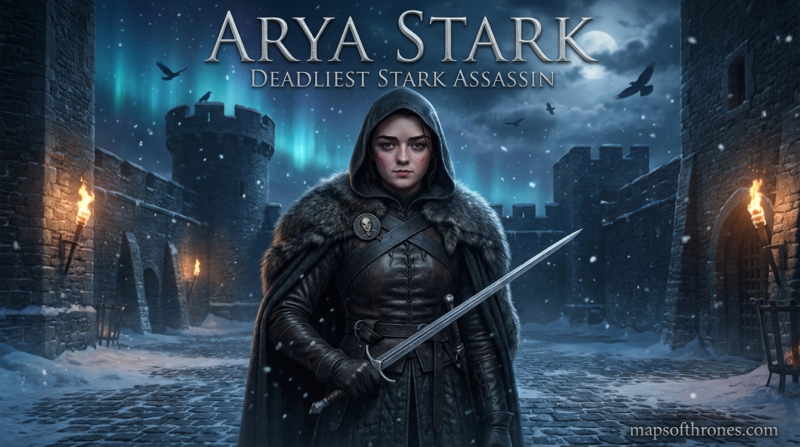
Arya Stark
Princess of Winterfell · Lady of House Stark · No One · The Wolf Girl · The Girl Who Killed Death
⚔ House StarkCharacter Vitals
Character Data
Chaotic Good rather than Neutral Good because Arya consistently discards institutional authority — family obligation, religious hierarchy, political alliance — in favour of self-defined justice. The distinction matters because every major decision she makes, from refusing to join her father’s captors to assassinating the entire Frey line, comes not from a code but from an internal moral compass that answers to nothing above itself.
Actor Data
Character Overview
Arya Stark is the structural answer to a question Game of Thrones keeps refusing to ask directly: what happens when the system has nothing left to offer a person, and that person decides the system is the enemy? She begins as a tomboy princess in Winterfell who wants to fight instead of embroider, which reads initially as charming rebellion. But the show rapidly closes off every possible alternative. Her father is executed. Her family is destroyed. Every institution she turns to — the Night’s Watch convoy, the Brotherhood Without Banners, the Many-Faced God — either fails her or tries to erase her. What she becomes is not a hero shaped by mentors and growth. She becomes someone shaped almost entirely by loss and fury.
The arc succeeds as long as the show trusts that process honestly. The middle seasons, particularly her time training in Braavos, build toward a genuinely interesting character study: can someone become an instrument of death without losing their identity entirely? The answer the show gives is no — she keeps Needle, keeps her name, keeps her list. But that refusal is purchased at the cost of her Faceless Man training making almost no narrative sense. She fails the training conspicuously, is punished, nearly dies, and then defeats a trained Faceless Man in darkness. The show never resolves this contradiction; it simply moves past it.
Her killing of the Night King is the most consequential moment in the series and the most debated. The argument that it was earned is legitimate — she is the character who has trained in exactly the skills it required. The argument that it was narratively imposed is also legitimate — eight seasons spent building Jon Snow and Daenerys as the mythological answer to this threat, only to sideline both in the climactic moment, reflects choices made for shock over coherence. Her ending — sailing west into unknown waters — is the most honest conclusion the show could offer her. She doesn’t rebuild. She doesn’t govern. She keeps moving. That is exactly who she became.
Who Is Arya Stark in Game of Thrones?
Arya Stark is the youngest daughter of House Stark of Winterfell, who transforms from a rebellious Northern princess into one of Westeros’s most lethal assassins after witnessing her family’s systematic destruction. Trained by Braavosi sword masters and the Faceless Men of the House of Black and White, she kills the Night King, avenges the Red Wedding, and ultimately chooses exploration over reclaiming any seat of power. She is the series’ most complete portrait of grief weaponized into purpose. Portrayed by Maisie Williams across all eight seasons, Arya appears in approximately 62 episodes of Game of Thrones.
First appearance: S1E1 “Winter Is Coming”Arya Stark’s Skills, Abilities & Fighting Style — Complete Analysis
Braavosi water dancing is a fluid, footwork-driven style that prizes speed and precision over strength — which is why it is the only viable school for a slight girl facing larger opponents. Syrio Forel introduces it in Season 1, drilling Arya in footwork and the principle that balance decides every fight before a blade is drawn. The technique matures significantly in Braavos under the Faceless Men, where it is stripped of its personality and taught as a pure instrument of killing.
Best moment: The sequence in the crypts of Winterfell during the Long Night (S8E3), moving at speed in total darkness, using memory and footwork to evade a Wight she cannot see. Failure moment: Her early fight against the Waif in the streets of Braavos, where she is visibly outmatched before being blinded — her water dancing insufficient against a more experienced practitioner. Critical verdict: The show uses this skill precisely in early seasons and then leans on it as a narrative catch-all in later ones. The darkness kill works thematically but demands the audience accept that Arya’s training made her uniquely capable in a way the show never fully earns on screen.
Best: Long Night crypts, S8E3The ability to assume the faces of the dead — literally wearing their skin to take their appearance and voice — is the Faceless Men’s core supernatural gift. Arya receives partial training in this art, learning to read people, strip ego, and act without attachment. In practice, the show allows her to use the face-wearing ability selectively and implausibly: she wears Walder Frey’s face to execute the entire Frey household, which requires skills far beyond what her training demonstrated she had mastered.
Best moment: The Red Wedding reversal — she enters the Twins wearing Walder Frey’s face, delivers his poisoned wine to his bannermen, and reveals herself before killing him. One of the series’ most satisfying constructed sequences. Failure moment: The entire Braavos arc culminating in the Waif chase, where her supposed stealth training is abandoned in favour of a straightforward action sequence through market stalls. Critical verdict: A skill the writing took seriously for two seasons and then treated as a plot convenience.
Best: Frey massacre, S7E1This is Arya’s most consistent and genuinely demonstrated skill across all eight seasons. She is repeatedly placed in environments that should break her — travelling with Night’s Watch recruits in disguise, imprisoned at Harrenhal, accompanying the Brotherhood, serving Tywin Lannister himself — and survives each by correctly reading what each person needs her to be and becoming it without losing the thread back to herself. This is not the same as the Faceless Men’s ego dissolution; it is pragmatic performance of a selfhood that remains intact underneath.
Best moment: Her time serving Tywin Lannister at Harrenhal. She is a prisoner working as a servant for the most dangerous man in the Seven Kingdoms, carrying a secret that would kill her, and she manages it — answering his questions about Robb Stark with calculated truth and misleading deflection. Failure moment: Arya’s decision to walk openly through Braavos as herself after leaving the House of Black and White, making no effort at concealment despite knowing the Waif has been sent to kill her — inconsistent with every instinct she had demonstrated for six seasons.
Best: Serving Tywin at Harrenhal, S2Arya is not a political player in the way that Sansa or Tyrion are. She does not build coalitions or navigate courts. Her strategic intelligence is tactical rather than systemic: she identifies threats quickly, formulates direct responses, and executes them with minimal hesitation. The distinction matters because it limits her as a character in the show’s later seasons, when she is placed back in political environments (Winterfell, Season 7-8) that her skill set is not built for.
Best alliance decision: Correctly identifying that The Hound, despite everything he had done, was a more reliable protector than any institutional structure available to her. Worst strategic call: Publicly confronting Sansa in Season 7 about the letter to Robb, apparently failing to identify Littlefinger’s manipulation until Sansa points it out — or at least, failing to communicate her awareness in a way the audience could track. Leadership verdict: She is not a leader in any structural sense and the show is wisest when it does not ask her to be one.
Best: Identifying Littlefinger’s manipulation (S7)Arya’s direwolf Nymeria is sent away in Season 1 after biting Joffrey and is absent from the series for five seasons. There is a brief, visually striking reunion in Season 7 when Arya encounters a massive wolf pack in the Riverlands and recognises Nymeria as its leader — but Nymeria returns to the wild. Whether Arya has any residual wolf-dream ability (as her book counterpart does, warging into Nymeria across vast distances) is never clarified in the show.
Critical verdict: The Nymeria storyline is one of the show’s most significant losses of nerve. In the books, Arya’s wolf-dream consciousness is an explicit, developed supernatural thread that pays off her training in ways the show never attempts. On screen, Nymeria is essentially abandoned for narrative convenience and her single reappearance is emotionally resonant but thematically incomplete.
Best: Nymeria reunion in the Riverlands, S7Arya survives situations that should kill her with a frequency that strains credulity in the later seasons. Her survival is entirely skill-based and emotionally earned through Seasons 1-4. It begins to require increasing suspension of disbelief from Season 5 onward: the Waif stabs her multiple times in the stomach, and she escapes, swims through a harbour, runs through streets, and defeats the Waif the following day. The show never addresses the physical implausibility.
Honest luck vs skill ratio: Seasons 1-4: approximately 80% skill, 20% circumstance. Seasons 5-8: closer to 50/50, with the Night King sequence requiring the audience to accept a narrative gift rather than a demonstrated capability.
Named plot armor instances: The Waif stabbing survival (S6E6-7); reaching the Night King undetected in complete darkness while an army of the dead fills Winterfell’s crypts (S8E3).
Strongest: Seasons 1–4 survival arcWas Arya Stark a Hero, Villain, or Something the Show Couldn’t Name?
The strongest heroic reading of Arya is structural: she is the only character in the series who tracks a genuine completion arc. She is given a problem — the destruction of her family by the corrupt systems of Westeros — and she solves it. Every person on her kill list earned their place there through specific, documented crimes against people she loved. Joffrey ordered her father’s death. Cersei enabled it. Walder Frey hosted the Red Wedding massacre. The Hound terrorised her and murdered the butcher’s son Mycah in Season 1. Her revenge is not indiscriminate. It is specific, remembered, and proportionate by the logic of the world she inhabits. When she kills the Night King, she does so in service of every living person in Westeros. The heroic reading is: she is the only person who actually finishes what they started.
The most honest counter-reading is not that Arya is a villain but that the show refuses to acknowledge the psychological horror of what she becomes. She bakes Walder Frey’s sons into a pie and feeds them to him before slitting his throat while wearing his wife’s face. She poisons an entire feast of men she has judged collectively guilty. At no point does the narrative ask her to reckon with what systematic killing at this scale costs a person. The show treats these moments as cathartic satisfaction rather than moral weight. A character who has cultivated the capacity to commit violence without feeling it, who maintains a list and works through it methodically, is not straightforwardly heroic — and the show’s refusal to complicate this in Seasons 7-8 is a genuine moral evasion.
Critical Verdict
Arya is neither hero nor villain in any meaningful binary sense — she is a trauma response given narrative form. The show is most honest about her when it shows the cost: the years of isolation, the loss of her family one by one, the attempt to erase herself entirely. It is least honest about her when it allows mass murder to function as entertainment without consequence. Her ending — choosing to sail into the unknown rather than reclaim any of the normal life she lost — is the only conclusion that acknowledges what she has become without either condemning or celebrating it. She goes west because there is no version of Winterfell, or King’s Landing, or anywhere in the known world where she fits anymore. That is the show’s most psychologically coherent moment for this character, and it arrives in the final episode almost by accident.
Arya Stark vs The Hound — Direct Comparison
Arya Stark Through Every Season
S1
“Before the World Broke”
~9 episodes
A
Role this season: Establishes her as the family member who refuses the mould, and documents the destruction of everything she took for granted.
The sword is explicitly sized for someone of no military significance. Jon tells her to stick them with the pointy end — a joke that doubles as her entire philosophy for eight seasons. Earned moment.
The Water Dancing sequences establish the physical and philosophical grammar of everything she becomes. Syrio’s lesson that what we say to the God of Death — “not today” — becomes her operating principle. Earned, and foundational.
She is in the crowd, steps forward, and is stopped by Yoren before she can reach her father. The camera holds on her face as the crowd reacts. It is the series’ most important traumatic event and she experiences it alone. The hinge point of her entire arc.
What she gained: A survival instinct, a fighting style, and a list of names.
What she lost: Her father, her home, her certainty that the world punishes wrongdoing.
Alliances formed: Syrio Forel (S1, trainer, killed); Jon Snow (S1, sibling and lifelong anchor).
Alliances broken: Joffrey Baratheon — their mutual contempt becomes permanent.
S2
“Surviving Under the Enemy’s Roof”
~10 episodes
A
Role this season: Trapped in Harrenhal serving Tywin Lannister — the most dangerous possible environment — she demonstrates for the first time that psychological survival under extreme pressure is her genuine superpower.
She is given three deaths by a Faceless Man in her debt. Her choices — Weese, Tickler, and ultimately naming Jaqen himself to force a mass prison break — show her already weaponising information and leverage rather than just violence. Earned — her use of the third name is the smartest play of the season.
She stands directly before the man who orchestrated the Red Wedding and answers his questions about Robb Stark without flinching, threading truth and misdirection with precision. The scene where Tywin asks why she is hiding her Northern identity and she gives him a half-convincing answer is the show at its best: a child holding something the most powerful man in Westeros does not yet realise is in the room. Earned in every detail.
What she gained: Jaqen’s coin and the word “Valar Morghulis.”
What she lost: Any remaining illusion that institutions protect people.
Alliances formed: Jaqen H’ghar (temporary, professional).
Alliances broken: None — she had none to break.
S3
“The Education of Grief”
~9 episodes
A
Role this season: Travelling with the Brotherhood Without Banners and then The Hound, she witnesses the Red Wedding — the single most devastating event of her arc — and survives it by being stopped at the gate.
She encounters resurrection — Beric has died and been returned six times by R’hllor — and her response is not wonder but fury. She demands they kill The Hound and they refuse. It is her first explicit confrontation with the idea that her justice and others’ justice are not the same thing. Earned; sets up the entire Hound dynamic correctly.
She reaches the Twins as the massacre begins, is stopped by The Hound, and watches a dying direwolf through a gap in the gate. She knows before she sees it. The Hound knocks her unconscious to save her life. She wakes orphaned again and wearing a new layer of stone. The defining moment of the season. Thoroughly earned.
What she gained: The Hound as reluctant protector; the knowledge that she can survive anything.
What she lost: Her mother, her brother, and the last functioning piece of her Stark family.
Alliances formed: Sandor Clegane (The Hound) — mutually suspicious, mutually dependent.
Alliances broken: Brotherhood Without Banners — they sell Gendry; she never forgives it.
S4
“Travelling with Death”
~9 episodes
A
Role this season: Her road season with The Hound produces some of the series’ best character work — two broken people who cannot admit they need each other, crossing a burning countryside.
The Hound robs a farmer and his daughter after eating their food. Arya objects — she still has moral limits, still distinguishes between predators and people. Later, she will watch the man die and understand that the Hound was right about what this world requires. The scene marks her last moment of principled objection before she accepts the logic of the road. Earned.
She recognises the man who killed Lommy and took Needle in the chaos after her father’s arrest. She kills him slowly, using his own words back at him before driving Needle through his throat. Her first solo kill on the list — and she is utterly calm. The show does not celebrate this. It watches it. Earned — and one of the series’ most precisely observed moments of character revelation.
Brienne defeats the Hound. Arya refuses to kill him when asked — and then leaves him to die without Needle finishing the job. She removes his name from the list not by killing him but by choosing to let the world do it. Her departure to Braavos with the iron coin is the season’s most important character moment. Earned.
What she gained: Closure on multiple list entries; passage to Braavos.
What she lost: The Hound; the last companion who knew her before Winterfell fell.
S5
“Learning to Be No One”
~8 episodes
B
Role this season: Her training arc in Braavos begins — philosophically interesting but narratively static, demanding the audience tolerate a protagonist who deliberately regresses as a condition of progress.
She presents the iron coin, is turned away, waits outside for days, and is eventually admitted when Jaqen H’ghar reveals himself. The patience is in character. The institution’s demands are not — she is asked to abandon everything she is, including her name. The show correctly identifies this as conflict rather than resolution. Earned setup; resolution is less clean.
She is sent to kill an insurance broker who cheats dying sailors. She studies him, befriends him, and poisons him. The moment is quietly shocking because she is good at it. The most psychologically honest sequence of her Braavos arc.
Writing Grade: B — Structurally sound but the pace demands patience the show has not entirely earned, and the Waif is underwritten as an antagonist.
What she gained: The first steps of assassination craft; the ability to see without being seen.
What she lost: Her name, her possessions, her sense of self as a starting point (temporarily).
S6
“I Am Not No One”
~8 episodes
B
Role this season: She rejects the Faceless Men’s identity erasure, claims herself, and returns to Westeros — but the resolution of the Braavos arc is narratively rushed and physically implausible.
She is sent to kill an actress and decides she will not. The decision is clear — she has never been able to kill people she deems innocent — but the show does not interrogate why the Faceless Men trained her if she was always going to fail this test. Earned emotionally; undermined structurally.
She tells Jaqen she is Arya Stark of Winterfell and she is going home. The scene lands correctly. The fact that she survives multiple stab wounds to the abdomen, swims in a harbour, and wins a fight the following night does not. Emotionally right; physically a writing failure.
Writing Grade: B — The thematic statement is correct but earned through narrative convenience rather than logical consequence.
What she gained: Her name; her sense of direction — home.
What she lost: Any coherent supernatural training framework the show might have built on.
S7
“The List Runs Short”
~6 episodes
C
Role this season: She completes the Red Wedding revenge (Frey massacre), reunites with Nymeria and Sansa, and is manipulated against Sansa by Littlefinger — a storyline that requires her to behave out of character.
Wearing Walder Frey’s face, she poisons his entire male line at a feast. The construction of the scene — the gathering, the toast, the reveal — is flawlessly executed. It is the show’s most satisfying payoff sequence. Earned by six seasons of patience.
The show presents Arya apparently turning against Sansa based on a letter Littlefinger engineered her to find, and then reveals in the finale that both sisters were always playing him. The problem is that the show does not allow the audience to understand this during the arc — it presents genuine conflict and then retcons it as performance. An unearned narrative choice that undermines both characters.
Writing Grade: C — Two excellent individual sequences (Frey massacre, Littlefinger’s death) surrounding a season-long arc that misrepresents how Arya’s trained instincts would actually function.
S8
“Not Today”
~6 episodes
C
Role this season: She kills the Night King, considers killing Cersei, and leaves Westeros. Her arc resolves correctly but the season around her does not.
She drops from above, is caught mid-air, switches the Valyrian steel dagger between hands, and drives it into the Night King’s chest. Technically, her training in Faceless Man movement in total darkness and water dancing speed both apply. The problem is eight seasons of framing Jon and Daenerys as the mythological respondents to this threat — and the writing’s failure to establish Arya as a serious alternative prior to this moment. Individually brilliant. Narratively imposed.
She rides south, enters a burning King’s Landing, witnesses Daenerys’s destruction, and turns back. She tells the Hound she is not coming home. Her final farewell is to Jon — quiet, specific, and exactly right. Earned.
She tells Jon there is nothing west of Westeros on the maps. He says that does not mean there is nothing there. She sails toward it. Her ship’s sail bears a direwolf. It is the series’ only ending that feels genuinely completed rather than assigned. Earned — the right ending for this specific character.
Writing Grade: C — Her individual moments are the season’s best writing. The structural decisions around them are not.
Arya Stark’s Geographic Journey
Complete Alliance & Enemy Record
Gifted Needle; the emotional anchor of her identity. Their farewell in S8 is one of the series’ most understated moments.
Smart — foundationalHer first real teacher and the philosophical foundation of her entire combat identity. His presumed death off-screen is one of the show’s few merciful narrative ambiguities.
Smart — transformativeReluctant, antagonistic, and the most psychologically productive relationship in the series. Neither of them acknowledges what the relationship actually was until the end.
Smart — necessaryTheir reunion in S7 is complicated by Littlefinger’s interference; their final dynamic — sisters, co-rulers of different domains — is the show’s healthiest sibling conclusion.
Smart — eventuallyThe closest thing to a peer relationship she forms. He offers marriage in S8; she declines, choosing her own path over any settled future.
Smart — self-aware conclusionOn her list from early seasons. He dies by poison before she can reach him. The list does not require her to personally execute every entry.
Personal — formative enemyOn her list throughout. In S8 she travels to King’s Landing to kill her but witnesses Daenerys’s destruction and turns back. Cersei dies in the rubble without Arya being the instrument.
Political enemy — unresolvedShe executes him and his sons. The most narratively complete revenge arc on her list.
Personal — resolvedAssigned to kill her by Jaqen. Their conflict is the Braavos arc’s most underdeveloped element — a potentially fascinating mirror character reduced to a chase sequence.
Institutional — unearned resolutionShe executes him on Sansa’s command in the great hall of Winterfell. The show presents this as a joint decision but the arc leading to it is narratively flawed.
Political — satisfying but confusedComplete Relationships Table
| Person | Type | Seasons | End Status |
|---|---|---|---|
| Jon Snow | Family / Anchor | S1, S7–S8 | Alive / Estranged by geography |
| Sansa Stark | Sister / Rival / Ally | S1, S7–S8 | Alive / Reconciled |
| Ned Stark | Father / Lost anchor | S1 | Dead (S1E9) |
| Catelyn Stark | Mother / Complicated | S1–S3 | Dead (S3E9) |
| Robb Stark | Brother / Lost | S1–S3 | Dead (S3E9) |
| Bran Stark | Brother / Estranged | S1, S7–S8 | Alive / Distant |
| Syrio Forel | Mentor / Foundational | S1 | Presumed dead (S1) |
| Jaqen H’ghar | Mentor / Institutional | S2, S5–S6 | Alive / Adversarial resolution |
| Sandor Clegane | Reluctant protector / Mirror | S3–S4, S8 | Dead (S8) |
| Gendry | Peer / Brief romance | S2–S3, S7–S8 | Alive / She declines his proposal |
| Hot Pie | Travel companion / Innocent | S2–S3, S7 | Alive / Still baking |
| Nymeria | Direwolf / Bond | S1, S7 | Alive / Wild |
| The Waif | Institutional enemy | S5–S6 | Dead (S6) |
| Melisandre | Significant encounter | S3, S8 | Dead (S8) |
What Most Fans Miss About Arya Stark
The popular reading of Arya’s Braavos arc is that she trains with the Faceless Men, masters their arts, and chooses Stark over No One. The more precise reading is that she fails the training, survives the consequences by a combination of established skill and narrative luck, and then the show allows her to use Faceless Man abilities selectively for the rest of the series without ever revisiting the theology or cost of that power.
This matters because the Faceless Men’s gift — wearing the faces of the dead — is explicitly tied to religious service and ego death in the show’s own logic. Arya rejects both and keeps the power. The show never explains why this is possible. What most viewers miss is that this represents a genuine failure of internal worldbuilding, not a triumphant character moment. The triumph is real; the logic that should underpin it is absent.
When Arya arrives at the House of Black and White, she is required to surrender her identity and possessions. She hides Needle in a crack in the steps rather than throwing it into the sea. This is not a small character beat — it is the physical proof that she was never going to complete the training. Needle is explicitly linked to Jon, to Winterfell, to her name, to everything she is. Hiding it is the show’s visual argument that she retained selfhood throughout the arc.
On a rewatch, Arya’s entire Braavos arc reads differently when you know she hid the sword on day one. Her failure is built in from the first scene. Every subsequent “progress” scene is undercut by what she did at those steps.
In the A Song of Ice and Fire novels, Arya’s wolf-dream ability is developed in parallel with her Faceless Man training. She wargs into Nymeria across the Narrow Sea, controlling the wolf pack in the Riverlands and hunting through her bond, while her body sleeps in Braavos. The two strands of her development — assassin training and direwolf consciousness — are clearly meant to converge. Her book characterisation as a warg adds a layer of supernatural identity that makes her trajectory toward individual action over institutional service more coherent.
The show strips this entirely. The loss matters most because it removes the only clear answer to why Arya specifically, rather than any Faceless Man, was capable of killing the Night King. In Martin’s books, a Stark warg defeating a supernatural creature of ice has thematic logic. On screen, it is speed and surprise.
When Arya and Melisandre encounter each other in Season 3, the Red Woman tells her she sees a darkness in Arya, and eyes of different colours that she will shut forever: brown, blue, and green. The blue eyes are the Night King’s. The brown were almost certainly Walder Frey’s. The green — Cersei’s — remain a closed arc, since Cersei dies in the rubble without Arya’s direct intervention.
Most casual viewers remember this as foreshadowing confirmed, but miss that the green eyes represent the one entry on the list Arya explicitly chooses not to complete. Whether the prophecy is still pending (Cersei had green eyes and died before Arya could reach her), or whether Arya’s choice to turn back fulfilled it in some spiritual sense, is never addressed. It is a loose thread that reveals the limits of how carefully the prophecy was constructed.
The Arya-Hound pairing works because it puts two characters who use violence in opposite registers in constant proximity. The Hound uses violence as the first answer — it is his profession, his identity, the thing he is best at. Arya uses violence as the final answer — she maintains precise targets, specific grievances, and will not kill indiscriminately. Their road together is essentially a slow debate about what violence is for.
What most fans miss is that both of them arrive at the same conclusion from opposite directions: the violence does not resolve anything. The Hound’s final act is to throw himself and his brother off a tower. Arya’s final act is to leave the continent. Neither of them uses their capacity for killing to build anything. The show is more honest about this than it is often given credit for — it just does not state it explicitly.
Jon goes beyond the Wall with the Free Folk — technically Westeros’s northern border. Sansa rules the North — a Westerosi kingdom. Bran rules the Six Kingdoms. Tyrion serves as Hand. Bronn is Lord of Highgarden. Davos sits on the small council. Brienne commands the Kingsguard. Every other surviving major character ends the series embedded in the structure of Westerosi governance or culture, even those who had questioned it throughout.
Arya alone sails off the known map. This is not an accident. It is the show’s acknowledgement — accidental or intentional — that there is no version of Westeros’s social order that Arya Stark can inhabit. She was never shaped for it. She cannot be a lady, a queen, a knight, or a Hand. She can only be herself, moving.
Where the Writers Failed Arya Stark
The Braavos arc is the most significant structural failure in Arya’s story. Seasons 5 and 6 invest approximately sixteen episodes in establishing that the Many-Faced God’s gift comes at genuine cost — of ego, of name, of attachment — and then refuse to follow through on any of it. Arya fails the training, survives through a combination of existing skill and improbable physical resilience, and walks away with the ability to wear faces selectively and without evident religious or personal consequence. The show built a theology and then abandoned it the moment it became inconvenient.
The Season 7 Littlefinger arc is a narrower failure but a more irritating one. The show presents Arya apparently turning against Sansa based on manufactured evidence, which requires the audience to believe that a character trained for two seasons in reading deception and detecting manipulation failed to identify Littlefinger’s scheme — or was playing a much deeper game than the show allowed us to see. Neither explanation is satisfying. If she genuinely failed to detect it, her training is retroactively undermined. If she was performing, the audience was cheated of information they needed to follow the story honestly.
The specific moment the writing stopped understanding this character is in the early Braavos sequences, when her physical survival of injuries that would kill an ordinary person becomes a recurring narrative device rather than an acknowledged exception. From that point forward, the show asks us to accept that Arya’s body is effectively indestructible when the plot requires it, which is a different kind of character — and a less interesting one — than the resourceful, psychologically precise survivor of the first four seasons.
What the books do better: Martin’s Arya is a warg whose supernatural connection to Nymeria provides a parallel psychological space — she lives two lives simultaneously, which deepens both. The show’s decision to drop this thread made her Faceless Man arc the only supernatural strand available, and then failed to resolve even that coherently.
Complete Stats Block
Survival Stats
Relationship Stats
Narrative Stats
Maisie Williams — Performance Analysis
Actor Vitals
Performance Analysis
What Williams does that the script consistently underestimates is the physical economy of Arya’s emotional life. Arya is a character who stopped crying after her father’s death — not because she stopped feeling, but because she made a decision that she needed to function. Williams communicates this without exposition. The stillness she develops across the middle seasons — the flat affect, the careful observation before response — is crafted and consistent, not passive.
Her strongest extended sequence is the Harrenhal arc in Season 2. She is eleven years old, playing a character who is perhaps twelve, sitting across from Charles Dance’s Tywin Lannister, and she does not flinch. The scenes work because she understood that Arya’s survival depends on stillness rather than performance, and she plays stillness in a way that reads as watchfulness rather than vacancy.
Her weakest material is the Braavos arc in Seasons 5 and 6, which asks her to play the absence of personality — No One — and gives her very little to anchor scenes to. This is a writing failure as much as a performance one, but her work in those seasons is the least specific in the run.
The Season 8 Night King sequence is her most technically demanding moment — she spent months in physical training for the leap — and the performance behind it, the look on her face in the seconds before she commits, is exactly right: not heroic, not frightened, simply decided.
Awards & Recognition
Williams received Emmy nominations for Outstanding Supporting Actress in a Drama Series, making her one of the youngest actresses to receive the nomination in that category. She was recognised in Screen Actors Guild Award nominations as part of the ensemble cast. She received a Saturn Award nomination for Best Performance by a Younger Actor. Critical reception across the run was consistently positive, with particular attention to her physicality in the action sequences and her restraint in the dramatic ones. Her work in the early seasons drew specific praise for the difficulty of sustaining a contained emotional register across what is essentially a child trauma narrative.
Book vs Show — Arya Stark
The book version of Arya Stark diverges from the show in two significant ways, both of which affect the coherence of her arc. The first is the wolf-dream. In A Song of Ice and Fire, Arya wargs into Nymeria during her sleep from the first book onward, leading the direwolf pack in the Riverlands while her body trains in Braavos. This parallel existence — cold efficiency during the day in the House of Black and White, freedom and pack loyalty during the night — provides the psychological architecture that explains why Arya cannot become No One. She is always two things simultaneously. The show drops this entirely, which removes the most coherent explanation for why she resists the Faceless Men’s training.
The second divergence is her characterisation in King’s Landing before her father’s death. Book Arya is younger, more obviously a child, and her political observations at court are sharper and more analytically developed than the show allows. She overhears conversations that the show assigns to Varys and Littlefinger, and she understands more of their significance than those around her realise. The show compresses this period and focuses on Syrio, which is correct — Syrio is more cinematically legible — but loses some of the intellectual dimension that makes book Arya’s survival instincts feel organically developed rather than gifted by training.
The book also handles the kill list differently. It is less ritualised — she does not recite it like a prayer each night in the early books — and grows more spontaneously from grief rather than deliberate construction. The show’s ritualistic version is better television. It may be less psychologically accurate.
Where the show version is arguably stronger: the Hound relationship. Book Arya’s time with the Hound is shorter and less developed, and their dynamic does not have the space the show gives it to become the series’ most interesting portrait of two people damaged in complementary ways. Maisie Williams and Rory McCann found something in those scenes that the books’ compressed timeline could not.
Arya Stark’s Most Defining Moments in Dialogue
The exchange defines her entire arc. She cannot articulate what she is building toward — only what she is refusing. The show is at its best when it trusts that incompleteness.
S1Three words that become the operating principle of eight seasons. The show returns to them twice — once when she faces the Night King directly — and earns both callbacks.
S1One of the series’ most quietly tense scenes. She is answering questions from the man who signed her brother’s death warrant, and she does it with audible breathing and no visible panic. The dialogue is less important than what she does not say.
S2The clearest articulation of her moral framework: justice is personal, not institutional. The Brotherhood’s god-granted authority means nothing to her.
S3The most honest moment in their relationship. Neither of them has the language for what the Red Wedding cost her. The Hound does not try to supply it.
S3–S4The line the entire Braavos arc was building toward. It lands correctly despite the writing failures surrounding it because Williams delivers it without triumph — just clarity. She is not claiming victory. She is claiming herself.
S6E8One of the most compact pieces of self-recognition in the series. She is speaking about Nymeria and about herself simultaneously. Neither of them is going home. Neither of them is the same creature that left.
S7The correct ending for their relationship — no resolution, no declaration, just recognition. He knows she understands what he did for her on the road. She knows she would not have survived without him. Neither of them says this aloud.
S8E5The clearest statement of her ending: she is not going because she has no other options. She is going because she has always been moving toward what is not yet known.
S8E6Frequently Asked Questions
Q1: Who is Arya Stark in Game of Thrones?
Arya Stark is the third child and younger daughter of Lord Eddard “Ned” Stark of Winterfell and Lady Catelyn Tully. She begins the series as a highborn girl who refuses the conventional life of a Northern lady and trains as a swordfighter under Braavosi master Syrio Forel. After her father’s execution and her family’s destruction in the War of the Five Kings, she becomes one of Westeros’s most capable assassins, training with the Faceless Men in Braavos. She kills the Night King in Season 8 and ultimately sails west beyond the known world rather than reclaiming any position of power.
Q2: Is Arya Stark a hero or a villain?
Arya Stark is neither a clean hero nor a villain — she is a character whose capacity for violence is entirely shaped by specific, documented grievances rather than ideology or ambition. Every person on her kill list earned their place there through crimes against people she loved. Her mass killing of the Frey household is presented as cathartic rather than morally complex, which is a writing failure the show never addresses. The strongest reading of her is as a trauma response given purpose: someone who found the only meaningful structure available to her after her world was destroyed, and followed it to its logical end.
Q3: Does Arya Stark die in Game of Thrones?
Arya Stark does not die in Game of Thrones. She survives all eight seasons and the series finale. She survives multiple near-death experiences including the Waif’s stab wounds in Braavos (Season 6) and the Battle of Winterfell against the Night King (Season 8, Episode 3), which she wins by killing the Night King with the Valyrian steel dagger. In the finale, she declines Gendry’s marriage proposal, chooses not to assassinate Cersei Lannister, and sails west of Westeros into uncharted waters.
Q4: What are Arya Stark’s greatest skills?
Arya Stark’s most consistently demonstrated skill is psychological survival — reading environments and people accurately enough to remain alive in situations that should kill her. Her combat training in Braavosi water dancing gives her speed, precision, and footwork over raw power. Her Faceless Man training adds the ability to assume others’ appearances and move unseen. Her most underrated skill is tactical intelligence: she formulates specific, direct solutions to specific problems rather than strategic planning. Her survival across Seasons 1-4 is primarily skill-based; later seasons require increasing suspension of disbelief regarding her physical resilience.
Q5: Who does Arya Stark love?
Arya Stark’s most significant relationships are familial rather than romantic. Jon Snow is the emotional anchor of her identity throughout the series — he gives her Needle in Season 1 and she returns to his farewell in the finale. Her bond with Sansa grows from rivalry to genuine alliance. Romantically, her only significant relationship is with Gendry in Season 8, with whom she shares a brief intimacy before he proposes marriage. She declines — not out of indifference to him but because any settled life within Westeros’s structures is not the life she can lead after everything she has become.
Q6: Who are Arya Stark’s main enemies?
Arya Stark’s primary enemies are the specific individuals on her kill list: Joffrey Baratheon (died by poison, Season 4, before she could reach him); Cersei Lannister (dies in the rubble of the Red Keep, Season 8, without Arya being the direct instrument); Walder Frey (killed by Arya, Season 7); and various Lannister soldiers and collaborators responsible for her family’s destruction. The Waif of the Faceless Men serves as her most personal antagonist in Seasons 5-6. The Night King is her most significant structural enemy, though he was never a personal one until she kills him in Season 8.
Q7: What house is Arya Stark from?
Arya Stark is from House Stark of Winterfell, one of the oldest noble houses in the Seven Kingdoms, ruling the North for thousands of years as Kings of Winter before the Targaryen Conquest. The Stark words are “Winter Is Coming.” Their sigil is a grey direwolf on a white field. Arya’s direwolf, whom she names Nymeria after a Rhoynish warrior queen, is sent away in Season 1 and reappears briefly as the leader of a massive wolf pack in the Riverlands in Season 7. Despite years away from Winterfell and attempts to erase her identity, Arya never ceases to identify as a Stark.
Q8: What is Arya Stark’s most important moment?
The most structurally important single moment in Arya Stark’s arc is witnessing her father’s execution in Season 1, Episode 9. Every subsequent decision she makes — the kill list, the training, the years of survival on the road — flows from that moment and her inability to stop it. The most dramatically significant moment is her killing of the Night King in Season 8, Episode 3, which resolves the series’ central supernatural threat. The most psychologically honest moment is her farewell to the Hound in the burning streets of King’s Landing in Season 8, where both characters say everything without saying it.
Q9: How does Arya Stark’s story end?
Arya Stark’s story ends with her sailing west of Westeros in the series finale, Season 8, Episode 6. After killing the Night King in the Battle of Winterfell, she travels to King’s Landing to assassinate Cersei Lannister but turns back after witnessing Daenerys Targaryen’s destruction of the city. She says goodbye to Jon Snow and declines Gendry’s marriage proposal. She departs Westeros on a ship bearing a Stark direwolf sail, heading into uncharted waters west of the known world — her stated goal being to discover what lies beyond the edge of every map. Her final destination remains unknown.
Q10: What does Arya Stark represent thematically?
Arya Stark represents the question of what happens to grief when it is given enough time and training to become competent. She is the show’s argument that the destruction of innocence does not have to produce either submission or nihilism — it can produce purpose, however dark that purpose becomes. She is also the series’ only character who ultimately refuses every available power structure, including the Stark restoration she helped enable. Her decision to sail west rather than rule or serve is the show’s most honest acknowledgement that the systems of Westeros cannot accommodate what the systems of Westeros created her to be.
Q11: Who plays Arya Stark and what else have they appeared in?
Arya Stark is played by Maisie Williams, born 15 April 1997 in Bristol, England. GOT was Williams’s first professional acting role, cast at age eleven from open auditions with no prior screen credits. After GOT, she appeared as Ashildr (“Me”) in Doctor Who Series 9 (BBC), Rahel in The New Mutants (2020), and led the Sky comedy series Two Weeks to Live (2020). She received Emmy nominations for Outstanding Supporting Actress in a Drama Series for her GOT performance, making her one of the youngest actresses to receive the nomination in that category at the time.
Q12: How is Arya Stark different in the books?
Book Arya has an explicit wolf-dream ability — she wargs into Nymeria across the Narrow Sea while her body trains in Braavos, leading the direwolf pack in the Riverlands during her sleep. This supernatural thread, which the show drops entirely, provides the most coherent explanation for why Arya resists the Faceless Men’s ego dissolution: she is always two beings simultaneously, and neither can be fully surrendered. The books also develop her King’s Landing period more politically, showing her overhearing significant conversations that sharpen her instincts for deception. Her kill list is less ritualistic in the novels, growing more organically from grief.
Extended Q&A
Q13: What is Arya’s relationship with The Hound?
Arya and Sandor Clegane travel together through Seasons 3 and 4 in a relationship built entirely on mutual utility and barely acknowledged mutual recognition. She puts him on her kill list for murdering the butcher’s boy Mycah. He keeps her alive because she is worth ransom. Neither of these explanations survives contact with what their actual dynamic becomes: two broken people who are better at surviving together than apart, who cannot admit this, and who say everything that matters through action rather than language. When he is dying after losing to Brienne, she withholds the mercy of a quick death — removing him from her list rather than completing it.
Q14: Did Arya Stark deserve her ending?
Arya’s ending is the series’ most logically consistent conclusion for any major character. She has spent eight seasons demonstrating that she cannot function within Westeros’s social order — not because she is incapable, but because the order was built on assumptions that her experience has comprehensively destroyed. Sailing west is not a reward or an escape. It is the only honest answer the story could give her. The problem is the path to it: the Night King kill makes her the series’ most consequential hero in the final season, which her arc from Seasons 5-7 does not entirely earn. The ending is right. Some of the journey to it is not.
Q15: What were Arya’s biggest mistakes?
Her most consequential mistake is walking openly through Braavos as herself after leaving the House of Black and White in Season 6 — directly contradicting every instinct she had demonstrated for five seasons and making the Waif’s attack almost inevitable. A secondary mistake is her handling of the Sansa conflict in Season 7, where her failure to communicate clearly nearly costs both sisters their alliance. Her earliest and most formative mistake is not leaving King’s Landing the moment Syrio is killed — but she was a child, and this is grief, not error.
Q16: How powerful is Arya compared to other GOT fighters?
Among the show’s fighters, Arya ranks in the upper tier not because of raw power — she has none — but because of speed, precision, and the unpredictability of her technique. Against a standard opponent she wins consistently. Against a large, powerful fighter in open combat she is disadvantaged. The show places her above The Mountain or Brienne in practical lethality because her style does not give opponents the targets they are trained to defend against. The Night King kill is the apex of this logic. Her realistic ranking: top 5 in precision assassination; mid-tier in open melee against the series’ heaviest fighters.
Q17: What happened to Arya in Season 8?
In Season 8, Arya reunites with Jon, Sansa, and Bran at Winterfell before the Long Night. She shares a brief intimacy with Gendry. In the Battle of Winterfell (Episode 3), she kills the Night King with the Valyrian steel dagger, ending the White Walker threat. She then rides south to King’s Landing to complete her kill list by assassinating Cersei. She witnesses Daenerys’s destruction of the city, survives the rubble, and turns back. In the finale, she refuses Gendry’s proposal, says goodbye to Jon, and sails west beyond the known world.
Q18: What is Arya Stark’s best episode?
Season 8, Episode 3 (“The Long Night”) is the episode most identified with Arya for the Night King kill. But her best episode in terms of character writing is arguably Season 4, Episode 1 (“Two Swords”), in which she kills Polliver, reclaims Needle, and demonstrates for the first time that her grief has become operational — calm, precise, and without drama. The moment she slides Needle through his throat while echoing his own words back at him is one of the series’ most precisely observed character revelations, and it does not require a set piece to accomplish it.
Q19: Was Arya’s survival believable across the series?
Arya’s survival is entirely believable through Season 4 — she survives through demonstrated competence, psychological precision, and situational awareness. It begins to require suspension of disbelief from Season 5 onward. The Waif’s stab wounds in Season 6 — multiple deep punctures to the abdomen — should be fatal; her recovery within days is not explained. The Night King leap in Season 8 requires accepting that she reached him undetected through a courtyard full of the dead, which the episode does not show us. The show substitutes shock for logic in both instances. The arc’s physical plausibility trades honesty for impact in its final act.
Q20: What would Arya have done differently?
The question the show never asks is whether Arya, with hindsight, would have chosen the Faceless Men training at all. She spent two seasons becoming something the training could not contain, and the cost — two years in Braavos, near-death, permanent psychological distance from ordinary life — is never audited. A version of Arya who trained only with Syrio Forel and then worked her way through her list with conventional skill and unconventional nerve might have achieved almost identical outcomes with fewer identity-dissolution crises. She chose Braavos because it was the most radical option available. That is exactly who she is. Whether it was wise is a different question.