House Stark
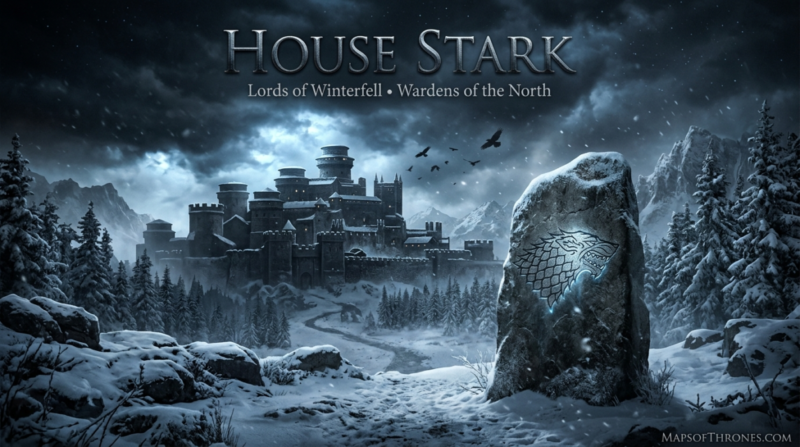
Lords of Winterfell. Wardens of the North. Keepers of the Old Ways. For eight thousand years, the grey direwolf has stood watch over the largest kingdom in Westeros — and their words echo still.
House Stark is the Great House of the North in Westeros, ruling from the ancient fortress of Winterfell for over eight thousand years. Their sigil is a grey direwolf on a white field; their words, Winter is Coming, reflect the North’s unflinching vigilance. Founded by the legendary Bran the Builder, the Starks maintained the North’s independence long before Aegon’s Conquest, embracing the old gods, the weirwood trees, and a culture distinct from southern Westeros. They serve as hereditary Wardens of the North and are central to both Game of Thrones and A Song of Ice and Fire.
The Ancient Lords of Winterfell
House Stark stands among the oldest and most storied of Westeros’s noble dynasties. Where southern lords built their legacies on courtly intrigue and golden promises, the Starks earned their place through something more enduring: a covenant with the land itself. The North is not merely a territory they govern — it is an identity, woven into stone and bone across eighty centuries of unbroken rule.
Their seat, Winterfell, is one of the oldest inhabited castles on the continent. Its famous hot springs run through the walls, keeping the fortress habitable even in the depths of northern winters. Beneath the castle lies the ancient Crypts of Winterfell, where the likenesses of Stark lords are carved in stone — each holding an iron sword across their laps to keep their spirits bound from walking. This is a house that lives in communion with its dead.
On the map of Westeros, the North dominates. It encompasses more territory than all six southern kingdoms combined, stretching from the Neck and Moat Cailin in the south — the ancient chokepoint that has repelled every southern invasion — to Castle Black and the Wall in the far north, beyond which lies the realm of the Free Folk and the existential terror of the White Walkers.
House Stark’s strategic importance runs deeper than geography. They command the loyalty of nearly twenty vassal houses — from the Bear Island Mormonts to the Boltons of the Dreadfort — and their word carries the weight of eight thousand years of precedent. When Ned Stark says the king’s peace must be honored, it is not a political calculation. It is a moral axiom. This is what makes House Stark simultaneously the noblest and most vulnerable of the great houses: they play the game of thrones by the rules of a world that no longer exists.
Their connection to the Old Gods and the weirwood network — the interconnected web of heart trees whose faces are carved with eyes and mouths — gives select Stark family members extraordinary abilities. The gift of warging (entering the minds of animals) and greensight (visions through the weirwood network) flows through Stark blood, making them not merely political rulers but something closer to guardian spirits of the ancient world.
The North: Territories of House Stark
From the Neck to the Wall — the vast dominion of the grey direwolf, spanning nearly half of Westeros by land area.
The Stark Family — Key Members of House Stark
From the Lord of Winterfell to the Three-Eyed Raven, each member of House Stark carries the weight of the North in their bones.
Eddard “Ned” Stark
The moral anchor of the series, Ned was the epitome of Northern honor — a man whose refusal to compromise his integrity set the entire War of the Five Kings into motion. His execution at the Great Sept of Baelor remains one of the most shocking moments in the saga.
Read Ned’s full profileCatelyn Tully Stark
A Riverlands noblewoman by birth, Catelyn became the backbone of Stark strategy during the War of the Five Kings. Her love for her children drove decisions both wise and catastrophic — none more so than releasing the Kingslayer.
Read Catelyn’s full profileRobb Stark
Declared King in the North after his father’s death, Robb proved a tactically brilliant commander — winning every battle he fought. Yet politics undid what swords could not. The Red Wedding at the Twins destroyed House Stark’s military power in a single, brutal night.
Read Robb’s full profileJon Snow (Aegon Targaryen)
Raised as Ned Stark’s bastard, Jon is in truth the trueborn son of Lyanna Stark and Rhaegar Targaryen — making him the legitimate heir to the Iron Throne. His journey from the Wall to dragonrider reshaped the fate of Westeros.
Read Jon’s full profileSansa Stark
What began as a story of a girl who dreamed of songs and knights evolved into one of the saga’s most powerful character arcs. Sansa survived Joffrey’s court, Littlefinger’s schemes, and Ramsay Bolton — emerging as an astute ruler of the independent North.
Read Sansa’s full profileArya Stark
The most unconventional Stark, Arya trained under Syrio Forel and the Many-Faced God in Braavos. Her list of names became a prayer of vengeance. She fulfilled the prophecy that a “little finger” would close the Night King’s blue eyes — forever.
Read Arya’s full profileBran Stark
Broken by a fall from Winterfell’s tower, Bran emerged as something beyond a man: a living repository of memory and time, able to perceive events past and present through the weirwood network. His ascension to the Iron Throne marks the triumph of ancient magic over dynastic politics.
Read Bran’s full profileLyanna Stark
Perhaps the most consequential Stark never seen on the field of war, Lyanna’s love for Rhaegar Targaryen sparked Robert’s Rebellion and ultimately produced Jon Snow. Her death in the Tower of Joy — and Ned’s promise — changed the course of Westerosi history.
Read Lyanna’s storyRickon Stark
The youngest of Ned and Catelyn’s children, Rickon was separated from his siblings after the fall of Winterfell. His years in hiding on Skagos ended tragically when Ramsay Bolton used him as a pawn — running him across the fields of Winterfell as an arrow’s target.
Read Rickon’s profilePolitical, Geographic, Cultural & Strategic Zones of House Stark
Understanding the North requires more than a map — it demands an appreciation of its political loyalties, geographic extremes, cultural identity, and military logic.
Lords & Loyalties
House Stark commands the allegiance of the North’s major lordly houses, many of whom have served the direwolf banner for thousands of years. Northern loyalty is fierce and long-memoried — but not unconditional, as the rise of House Bolton demonstrated.
Land & Terrain
The North’s geography is its greatest defender. Dense wolfswood, the swampy Neck, the rocky eastern coast, and the freezing lands beyond the Wall make invasion from any direction an exercise in attrition. Even Aegon the Conqueror chose diplomacy over dragons with Torrhen Stark.
- Winterfell
- The Wall
- Moat Cailin
- White Harbor
- The Wolfswood
- The Neck
- Bear Island
- Skagos
Faith, Blood & Memory
The North practices the Faith of the Old Gods — silent worship in godswoods centered on heart trees with carved weirwood faces. This stands in stark contrast to the Seven-Pointed Star of the south, and is a cornerstone of Northern identity, separatism, and resistance to cultural assimilation.
- Old Gods of the Forest
- Weirwood Network
- Warging / Skinchanging
- Greensight
- Crypt Traditions
- First Men Heritage
- Northern Hospitality Laws
Military & Defensive Logic
The North’s military doctrine prioritizes depth over numbers. With a thin population spread across massive territory, Stark war strategy relies on chokepoints like Moat Cailin, the economic power of White Harbor, and the moral authority of Winterfell to rally disparate lords in moments of crisis.
- Moat Cailin (Chokepoint)
- Castle Black (Watch Alliance)
- White Harbor Port
- The Dreadfort (Threat)
- Ironborn Threat (Western)
- Wildling Threat (Northern)
- Manderly Fleet
Key Locations in House Stark Territory
A structured reference of the North’s major sites — optimized for quick lookup and geographic orientation.
| Location | Type | Region / Position | Known For | Importance |
|---|---|---|---|---|
| Winterfell | Castle / Seat | Central North | Ancient seat of House Stark; hot springs; crypts of Stark kings | Critical |
| The Wall | Fortification | Far North | 700-foot ice barrier; built by Bran the Builder; defended by Night’s Watch | Critical |
| Castle Black | Fortress / Castle | Far North (Wall) | Seat of the Lord Commander of the Night’s Watch | Critical |
| Moat Cailin | Fortress / Ruin | The Neck (South Border) | Ancient chokepoint; only southern land route into the North | Critical |
| White Harbor | City / Port | East Coast | Largest city in the North; seat of House Manderly; major trading port | Critical |
| The Dreadfort | Castle | East North | Seat of House Bolton; site of notorious atrocities; political threat to Starks | High |
| Last Hearth | Castle | Far North Interior | Seat of House Umber; northernmost major castle below the Wall | High |
| Bear Island | Island | West Coast | Seat of House Mormont; tough, bear-hunting warriors; Lyanna Mormont’s domain | High |
| Greywater Watch | Floating Castle | The Neck | Seat of House Reed; moves through the bogs; seat of Howland Reed | High |
| Skagos | Island | Far East | Remote, wild island; home of the Skaggs; Rickon Stark’s refuge | Notable |
Frequently Asked Questions About House Stark
Direct answers to the most searched questions about House Stark, the North, and the Stark family in Game of Thrones and ASOIAF.
What are House Stark’s words?
House Stark’s words are “Winter is Coming” — a solemn warning and a philosophy of constant vigilance rather than a boast of power. Unlike most noble houses whose words speak to glory or pride, the Starks acknowledge that hardship is inevitable. The phrase reflects the North’s brutal winters and, allegorically, the existential threat of the White Walkers and the Long Night.
Where is Winterfell located on the map?
Winterfell sits roughly in the geographic center of the North, south of the kingsroad from Moat Cailin to Castle Black. On the map of Westeros, it occupies the broad interior plateau between the western Wolfswood and the eastern coast. Its central position allows Stark lords to project power in all directions across their enormous domain.
Who founded House Stark?
House Stark was founded by Bran the Builder, one of the most legendary figures in Westerosi history. He constructed both Winterfell and the Wall, and ruled as the first King of Winter. The Starks maintained the title “King in the North” until Torrhen Stark knelt to Aegon the Conqueror — earning him the nickname “the King Who Knelt” and making the Starks Wardens rather than kings.
What is the direwolf connection to House Stark?
The direwolf is both the sigil of House Stark and a literal, magical element of their story. In A Game of Thrones, the Stark children each bond with a direwolf pup found dead beside their mother south of the Wall — an omen of the stag (Baratheon) killing the wolf (Stark). The wolves serve as companions and, for some Starks, vessels for their warging abilities.
Does House Stark survive Game of Thrones?
Yes. Despite devastating losses — Ned, Robb, Catelyn, and Rickon all die — House Stark emerges from the show’s events in a position of historic strength. Sansa Stark becomes Queen in the North as it declares independence. Arya Stark sails west to explore unknown lands. Bran Stark becomes King of the Six Kingdoms. Jon Snow ventures beyond the Wall with the Free Folk.
What religion does House Stark follow?
House Stark and the North follow the Old Gods of the Forest — a pre-Andal religion practiced in sacred godswoods beside heart trees (weirwood trees with carved faces). Unlike the seven-faced deity of the south, the Old Gods have no formal clergy, no texts, and no prayers — only silent contemplation beneath the watching eyes of the weirwoods, which serve as nodes in a vast mystical network connecting past and present.
What is Jon Snow’s real identity in relation to House Stark?
Jon Snow, raised as Ned Stark’s bastard, is in truth Aegon Targaryen — the legitimate son of Prince Rhaegar Targaryen and Lyanna Stark, who were secretly wed. Ned raised him as his own to protect him from Robert Baratheon. By blood, Jon is both a Stark through his mother and a Targaryen through his father, with a claim to the Iron Throne that supersedes Daenerys Targaryen’s own.
What is the importance of the crypts of Winterfell?
The Crypts of Winterfell hold the stone effigies of past Stark lords and kings, each bearing an iron sword across their lap — a tradition believed to keep the spirits of the dead from walking. In the books, the crypts hold deeper secrets: A Song of Ice and Fire fans theorize the crypts may contain hidden chambers, Lyanna Stark’s actual remains, and possibly magical sigils connected to the Long Night’s ancient defenses.
Continue Exploring
The North is vast. Every castle, every house, every story — mapped and chronicled for those who wish to know the world of ice and fire as deeply as those who lived it.