
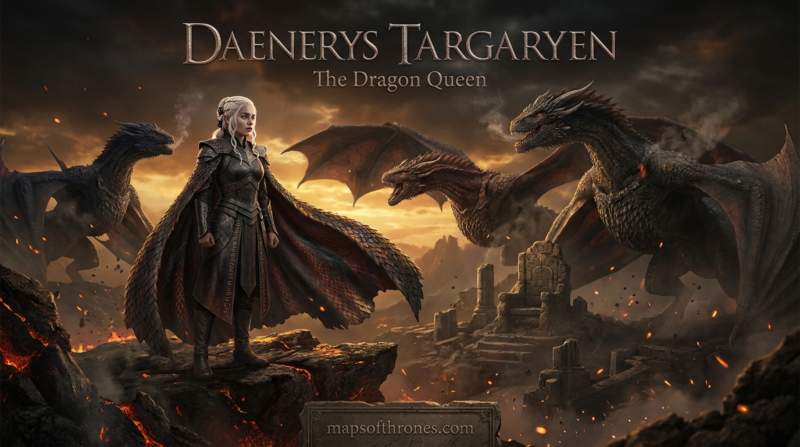
Daenerys Targaryen
Character Data
Chaotic Good rather than Neutral Good through Seasons 1–7 because her liberation campaigns consistently override established law and institution, even when those institutions produce stable outcomes — she doesn’t reform systems, she burns them. The alignment collapses to Chaotic Neutral in Season 8, where her destruction of King’s Landing cannot be defended as liberation of any kind; it is punishment, and the show never honestly names it as such.
Appearance Data
Actor Data
Character Overview
Daenerys Targaryen is not a story about power corrupting. That reading is the show’s own post-hoc rationalization of what happens to her in Season 8, and it does not hold up to scrutiny. She is, more accurately, a story about a person built to believe in their own exceptionalism — raised on the mythology of dragonlords and destiny, surrounded by people who needed her to be a savior — and what happens when that mythology collides with a world that refuses to recognize it on her terms.
Her fundamental contradiction is this: she is a liberator who cannot tolerate dissent. From the earliest Essos storylines, her liberation campaigns carry an implicit condition — those she frees must accept her authority absolutely. The Unsullied, the Dothraki, the people of Meereen: she does not ask them to govern themselves. She asks them to govern themselves under her. When they do not, when factions resist and political reality asserts itself, she reaches for fire. This pattern is established in Season 3 and repeated so consistently that her Season 8 destruction of King’s Landing, however compressed and poorly staged, is not a break from her character. It is its logical destination.
Where the show succeeds with her is Seasons 1 through 5 — a patient, granular portrait of someone acquiring power and discovering both its seductions and its costs. Where it fails is everywhere after that. The show needed Daenerys to become a villain for its finale to function. It was unwilling to pay the narrative price of building her there honestly, so it compressed years of psychological deterioration into six episodes. The result is not a complex character study. It is a character assassination with a thesis the writers did not have the courage to actually argue.
Her ending reveals something damning about the show’s actual thesis: that the most dangerous person in the world is someone who genuinely believes they are right. Game of Thrones raises this point in its final season and then refuses to examine it — killing her off rather than living with the discomfort of what she represents.
Who Is Daenerys Targaryen in Game of Thrones?
Daenerys Targaryen is the exiled last scion of House Targaryen who spends eight seasons building an army, hatching three dragons, and crossing the Narrow Sea to reclaim the Iron Throne she believes is her birthright. Her arc moves from powerless pawn sold into marriage to the most militarily dominant figure in Westeros — then ends in the ruins of King’s Landing, which she burns, before being killed by the man she loved. Emilia Clarke played the role across all eight seasons from 2011 to 2019.
First appearance: S1E1 “Winter Is Coming”Daenerys Targaryen’s Skills, Abilities & Fighting Style — Complete Analysis
Dragon Command
Name: Valyrian dragon-bonding, fire direction, Dothraki field command via Drogon.
Technique: Daenerys does not simply possess dragons — she pilots Drogon in combat (demonstrated from Season 5 onward), directing his fire runs with vocal commands in High Valyrian. Her best tactical use is the attack on the Lannister supply line (Season 7), where she coordinates cavalry and dragon to devastating effect. Her worst is the unsupported charge on Euron’s Iron Fleet in Season 8 Episode 4, where she loses Rhaegal to an ambush that she — with three dragons and aerial superiority — had no excuse not to anticipate.
Evolution: From hatchling wrangler in Season 2 to strategic air power in Season 6–7; regresses to emotionally driven scorched earth in Season 8.
Verdict: The writing never used this skill at its full potential because it was structurally too powerful — the show spent six seasons trying to find excuses to nerf her dragons rather than letting the story adapt to what three adult dragons actually mean.
Combat & Physical
Weapon proficiency: None in the conventional sense. Daenerys is not a fighter on foot. Her physical courage is real — she walks into fire, she rides into chaos — but personal combat is not her domain.
Among the show’s fighters, Daenerys ranks at the bottom tier in individual combat because she never fights individually. Her power is entirely mediated through dragons, armies, and political authority. Remove those and she is physically vulnerable — which Season 8 uses against her, though quietly.
Plot armor instances: The Walk of Punishment pyre (S1 finale — fire immunity established here with no prior buildup); walking into Drogo’s funeral pyre; standing in the burning temple of the Dosh Khaleen (S6).
Oratory & Persuasion
This is Daenerys’s most underrated skill and the one the show uses most inconsistently. Her speech to the Dothraki khalasars at Vaes Dothrak in Season 6 — spoken in Dothraki, delivered with total command — is one of the finest political moments in the series. She understands that authority requires spectacle, and she provides it. Her failure is that persuasion only works for her when the audience is already susceptible. She cannot persuade Sansa. She cannot persuade the North. She has no language for people who have already decided not to trust her — and the show never forces her to develop one.
Best moment: The Vaes Dothrak speech reclaiming the Dothraki without a battle (S6).
Failure moment: Every conversation with Sansa Stark, who sees through the performance and whom Daenerys treats as a subordinate rather than an ally she needs to win.
Political & Strategic
Alliance successes: Securing the Unsullied through a calculated deception (S3); winning the Dothraki without battle (S6); the Targaryen alliance with Dorne and Highgarden (S6 finale — dismantled by S7E3 through her own tactical impatience).
Alliance failures: Refusing to consider compromise with Sansa or the Northern lords in Season 8; ignoring Tyrion’s consistent advice to demonstrate restraint; alienating the people she needed most at the moment she needed them.
Best strategic call: Freeing the Unsullied with Drogon in Astapor — she reads her enemy’s greed precisely and exploits it.
Worst strategic call: Attacking the Lannister supply train alone in Season 7 rather than using coordinated force — tactically successful, politically catastrophic, as it demonstrated to every watching noble that she was willing to burn Westeros rather than govern it.
Fire Immunity
Ability: Apparent immunity to fire and extreme heat — demonstrated in the funeral pyre of Khal Drogo (Season 1 finale), the burning temple of the Dosh Khaleen (Season 6), and throughout her time with Drogon.
Consistency: The show establishes this inconsistently. In the books, George R.R. Martin has specifically stated that Targaryens are not generally fire-immune — it is specific to Daenerys in the show. The show avoids explaining this, which works as mystery but fails as worldbuilding.
Where the writing failed it: The ability is used as spectacle (the pyre scenes are visually extraordinary) but never meaningfully explored as part of her identity. What does it mean for her self-conception to be literally impervious to the weapon she wields? The show never asks.
Survival Skills
How she stayed alive: Largely through the loyalty of those around her — Jorah Mormont in Seasons 1–5, the Dothraki guard, Daario Naharis, and eventually Drogon. Her personal survival instinct is real (she escapes Astapor, navigates Qarth) but frequently depends on others absorbing the actual danger.
Luck vs. skill ratio: Approximately 50/50 through Season 5; skill-dominant in Season 6 when she operates with genuine agency; luck-dominant again in Seasons 7–8 where plot requirements keep her alive despite tactical errors that should have been fatal.
Named plot armor instances: Surviving the wight attack beyond the Wall with no cover (S7); Drogon’s perfectly timed arrival at the Sons of the Harpy assassination attempt in Meereen (S5); the Iron Fleet ambush in S8 where she loses Rhaegal but not herself despite being the obviously higher-value target.
Was Daenerys a Hero, Villain, or Something the Show Couldn’t Name?
The Case For Hero
The strongest heroic reading of Daenerys Targaryen is also the most defensible: she is the only person in the entire eight-season run of the show who systematically dismantles slavery at scale. Not theoretically. Not as policy. She burns slave infrastructure, breaks slave collars, and builds armies of free people who chose to follow her. That is not nothing. The Unsullied were chattel; by Season 3’s end they were free soldiers. The people of Astapor, Yunkai, and Meereen were not freed symbolically — they were freed materially, with armed backing.
The heroic reading also accounts for her personal cost: she defers her Westeros invasion for years to consolidate liberation in Essos, at considerable strategic disadvantage to herself. A purely self-interested tyrant does not do that. A person who genuinely believes in her stated values does.
The Case For Villain
The villainous reading requires accepting what the text actually shows rather than what the show asks you to feel. Every liberation campaign she runs ends the same way: with Daenerys in charge, her authority absolute, dissent a death sentence. She crucifies slave masters in numbers the show does not ask you to examine carefully. She sentences Mossador to public execution for vigilante justice in Meereen while simultaneously conducting drone-war-scale fire raids that kill civilians. The rules apply to others. For herself, the calculus is always different.
The burning of King’s Landing is the villainous reading made undeniable. The city had surrendered. She knew it. She burned it anyway. That is not madness — it is a deliberate choice, and the choice is indefensible. The show never finds the courage to actually call it that.
Critical Verdict
Daenerys is something the show ultimately could not name: a true believer who becomes the thing she set out to destroy. Not because she went mad. Because the logic of her ideology — liberation through fire, authority through absolute power — was always pointing here. The seeds are in Season 1. They bloom in Essos. They bear fruit in Season 8. The problem is not that her arc ends in destruction; the problem is that the show spent seven seasons asking us to root for someone with this trajectory, and then acted surprised when it arrived at its destination.
What the text actually supports — and the show could not commit to — is a reading of Daenerys as a person with genuinely good intentions and a fundamentally authoritarian method of realizing them. That is a more sophisticated villain than any the show produced. It is also the only reading that makes her ending earned rather than imposed. Her narrative ending is not earned by the writing of Seasons 7–8. It is earned by Seasons 1–6. The finale just got there the wrong way.
Daenerys Targaryen vs. Jon Snow — Direct Comparison
No character defines Daenerys by contrast more completely than Jon Snow. They are structurally opposite responses to the same problem: what do you do with power you believe you earned by suffering for it?
| Category | Daenerys Targaryen | Jon Snow |
|---|---|---|
| Combat Ability | Near-zero personal; overwhelming with dragons | Skilled individual fighter; mediocre tactician EDGE: Jon |
| Political Intelligence | High early, collapses under isolation in S7–8 | Consistently poor — alienates everyone repeatedly EDGE: Daenerys |
| Moral Decision-Making | Principled until challenged, then absolutist | Consistent to the point of inflexibility EDGE: Jon |
| Narrative Role | Structural protagonist with antagonist ending | The moral conscience the show uses to judge her Daenerys more complex |
| Writing Quality of Arc | Superb S1–S6; catastrophically compressed S7–8 | Good S1–S5; passive S6–8; finale wastes him Daenerys S1–6 wins |
| Who Served the Story Better | Daenerys, definitively. Jon exists primarily as a vessel for the show’s thesis statement about lineage and destiny. Daenerys is the thesis itself. | |
The show positions Jon as the moral corrective to Daenerys — the man who kills her because he cannot follow a tyrant. But Jon’s moral superiority in the finale rests entirely on doing nothing throughout Season 8 while she makes decisions he disagrees with. That is not heroism. That is passivity crowned in retrospect.
Daenerys Targaryen Through Every Season
S1
The Girl Who Became Khaleesi
Grade A
1. Sold to Khal Drogo and surviving a wedding night that the show stages as assault — the arc begins in victimhood and the writing is honest about it, even if later seasons sanitize her memory of Drogo.
2. Standing in fire with the dragon eggs after Drogo’s pyre — her first display of something beyond ordinary mortality, and the most visually coherent statement of her mythology the show ever produces.
3. Her gradual assertion of authority over the khalasar after learning the Dothraki language — a patient, earned transformation the show later abandons as a method.
Character Development: She gains physical and psychological autonomy, beginning as a bartered child and ending as a grieving mother with supernatural attributes. She loses Drogo, her son Rhaego, and any illusion that the world will accommodate her gently.Writing Grade Justification: The season commits to her vulnerability and does not apologize for the difficulty of her circumstances. It earns every step of her transformation.
Alliances: Khal Drogo (formed S1, ended by death); Ser Jorah Mormont (formed S1, becomes the series’ most durable loyalty)
S2
Survival and Seduction in Qarth
Grade B
1. Navigating the politics of Qarth with no money, no army, and infant dragons — the show at its best is her reading power structures from a position of weakness.
2. The House of the Undying — her vision of the Iron Throne covered in snow (or ash) is the show’s most honest foreshadowing, and it was visible to anyone paying attention at the time.
3. Recovering her stolen dragons by destroying Xaro Xhoan Daxos — a cold, decisive act that previews the Daenerys of later seasons.
Character Development: She discovers that charisma alone is not enough — that people will take from her as long as she has nothing they cannot replicate. She learns to act decisively rather than petition. Alliances: Xaro Xhoan Daxos (formed S2, ended by betrayal and his death)
S3
Liberation Theology, Applied
Grade A
1. The Astapor slave market scene — she trades Drogon for the Unsullied, speaks the command to kill the slavers in Valyrian, then reclaims her dragon. It is one of the finest sequences of political theater the show produces. Earned, not unearned.
2. The “Mhysa” scene — crowds of freed slaves lifting her above their heads as she walks among them. The show presents this uncritically. A more honest reading notes that she has now acquired thousands of dependents who look to her rather than to reconstructed institutions.
3. Her decision to stay in Yunkai rather than sail for Westeros — the first of many self-imposed delays, framed as moral duty and arguably also as fear of confronting her actual destination.
Character Development: She acquires real military power for the first time. She also acquires the habit of collecting people who worship her, which the show does not yet identify as a problem. Alliances Formed: The Unsullied army; Daario Naharis; expanded Jorah Mormont loyalty
S4
The Cost of Ruling What You Freed
Grade B
1. Her decision to crucify 163 Great Masters in retaliation for the crucified slave children — the show presents this as justice, but the number and method invite comparison to the tactics of the regimes she replaced. This is the first moment where the heroic reading of Daenerys should feel genuinely uncomfortable.
2. Locking Rhaegal and Viserion in the catacombs beneath the pyramid — she loses control of her dragons for the first time. The metaphor is explicit: her power is becoming something she cannot govern.
3. Learning that freeing Meereen is not the same as governing it — insurgency, political resistance, and economic collapse follow her liberation.
Character Development: She learns that her instinct (destroy injustice) and the reality of governance (manage the aftermath) are not the same thing. She refuses to fully learn this lesson. Writing Grade Justification: Solid political storytelling held back slightly by the isolation of the Essos storyline from the Westeros mainline.
S5
The Limits of Good Intentions
Grade B
1. The execution of Mossador for vigilante justice — she publicly executes a man for doing something she has done herself at scale, and the freed slaves she liberated riot against her. It is the show at its most politically sophisticated regarding her character.
2. The Great Games assassination attempt by the Sons of the Harpy — Drogon’s arrival and her escape on dragonback is visually extraordinary and confirms her physical courage, if not her tactical judgment.
3. Jorah’s banishment and return — the relationship that best defines her capacity for loyalty given and withheld is handled with more care this season than the finale will manage for any character.
Character Development: She learns that moral authority is not self-sustaining — that governance requires negotiation, not proclamation. She learns it insufficiently.
S6
Peak Daenerys, Maximum Stakes
Grade A
1. The Dosh Khaleen temple — she burns the Dothraki leaders alive and walks out unscathed, uniting every khalasar under her. It is her finest display of strategic patience: she waited for exactly the right moment and context to deploy her fire immunity as political spectacle.
2. “The Winds of Winter” — the Season 6 finale, in which she sails for Westeros at last, flanked by dragons, the Iron Fleet, and an unprecedented coalition. It is the peak of her character’s narrative power, and the show never betters it.
3. Burning the slavers’ fleet at Meereen — her first major combined-arms operation, coordinating Dothraki cavalry, the Unsullied, and all three dragons simultaneously.
Character Development: She resolves the Meereen storyline, acquires Varys, Tyrion, and Theon/Yara’s fleet, and begins moving toward her stated goal. The season rewards six seasons of patient investment in her arc. Writing Grade Justification: The best season of Daenerys material; patient setup pays off completely.
S7
The Beginning of the Compression
Grade C
1. The Field of Fire 2.0 — she attacks the Lannister supply train with Drogon and the Dothraki. Tactically brilliant; strategically reckless; politically a disaster she does not recognize as such.
2. The rescue beyond the Wall — she loses Viserion to the Night King while saving Jon’s group. A dragon killed by an ice javelin thrown from ground level to air stresses credibility, but the emotional weight of losing one of her children lands.
3. Jon Snow bending the knee in the dragonglass caves — and the dawning of a romantic entanglement the show needed 3 seasons to develop and compressed into two episodes.
Character Development: She begins making decisions the show frames as impatience but which are actually the show running out of time. The compression that destroys Season 8 begins here. Writing Grade Justification: Action sequences are spectacular; the political and psychological architecture collapses under the speed of the storytelling.
S8
The Betrayal of Eight Seasons
Grade F
1. The burning of King’s Landing — the finale’s central event and the show’s most controversial narrative decision. Daenerys hears the bells of surrender and burns the city anyway. The act is consistent with her established psychology. The problem is that the show had not prepared the ground for it honestly: it required three seasons of gradual isolation and deterioration it did not show.
2. Missandei’s execution on the walls of King’s Landing — the show kills Daenerys’s only close personal friend specifically to trigger her psychological break. It is a lazy narrative mechanism dressed as trauma.
3. Jon’s assassination — she dies on the steps of a throne she never sat on, killed by the person she trusted most. The poetry is there. The earned grief is not, because Season 8 gave neither character the space to make their final scenes feel inevitable rather than scheduled.
Character Development: There is none. She arrives at the finale in the same psychological state she was in at the end of Season 7, makes one catastrophic decision, and dies. Writing Grade Justification: F — not for what happened to Daenerys, but for how it was executed: in six episodes that needed to be three full seasons.Daenerys Targaryen — Geographic Journey
Complete Alliance & Enemy Record
Alliances
Enemies
| Person | Type | Seasons | End Status |
|---|---|---|---|
| Khal Drogo | Husband / First love | S1 | Dead; she ends his life |
| Viserys Targaryen | Brother / Abuser | S1 | Dead; killed by Drogo with Daenerys’s implicit approval |
| Ser Jorah Mormont | Advisor / Protector / Unrequited love | S1–S8 | Dead at Winterfell defending her |
| Jon Snow / Aegon Targaryen | Ally / Lover / Killer | S7–S8 | He kills her; exiled beyond the Wall |
| Tyrion Lannister | Hand of the Queen | S5–S8 | Estranged; she imprisons him; he survives |
| Missandei | Closest friend / Interpreter | S3–S8 | Executed by Cersei; triggers Daenerys’s final break |
| Grey Worm | Military commander | S3–S8 | Survives; sails to Naath after her death |
| Daario Naharis | Captain / Lover | S3–S6 | Left to govern Meereen; estranged |
| Varys | Advisor / Political operative | S6–S8 | Executed by her for treason in S8 |
| Cersei Lannister | Political enemy | S7–S8 | Dead under the Red Keep |
What Most Fans Miss About Daenerys Targaryen
1. Her liberation campaigns always required absolute personal authority — that’s not incidental to her character, it’s definitional.
From Season 3 onward, every city she frees immediately reorganizes around her as ruler. She never builds institutions that persist without her. The freed people of Astapor dissolve into chaos the moment she leaves. The slaves of Meereen spend three seasons fighting over what governance looks like without her at the center. Daenerys does not liberate people. She transfers their dependence from one authority to herself. The show frames this as her strength. It is also her doom.
2. The House of the Undying vision in Season 2 is a literal preview of the finale.
In the House of the Undying, Daenerys walks through a destroyed, snow-covered (or ash-covered) throne room. The Iron Throne is within reach — and she turns away from it, following Drogo and the son she never had. The show presents this as a temptation she resists. But it is also the finale compressed to a single image: she reaches the throne through ruin, and the people she loves are dead. She does not take the throne in that vision. She did not take it in the series. Her story was never about the throne. It was about what she burned to try to reach it.
3. Daenerys’s relationship with Khal Drogo is never retroactively criticized by the show — which is a significant choice.
The marriage begins as a transaction in which she has no say. Her early relationship with Drogo involves coercion the show is not shy about in its first episodes. But by mid-Season 1, it has transformed — in her telling — into genuine love. The show asks viewers to accept this transformation without interrogating how it happened or what it says about her psychology. The book version of Daenerys carries this more ambiguously. The show’s Daenerys seems to have genuinely processed her earliest experiences as love, which tells you something important about the depth of her capacity to reframe painful realities as acceptable — a skill she deploys throughout her arc.
4. The “bells” moment in Season 8 is psychologically earned — just not by Season 8.
The critical consensus that Daenerys’s destruction of King’s Landing is an unearned character reversal is only partly correct. The pattern — moral absolutism, fire as first resort, inability to tolerate resistance — is visible from Season 3. What Season 8 lacks is not the character logic but the bridge scenes: the psychological deterioration following the death of Jorah, the loss of Rhaegal, the revelation of Jon’s parentage, and Missandei’s execution needed to be shown in granular, costly detail. Compressed into four episodes, it reads as a sudden break. Spread across two full seasons, it would read as an inevitable arrival.
5. In the books, Daenerys has explicit “fire and blood” impulses she actively suppresses — and the suppression failing is the story.
George R.R. Martin’s Daenerys in A Dance with Dragons explicitly wrestles with destructive impulses she identifies as the “dragon” part of herself and tries to restrain as the “Daenerys” part. The show collapses this internal dialogue entirely, presenting a character who seems genuinely surprised by her own violence in Season 8. The book version would not be surprised. She would be horrified. That distinction — between a character who is ambushed by her own nature and one who has been fighting it for years and simply stops winning — is the difference between a tragedy and a plot twist.
6. She is the only character in the show who consistently wins by giving people something rather than taking it.
Every other major political player in Game of Thrones wins by accumulation — gold, armies, marriages, debts. Daenerys’s method in Seasons 3–6 is to give: freedom, protection, belonging, identity. The Dothraki follow her not because she commands it but because she proved herself by walking from fire. The Unsullied fight for her with a ferocity beyond obligation because she granted them personhood. The show stops noticing this dynamic in Season 7 when it repositions her as a conventional military conqueror. That repositioning is where her narrative begins to fail.
7. Tyrion’s bad advice is systematically blamed on her “madness” — an act of narrative dishonesty the show never corrects.
Tyrion Lannister’s counsel in Seasons 7–8 is consistently poor: he engineers the Casterly Rock gambit that loses her the Tyrell and Dornish alliances; he advises against the loot train attack that was her only decisive military action; he repeatedly urges restraint in contexts where restraint favored Cersei. When Daenerys ignores his advice and succeeds, the show treats it as dangerous impatience. When she takes his advice and fails, the show treats it as tragic circumstance. Tyrion is protected by his narrative function as moral compass. Daenerys is not. The audience should examine whose decisions actually made the war harder to win.
Where the Writers Failed Daenerys Targaryen
The most consequential writing failure in Daenerys’s arc is not Season 8 — it is the decision, beginning in Season 7, to stop treating her psychology as the story’s subject. Seasons 1 through 6 build a portrait of a person whose method of acquiring love and loyalty is by proving herself worthy of them. Season 7 begins treating her as a military asset who happens to have a character arc. The shift is subtle in Season 7 and catastrophic in Season 8.
The specific moment the writing stops understanding her: the council scene in Season 8 Episode 2, where she learns that Jon has a stronger claim to the throne and responds with a political calculation rather than a personal one. The writers give her no space to process what this means for her identity — only for her strategy. This collapses six seasons of character development into a plot point.
Storylines abandoned: her gradual psychological deterioration following the losses of Season 7 is simply skipped. Her grief for Jorah receives one scene. Her processing of Jon’s parentage receives none. Her evolving relationship with her own capacity for violence — the central subject of Seasons 4–5 — is dropped entirely in Season 7 and replaced with tactical discussions.
What a better version of her arc requires: two full additional seasons following Season 6’s peak, showing the Westeros invasion in slow political detail — the Northern lords’ distrust, the smallfolk’s ambivalence, the costs of her methods becoming visible to herself. Her descent into the destruction of King’s Landing should be something she chooses in full psychological clarity, not something the audience is asked to accept as madness. She was always going to burn something. The tragedy is that she knew it, and the show pretended she didn’t.
In the books, her internal conflict is much more explicit — which makes the eventual convergence of her impulses feel earned rather than imposed. The show traded that internal architecture for spectacle, and lost its most interesting character in the trade.
Complete Stats Block
Emilia Clarke — Performance Analysis
Actor Vitals
Performance Analysis
Emilia Clarke’s contribution to Daenerys Targaryen is not reducible to the character’s most iconic moments — the fires, the dragons, the Dothraki speeches. Her most significant achievement is conveying the specific texture of someone who has learned to perform certainty as a survival mechanism. In the early seasons, you can see the performance inside the performance: Daenerys practicing being a queen, checking whether it is working, adjusting. That internal layer — visible in Clarke’s eyes and the slight hesitation before her most commanding scenes — is what makes the character’s early arc so watchable.
Her strongest extended sequence is Season 6, where she delivers the Vaes Dothrak speech in Dothraki with total command. She had been working in the language for several seasons; by Season 6 it sounds habitual rather than rehearsed. That naturalness with three different languages (English, High Valyrian, Dothraki) across eight seasons is technically demanding in a way that rarely gets acknowledged.
Her most difficult scenes are in Season 8 Episode 5 and 6, where she is asked to convey a psychological state the script does not build toward. She does the work the script doesn’t — particularly in the moment before the bells, where you can see grief become decision — but she cannot fully rescue material that needed more preparation than the writers gave her or the character.
One honest critique: her range in quieter scenes — political conversations without emotional stakes — can plateau into a single register of dignified authority. The scenes where Daenerys negotiates rather than commands tend to be the least interesting Clarke delivers. This is partly a writing issue; those scenes rarely give her anything to find.
Awards & Recognition
Clarke received multiple Emmy Award nominations for Outstanding Supporting Actress in a Drama Series for her work in this role. She was also recognized at the Saturn Awards and Critics’ Choice Television Awards for her performance across the series. Her work received consistent critical acknowledgment, particularly for Seasons 3 and 6.
Daenerys Targaryen: Book vs Show
Core Characterization Differences
The most consequential difference between the book and show versions of Daenerys is internal: Martin’s Daenerys explicitly articulates the tension between her liberating instincts and her destructive ones, naming them as competing selves. The show renders this conflict in action and event rather than interiority, which is legitimate television practice — but it loses something critical in the translation. Book Daenerys knows she is capable of burning everything. She is afraid of it. Show Daenerys seems genuinely unaware of this tendency until Season 7, and then the show treats her awareness as paranoia rather than honest self-knowledge.
Key Book Moments Cut From the Show
The Meereen chapters of A Dance with Dragons are among Martin’s most psychologically complex writing. Daenerys’s choice to marry Hizdahr zo Loraq — a calculated political compromise she despises — and her eventual recognition that it is failing demonstrates a version of her who tries pragmatic accommodation and finds it untenable. The show collapses this into the brief Hizahdahr storyline of Season 5 without conveying the depth of what the compromise costs her. Its absence means the show never establishes why she ultimately abandons pragmatism: because she already tried it and it didn’t work.
Where the Show Version Is Stronger
The Vaes Dothrak sequence in Season 6 — burning the Dothraki leadership and walking from the fire — has no direct equivalent in the books, which are not yet published to that point in the story. It is the show’s best original addition to her character: a scene that crystallizes everything that has been built over five seasons into a single decisive image. It is also the last moment where the show is fully confident in what it is doing with her.
Which Version Is More Psychologically Consistent
The book version, decisively. Martin constructs Daenerys’s psychology with an internal logic that makes her eventual violence feel like the endpoint of a coherent character study. The show version is more visually spectacular but psychologically thinner — particularly in the final two seasons, where the writers appear to have lost confidence in the character they had spent six seasons building.