
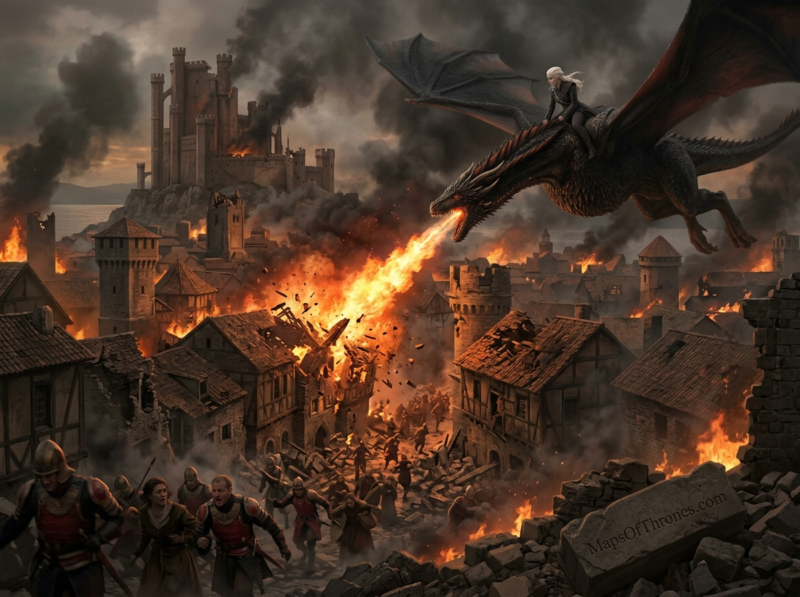
Battle of King’s Landing: The Burning
The dragonfire reckoning that ended a dynasty, consumed a city, and shattered the dream of a just queen — King’s Landing’s final and most devastating siege.
Battle of King’s Landing: The Burning took place in 305 AC during the final phase of Game of Thrones (Season 8, Episode 5: “The Bells”). Daenerys Targaryen, riding Drogon, led her Unsullied infantry, Dothraki cavalry remnants, and northern allies against Cersei Lannister’s garrison, the contracted Golden Company, and Euron Greyjoy’s Iron Fleet. After swiftly destroying all organised resistance, Daenerys refused to honour the city’s bells of surrender and ordered Drogon to burn King’s Landing — killing tens of thousands of civilians and reducing much of the capital to ash. The city fell to Targaryen forces, but Daenerys was subsequently assassinated by Jon Snow, making it a catastrophic pyrrhic victory that ended the Targaryen restoration before it could begin.
Battle of King’s Landing: The Burning — Scale and Significance
No battle in the history of Westeros — real or imagined — carries the same searing weight as Battle of King’s Landing: The Burning. Fought in the shadow of the Iron Throne that Daenerys Targaryen had spent her entire life pursuing, it was a military engagement that was won within the first hour of fighting. What followed was something else entirely: a act of mass destruction that would define Daenerys’ legacy, fracture her alliance, and trigger her assassination. It is simultaneously the greatest military victory ever achieved in Westeros and its most catastrophic moral failure.
The battle took place in King’s Landing, the seat of the Iron Throne and capital of the Seven Kingdoms, situated at the mouth of the Blackwater Rush on Blackwater Bay. The city’s population numbered in the hundreds of thousands — tradespeople, smallfolk, merchants, refugees — all trapped within the walls as the most powerful dragon in the known world circled overhead. The Crownlands had seen siege and battle before — the Battle of the Blackwater had been fought in this same harbour — but nothing in living memory had prepared King’s Landing for dragonfire delivered without restraint.
In the broader arc of the War of the Five Kings and its aftermath, Battle of King’s Landing: The Burning represents the terminal event: the final military action that ended House Lannister‘s grip on the throne and cleared the path for a new political order — though not the one Daenerys had envisioned. The political fallout from the burning reshaped Westeros more profoundly than any single battle since the Trident.
Cersei Lannister, having spent the long war consolidating power at any cost, had fortified King’s Landing with mercenary muscle, naval supremacy, and the city’s walls themselves as a shield behind which she could wait out any siege. Euron Greyjoy‘s Iron Fleet controlled Blackwater Bay. The Golden Company — ten thousand veteran sellswords from across the Narrow Sea — stood arrayed outside the city gates. On paper, it was a formidable defence. Against a single healthy dragon and a commander willing to use it without restraint, it was ash waiting to happen.
Battlefield Diagram — King’s Landing Approaches & Attack Vectors
Key Participants & Factions
Riding Drogon, Daenerys personally executed every phase of the aerial assault — annihilating the Iron Fleet, destroying the scorpion emplacements, and breaching the city walls before making the fateful decision to burn the surrendering city.
Daenerys TargaryenGrey Worm led the Unsullied ground assault following the wall breach, personally slaying Harry Strickland of the Golden Company. After the bells rang, he followed Daenerys’ implicit command and initiated the massacre of the Lannister garrison.
Grey WormJon led the northern contingent into the city but attempted to halt the massacre after the bells. Horrified by the destruction, he ultimately assassinated Daenerys in the aftermath — the act that ended the battle’s political consequences.
Jon SnowCersei directed the defence from the Red Keep, having fortified the city with the Golden Company and Euron’s fleet. She perished beneath the Keep’s rubble alongside Jaime Lannister as Drogon’s assault destroyed the structure’s foundations.
Cersei LannisterEuron commanded the Iron Fleet’s scorpion-armed warships in Blackwater Bay. Drogon’s surprise approach angle negated their preparation, and the fleet was destroyed in minutes. Euron survived to duel Jaime Lannister on the shore, dying from his wounds.
Euron GreyjoyStrickland commanded ten thousand sellswords outside the city gates — veterans of the Free Cities’ wars. Drogon’s assault dissolved their formation before they could engage infantry. Strickland was killed by Grey Worm during the ground phase.
Harry StricklandCaptured at Riverrun, Jaime broke from the Targaryen camp and fought south to reach Cersei. He killed Euron Greyjoy in single combat at the docks but was mortally wounded. He reached Cersei in the Red Keep tunnels only for both to be crushed beneath the falling Keep.
Jaime LannisterSandor used the chaos of the burning to reach the Red Keep and confront his brother Gregor. The long-anticipated Cleganebowl concluded with both brothers plunging from the Keep into the dragonfire below. Sandor died by his own choice — driving his brother into the flames.
Sandor CleganeThe last of Daenerys’ three dragons, Drogon was the singular force that determined the battle’s outcome. His firepower neutralised every defensive layer Cersei had prepared: fleet, scorpions, walls, gate, and finally the Red Keep itself.
DrogonBattle Breakdown — Phase-by-Phase Analysis
Daenerys arrived at King’s Landing already diminished. Rhaegal had been shot from the sky by Euron’s scorpions off Dragonstone. Missandei had been executed atop the city walls by Cersei. Varys had committed treason and been executed. Jorah Mormont lay dead at Winterfell. The Daenerys who flew south was not the measured conqueror who had liberated Meereen — she was a woman stripped of everything except one dragon and an army. Her Hand Tyrion, still hoping for a bloodless surrender, had negotiated back-channel intelligence that the garrison would ring the bells if the battle turned. Daenerys agreed to halt the assault if the bells rang. It was a promise she would not keep.
Daenerys exploited a fundamental vulnerability in Euron’s defensive posture: the Iron Fleet’s scorpions were fixed, forward-facing weapons. She approached from the eastern sea at low altitude, in the sun — a blind spot Euron had not anticipated. Drogon destroyed the fleet’s flagship within seconds, then systematically eliminated ship after ship before the crews could traverse their scorpions to track a target moving at full dragon speed. Within minutes, Blackwater Bay was a graveyard of burning hulks. The city’s wall-mounted scorpion emplacements fell next — each destroyed before their operators could fire a second bolt. It was a masterclass in suppressing anti-air fire before beginning a ground assault.
With the city’s aerial defences neutralised, Daenerys turned Drogon on the King’s Landing city gates — breaching them in a single pass. The Golden Company, positioned outside the walls in textbook anti-infantry formation, had no answer for dragonfire. Harry Strickland’s ten thousand veterans — the finest mercenary force money could buy — were scattered, routing, and dying within moments of Drogon’s first pass. The Unsullied and Dothraki poured through the breached gates. Grey Worm engaged and killed Strickland personally. The Lannister garrison, watching from within, began to understand that resistance was futile. The city’s residents, trapped in the streets, braced for what they hoped would be a swift, merciful end to the fighting.
The Lannister garrison threw down their swords. Church bells — the ancient signal of surrender in the Seven Kingdoms — began to ring across King’s Landing. The battle was over. Every defensive force had collapsed. Tyrion’s plan had worked. For a moment, atop Drogon circling the walls, Daenerys looked down at the Red Keep — the symbol of everything that had been taken from her family. She heard the bells. And then she flew forward. Whether it was grief, psychological fracture, or a conscious ideological decision to rule through fear rather than love, Daenerys Targaryen chose not to accept the surrender. She chose to burn.
What followed was not battle — it was massacre. Drogon made systematic passes over the city’s districts, incinerating streets, markets, and the fleeing civilian population. Grey Worm, interpreting the dragon’s actions as orders, led the Unsullied in executing surrendering Lannister soldiers. Dothraki riders swept through burning streets. Jon Snow, horrified, tried to halt his men and largely failed. Sandor and Gregor Clegane fought their anticipated duel on the crumbling steps of the Red Keep — both dying in the burning structure’s collapse. Jaime Lannister, mortally wounded from his encounter with Euron, reached Cersei in the Red Keep’s tunnels. As Drogon’s fire brought the ancient structure down around them, they died together beneath the rubble — ending House Lannister‘s dynastic claim with them. The city fell completely. But Daenerys had not won what she came for — she had destroyed it.
Battle of King’s Landing: The Burning — Force Reference Table
| Force | Commander | Strength | Casualties | Objective | Outcome | Significance |
|---|---|---|---|---|---|---|
| Targaryen Dragon Forces | Daenerys Targaryen (Drogon) | 1 dragon | None | Destroy Iron Fleet & scorpions; breach walls | Total success (Phase I–III); pyrrhic (Phase IV–V) | Single decisive weapon that negated all defensive preparation |
| Unsullied Infantry | Grey Worm | ~5,000–7,000 | Light (initial); significant (street fighting) | Exploit wall breach; seize city | Victory; participated in massacre | First organised force through the gates; executed Lannister soldiers after surrender |
| Dothraki Cavalry | Unnamed Bloodriders | Remnants (~2,000–3,000) | Moderate | Sweep and pursue routing enemies | Victory; participated in civilian killing | Dramatically reduced from Winterfell losses; still decisive in open street combat |
| Northern Alliance | Jon Snow | ~2,000–4,000 | Moderate | Support ground assault; seize city | Victory; Jon attempted to halt massacre | Jon’s moral refusal during the burning created the political fracture that led to Daenerys’ assassination |
| Iron Fleet | Euron Greyjoy | ~40–60 warships | Total fleet destruction | Control Blackwater Bay; destroy Daenerys’ approach | Catastrophic defeat; fleet destroyed in minutes | Exposed fundamental weakness of fixed scorpions vs. a fast-moving dragon with tactical surprise |
| Golden Company | Harry Strickland | ~10,000 infantry, 2,000 horse, war elephants (not delivered) | Near-total annihilation | Repel ground assault; hold the gates | Destroyed before meaningful engagement | The most expensive sellsword contract in recent history rendered worthless by a single dragon |
| Lannister Garrison | Cersei Lannister (political), unnamed captains | ~5,000–10,000 | Near-total (executed after surrender) | Defend city walls and the Red Keep | Surrendered; then executed by Grey Worm’s forces | Their surrender and execution post-bells directly implicated Daenerys in war crimes |
Frequently Asked Questions — Battle of King’s Landing: The Burning
Explore the Wars That Forged the Realm
From the Field of Fire to the Long Night — every battle mapped, every commander analysed.