Battle of the Bastards
The defining clash of Winterfell’s reclamation — Jon Snow’s desperate assault against Ramsay Bolton’s fortified host, redeemed only by the cataclysmic arrival of the Knights of the Vale.
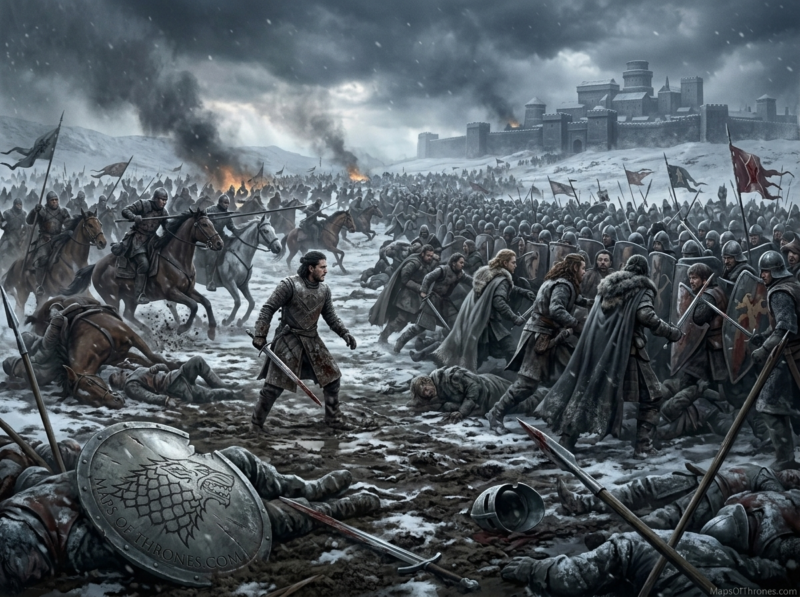
The Battle of the Bastards was fought in 300 AC on the fields south of Winterfell in the North of Westeros. It pitted Jon Snow‘s outnumbered Stark-aligned coalition — comprising Free Folk, House Mormont, and other northern loyalists — against Ramsay Bolton‘s larger, disciplined Bolton host. After Jon’s forces were nearly annihilated in a deadly encirclement, the timely arrival of Sansa Stark‘s secret alliance with Petyr Baelish and the Knights of the Vale shattered the Bolton lines. Ramsay Bolton fled into Winterfell and was subsequently executed by Sansa. The result was a decisive Stark–Vale victory, restoring House Stark’s control over Winterfell and the North.
The Battle That Reclaimed the North
Few engagements in the long and blood-soaked history of the War of the Five Kings compressed so much desperation, tactical horror, and redemptive fury into a single afternoon as the Battle of the Bastards. Fought across the frost-hardened fields south of Winterfell, the clash was not merely a contest of arms — it was a reckoning between two bastards whose claims to the North defined everything that remained of the Stark legacy.
Jon Snow, legitimized son of Eddard Stark and resurrected Lord Commander of the Night’s Watch turned rallying figure of northern resistance, arrived at the field with a coalition that was fractured from the outset. The Free Folk, hardened by years beyond the Wall but unaccustomed to pitched southern warfare; the small but fiercely loyal soldiers of House Mormont; and a scattering of men from Houses loyal enough to risk Ramsay’s reprisals. Against him stood Ramsay Bolton — Lord of Winterfell by the grace of a murdered father — commanding a seasoned force of Bolton soldiery, supported by House Umber and the armored infantry that had crushed the Ironborn and pacified the North for years.
The battle’s significance reaches far beyond its tactical outcome. It marked the end of House Bolton’s dominion over the North, reversed the catastrophic legacy of the Red Wedding, and restored Stark hegemony to Winterfell for the first time since Theon Greyjoy’s seizure in 299 AC. Strategically, it also demonstrated the decisive power of cavalry reserve and the irreversible cost of emotional command decisions in the face of a calculating enemy.
Battlefield Map: Dispositions at Dawn
Center (6,000)
(Umber)
Flank
(~2,000)
the Vale
Key Participants & Factions
Battle of the Bastards: Full Breakdown
The strategic situation before the first arrow was loosed was already dire for House Stark. Ramsay Bolton commanded an estimated 6,000 trained soldiers — veterans of northern campaigns against Ironborn and rebellious lords — supported by the heavy infantry of House Karstark and the fierce spearmen of House Umber. His cavalry arm was substantial; his flanking discipline was evident in how he deployed his forces.
Jon Snow’s coalition numbered roughly 2,000: the Free Folk formed the bulk, supplemented by a few hundred men from scattered northern houses and the 62 Mormont soldiers. Davos Seaworth, the sober tactical mind of the coalition, counseled patience and a defensive posture — drawing Bolton into an assault against a fortified line. Jon refused to be fully drawn into that strategy, a decision whose consequences would define the battle’s first two phases.
The night before battle, Ramsay revealed his trump card: Rickon Stark, the youngest Stark heir, held captive since being delivered by Smalljon Umber. His presence guaranteed an emotional provocation Jon could not resist.
Ramsay opened the engagement with pure psychological warfare. He released Rickon Stark across the open field — an apparent act of mercy that was, in fact, a precision trap. As Rickon sprinted toward Jon’s lines and Jon rode forward to intercept him, Ramsay’s archers systematically adjusted their aim, finally cutting Rickon down with a final arrow seconds before Jon could reach him.
The murder of Rickon Stark shattered Jon’s calculated composure. He wheeled his horse and charged headlong toward the Bolton line alone — the single most dangerous position on the battlefield. The Bolton cavalry counter-charged. Jon’s command structure fell apart as his own cavalry scrambled forward to support him before Davos could organize a proper advance.
What should have been a deliberate, coordinated assault became a disordered cavalry melee played entirely on Ramsay’s terms, in ground of Ramsay’s choosing.
With Jon’s forces disordered and the cavalry melee spent, Ramsay executed a pre-planned tactical maneuver of considerable sophistication: a double-wing encirclement. Bolton infantry marched in disciplined formations on both flanks, while a phalanx of shields and pikes — soldiers locked in an overlapping shield wall reinforced with inward-facing spear points — closed in from behind, completing the encirclement.
The effect was catastrophic. Jon’s men were compressed into an ever-shrinking killing ground, forced to climb over their own dead. Archers on the Bolton flanks poured arrows into the mass with impunity. The pile of corpses grew so high that soldiers fought for footing on the bodies beneath them. For several minutes, the complete annihilation of the Stark coalition appeared not merely likely but inevitable.
Tormund’s Free Folk and Jon’s surviving fighters were suffocating under the weight of the Bolton press. Only the ferocious close-quarters savagery of the Free Folk — bred for brutal survival in conditions far worse than this — delayed final collapse.
The battle’s entire calculus inverted in the span of minutes when the thunder of hooves announced the Knights of the Vale. Sansa Stark had written to Petyr Baelish without Jon’s knowledge, having been deliberately excluded from the pre-battle council that dismissed any hope of reinforcement. The Vale cavalry — heavily armored, rested, and numbering in the thousands — struck the Bolton encirclement from the rear and flanks with overwhelming force.
Ramsay’s pike formation, designed to contain infantry from the front, was completely unprepared for a cavalry charge from its exterior. The disciplined Bolton shield wall that had been an impenetrable trap from the inside became a death trap for its own soldiers as Vale lancers crashed through formation after formation. The encirclement collapsed with stunning speed.
Ramsay Bolton — suddenly commanding a broken army — retreated into the walls of Winterfell, apparently believing the castle’s walls would hold.
The final act of the Battle of the Bastards was not fought on the open plain but against Winterfell’s ancient gates. With Ramsay sealed inside and his army shattered behind him, Jon’s forces faced a castle that could not be taken by his exhausted remnant in any conventional way.
Wun Wun solved the problem. The last giant, already grievously wounded by dozens of arrows throughout the battle, drove himself through Winterfell’s gates in a supreme final act of force — tearing open a breach that Jon’s fighters poured through. Wun Wun collapsed inside the courtyard, barely alive. Ramsay fired a final, personal arrow through the giant’s eye, killing him.
Jon Snow then beat Ramsay Bolton bare-handed into the ground before stopping — stopping himself from killing Ramsay outright, recognizing that the execution belonged to Sansa. Hours later, in Winterfell’s kennels, Sansa Stark fed Ramsay to his own starving hounds. The Bolton line ended there.
The immediate aftermath reestablished House Stark’s dominion over the North for the first time since Theon Greyjoy’s seizure in 299 AC and the subsequent Bolton occupation. Jon Snow was declared King in the North at a council of northern lords — a title last held by Robb Stark — fulfilling a symbolic restoration that the Red Wedding had seemingly made impossible.
The political debt incurred to the Vale of Arryn, however, was significant. Petyr Baelish had not acted out of charity. His price — Sansa’s political favor, and ultimately his own ambitions within northern politics — created complications that would haunt the Stark restoration throughout the following season. Nonetheless, strategically, the North was secured. Jon’s attention could turn, at last, to the existential threat beyond the Wall that none of the political maneuvering south of it had addressed: the Night King and his advancing dead.
Casualties on both sides were catastrophic. Jon’s Free Folk contingent suffered enormous losses. The Bolton host was effectively destroyed as a fighting force — the proud military machine that had broken the Stark army at the Red Wedding ceased to exist as a cohesive entity.
Battle of the Bastards — Reference Table
| Force | Commander | Strength | Casualties | Objective | Outcome | Significance |
|---|---|---|---|---|---|---|
| Bolton Host | Ramsay Bolton | ~6,000 | Catastrophic — force destroyed | Destroy Jon’s coalition; hold the North | Defeat; Ramsay executed | End of House Bolton’s political power |
| House Umber infantry | Smalljon Umber | ~500–1,000 | Very heavy; Smalljon killed | Anchor Bolton right flank | Destroyed by Vale cavalry | Loss of a key Bolton vassal house |
| House Karstark | Harald Karstark | ~400–600 | Heavy | Reinforce Bolton left | Routed | Karstarks’ betrayal of Stark legacy confirmed |
| Jon Snow’s Coalition | Jon Snow / Davos Seaworth | ~2,000 | Severe; near-annihilation pre-Vale | Retake Winterfell; save Rickon | Victory; Winterfell reclaimed | Restoration of Stark rule in the North |
| Free Folk | Tormund Giantsbane | ~1,500+ | Devastating | Form primary assault force | Survived; victory | Permanent integration of Free Folk with northern forces |
| Knights of the Vale | Petyr Baelish / Sansa Stark (political) | ~2,000 cavalry | Minimal | Relief of encircled Stark forces | Decisive victory; Bolton encirclement shattered | Single most decisive action of the battle |
| Wun Wun (giant) | Independent | 1 (giant) | Killed (castle breach) | Breach Winterfell gates | Gates breached; died of wounds | Last giant in the known world; death mourned by Free Folk |
Battle of the Bastards — FAQ
House Stark and the Knights of the Vale won the Battle of the Bastards. Jon Snow’s coalition, on the verge of total destruction, was rescued by the timely arrival of the Vale cavalry — secured in secret by Sansa Stark. The Bolton army was destroyed, Ramsay Bolton fled into Winterfell, and was subsequently captured and executed by Sansa. Winterfell was restored to House Stark.
The Battle of the Bastards took place in 300 AC, during the closing period of the War of the Five Kings. In television terms, it was depicted in Season 6, Episode 9 (“Battle of the Bastards”) of Game of Thrones. The battle occurred on the open plain south of Winterfell in the North.
Jon nearly lost because he was emotionally manipulated into abandoning his defensive strategy. Ramsay Bolton deliberately used Rickon Stark as bait, executing him in plain view to provoke Jon into a solo charge — which triggered a disordered cavalry engagement on Ramsay’s terms. Ramsay then executed a pre-planned double-envelopment, surrounding Jon’s forces with pike and shield infantry. Without Sansa’s secret Vale cavalry, the encirclement would have been fatal.
Sansa Stark was the decisive strategic actor of the battle despite not fighting on the field. She secretly contacted Petyr Baelish and secured the Knights of the Vale as a relief force — without telling Jon, who had excluded her from battle planning. The Vale cavalry arrived at the critical moment of encirclement and shattered the Bolton lines. Sansa also personally executed Ramsay Bolton afterward, feeding him to his own hounds.
Tactically, yes — Ramsay executed one of the most sophisticated battlefield maneuvers in the series. His psychological manipulation of Jon, the Rickon bait gambit, and the double-envelopment encirclement were all deliberate and effective. He correctly identified Jon’s emotional vulnerability and exploited it to near-total effect. He only lost because of an intelligence failure: he did not know about the Vale cavalry. That single unknown made his victory impossible.
Wun Wun, the last known giant, was killed at Winterfell after breaching its gates. Throughout the battle he absorbed hundreds of arrows and still fought effectively, but after shattering the castle gates to allow Jon’s forces entry, he collapsed in the courtyard. Ramsay Bolton shot a final arrow through Wun Wun’s eye, killing him — an act that provoked Jon to beat Ramsay senseless immediately afterward.
The Battle of the Bastards ended Bolton rule over the North and restored Winterfell to House Stark. Jon Snow was subsequently proclaimed King in the North by the assembled northern lords. The Free Folk were formally integrated as northern allies. House Umber and House Karstark, having supported Bolton, faced consequences under Stark rule. Politically, it also created a significant debt to the Vale of Arryn and Petyr Baelish — a complication Jon and Sansa would navigate with difficulty thereafter.
Related Pages & Lore Connections
Every battle. Every house. Every turning point in the history of Westeros and beyond.