House Bolton
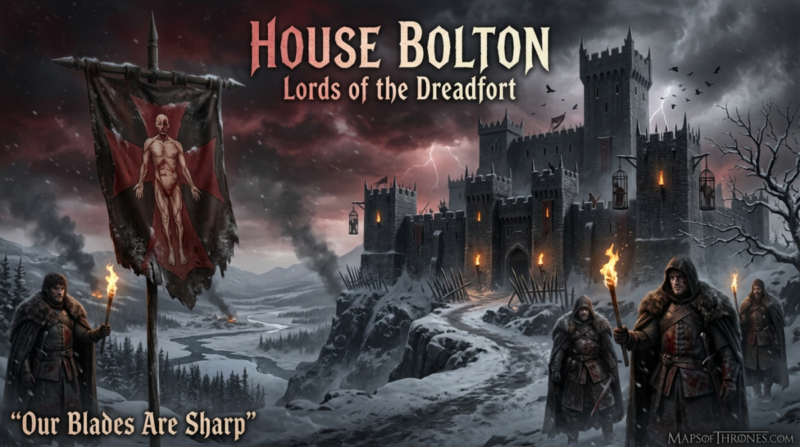
Lords of the Dreadfort. Flayers of Men. The North’s most feared house — eight centuries of calculated cruelty, patient ambition, and blades that never stayed clean.
House Bolton is the most feared vassal house of the North, ruling from the grim fortress of the Dreadfort on the banks of the Weeping Water. Their sigil — a flayed man, red on pink — reflects their ancient and notorious practice of skinning enemies alive. Their words, Our Blades Are Sharp, are one of the most overtly threatening house mottos in all of Westeros. Though sworn bannermen to House Stark for millennia, the Boltons harbored a long tradition of rivalry and resentment that culminated in Roose Bolton’s betrayal at the Red Wedding — briefly making them Wardens of the North before their utter extinction at the Battle of the Bastards.
The Most Feared House Bolton in the North
In a land defined by stoic endurance and iron loyalty, House Bolton carved its identity from something altogether darker: the deliberate cultivation of terror. Where House Stark offered protection, House Bolton offered a warning. Their ancient seat, the Dreadfort, rises from the eastern banks of the Weeping Water like a monument to everything the North’s other houses quietly despise — and secretly fear.
The Boltons are First Men, as old as the Starks themselves. Their history stretches back into the Age of Heroes, and their tradition of flaying enemies predates the Andal invasion. For centuries, they styled themselves Kings of the Dreadfort and warred openly against the Starks for dominance of the North. The last of these wars ended when a Bolton king surrendered and bent the knee — though historians debate whether that submission was ever genuine, or merely a tactical pause in a rivalry eight millennia long.
On the map of Westeros, the Dreadfort’s position is deliberately significant. It sits northeast of Winterfell and west of the eastern coast, close enough to the Stark heartland to threaten, yet far enough north to be logistically difficult to besiege. Bolton territory controls access to the eastern interior of the North — a region that includes rich hunting grounds, the Weeping Water river system, and the remote approach roads to the Wall’s eastern flanking positions.
What made House Bolton existentially dangerous was never mere military strength — they were a vassal house, after all, and the Starks commanded far greater numbers. Their power lay in patience and psychological warfare. The flayed man on their banner was a calculated communication: we have done this before, and we will do it again. It worked. Northern lords who might defy the Starks openly would hesitate before crossing a Bolton, knowing what the alternative looked like.
The arrival of Ramsay Snow — later Ramsay Bolton — transformed this ancient tension into something more volatile. Where Roose Bolton was calculating and cold, Ramsay was uncontrolled savagery given lordly power. His treatment of Theon Greyjoy, his hunting of women for sport, his marriage to Sansa Stark as a political chess piece: each act compounded the family’s infamy while simultaneously overextending their political capital. In the end, the Boltons fell not to a superior army but to the consequences of their own nature — enemies united by a shared hatred only true monsters can inspire.
The Dreadfort & Bolton Territories in the North
From the Weeping Water to Winterfell’s shadow — the strategic geography of House Bolton’s domain, and why it made them the most dangerous vassals in the North.
House Bolton — Members & Key Actors in Their Story
From the cold pragmatism of Roose to the unhinged cruelty of Ramsay — the men and women whose fates intertwined with the Bolton name.
Roose Bolton
A man of eerie calm and lethal calculation, Roose Bolton served Robb Stark loyally enough to be trusted as a field commander — then drove a blade through him at the Red Wedding. His rule of the North was efficient and brutal. He died as he lived: by a sharper blade, wielded by his own son.
Read Roose’s full profileRamsay Bolton (Snow)
Born a bastard to Roose and a miller’s wife, Ramsay was legitimized after demonstrating a talent for cruelty that even his father found useful. He became the show’s most viscerally terrifying antagonist — not for power, but for what he enjoyed doing with it. He fell to the hounds he had starved, in the very castle he had stolen.
Read Ramsay’s full profileDomeric Bolton
Roose’s trueborn son from a previous marriage, Domeric was by all accounts a man of education and honor — trained as a knight, a skilled musician, cultured by Bolton standards. He died mysteriously after seeking out his bastard half-brother Ramsay, whom Roose all but directly blamed for the death. Had Domeric lived, the Bolton story might have ended very differently.
Read Domeric’s profileWalda Frey Bolton
Roose Bolton’s fourth wife and a granddaughter of Walder Frey, Walda represented the political glue between two of Westeros’s most infamous betrayals. Her marriage sealed the Frey-Bolton axis that made the Red Wedding possible. She died along with her newborn son — murdered by Ramsay to eliminate potential rivals to his lordship.
Read Walda’s profileTheon Greyjoy
Not a Bolton by blood, but no story of House Bolton is complete without Theon — the Ironborn ward of Winterfell who took the castle from Bran Stark, and paid for it in ways too terrible to catalogue. Ramsay’s systematic dismantling of Theon’s identity into “Reek” stands as the purest expression of Bolton psychology: the complete destruction of selfhood.
Read Theon’s full arcSansa Stark
Forced into marriage with Ramsay Bolton as a political maneuver by Littlefinger, Sansa’s time at Winterfell under Bolton rule was her darkest chapter — and the crucible that forged her political instincts into steel. Her escape, her rally of Vale forces, and her orchestration of Ramsay’s end defined her as the North’s true strategic mind.
Read Sansa’s full profileJon Snow
The man who ended the Bolton reign. Jon’s retaking of Winterfell at the Battle of the Bastards — vastly outnumbered until the Knights of the Vale arrived — is the moment House Bolton’s arc was definitively closed. His subsequent beating of Ramsay in the snow is one of the series’ most cathartic sequences.
Read Jon’s full profileLocke
The most capable of Roose Bolton’s military agents, Locke was tasked with eliminating Stark loyalists and ultimately tracking down the surviving Stark children. He captured Jaime Lannister and Brienne of Tarth, costing Jaime his sword hand. A hunter by nature, he was killed by a Bran-warged Hodor before completing his mission.
Read Locke’s profileHarald Karstark
After Robb Stark executed his father Rickard Karstark for treason, House Karstark defected to the Boltons — bringing the fighting men of Karhold to Ramsay’s banner. Harald Karstark fought for the Boltons at the Battle of the Bastards, his allegiance a direct consequence of Robb Stark’s rigidly honorable decision to honor justice over military pragmatism.
Read Harald’s profilePolitical, Geographic, Cultural & Strategic Analysis of House Bolton
Understanding the Boltons requires looking beyond their cruelty to see the cold system of power beneath it.
Alliances & Betrayals
House Bolton’s political playbook was long-game patience. For centuries they served the Starks while quietly maintaining their own network of loyalties. The Red Wedding alliance with House Frey and House Lannister was not impulsive — Roose had been preparing his exit from Robb’s war for months, reading the signs of inevitable Stark defeat.
- House Frey
- House Lannister
- House Karstark
- House Umber (briefly)
- Tywin Lannister (deal)
- King Joffrey (reward)
Territory & Terrain
The Dreadfort’s eastern position gave the Boltons control of the North’s most defensible interior approaches. The Weeping Water river system served as a natural boundary, and the surrounding forests provided both resources and barriers to rapid military response from Winterfell.
- The Dreadfort
- Weeping Water
- Eastern Interior Forests
- Winterfell (occupied)
- Barrowton (vassal)
- Hornwood Lands
Tradition of Terror
Flaying is not mere cruelty in Bolton culture — it is a ritual assertion of dominance. The practice predates written Westerosi history, and the Boltons maintained it even after the Targaryens demanded its formal abandonment. Their pink-and-red heraldry is a deliberate aesthetic choice: they want you to think of what the colors represent.
- The Art of Flaying
- Old Gods (nominal)
- Pink Flag Tradition
- Psychological Warfare
- Reek (Broken Identity)
- Bolton Family Motto
Military Logic & Downfall
The Boltons’ military strategy at the Battle of the Bastards was textbook — encirclement, superior numbers, patience. It nearly worked. What undid them was Sansa Stark’s secret alliance with the Knights of the Vale, a variable Ramsay’s arrogance had made him incapable of anticipating. They won every tactical calculation and lost the strategic one that mattered.
- Battle of the Bastards
- Spearman Encirclement
- Dreadfort Garrison
- Vale Alliance (enemy)
- Winterfell Occupation
- Red Wedding Stratagem
Key Locations & Events in House Bolton’s History
A structured reference of Bolton-linked sites and pivotal moments — for quick lookup, research, and geographic orientation.
| Location / Event | Type | Position | Known For | Importance |
|---|---|---|---|---|
| The Dreadfort | Castle / Seat | Eastern North | Ancestral Bolton seat; site of flaying chambers; Theon Greyjoy’s imprisonment | Critical |
| The Red Wedding | Massacre / Event | The Twins, the Riverlands | Bolton-Frey betrayal of Robb Stark; annihilation of Northern army; Roose kills Robb | Critical |
| Winterfell (occupied) | Castle / Seat | Central North | Briefly ruled by Ramsay Bolton after Red Wedding; site of Battle of the Bastards | Critical |
| Battle of the Bastards | Battle / Event | Winterfell, the North | Jon Snow vs Ramsay Bolton; Bolton military defeat; end of House Bolton’s rule | Critical |
| Weeping Water | River | Eastern North | Primary waterway of Bolton territory; natural defensive boundary | High |
| Hornwood Lands | Territory | North-Central | Seized by Ramsay after the death of Lord Hornwood; key land grab expanding Bolton power | High |
| Karhold | Castle | Eastern North | Seat of House Karstark; Bolton allies after Robb Stark executed Rickard Karstark | High |
| The Flaying Grounds | Cultural Site | Dreadfort territory | Traditional execution grounds for Bolton enemies; site of the practice that defines their sigil | Notable |
Frequently Asked Questions About House Bolton
Direct answers to the most searched queries about House Bolton, the Dreadfort, Roose, and Ramsay in Game of Thrones and ASOIAF.
What is House Bolton’s sigil and words?
House Bolton’s sigil is a flayed man, red on pink — one of the most viscerally disturbing in all of Westeros, directly referencing their ancient practice of skinning enemies alive. Their words are “Our Blades Are Sharp” — a threat, not a boast. Unlike most house mottos that speak to virtue or glory, Bolton words are purely predatory in tone.
Where is the Dreadfort on the map of Westeros?
The Dreadfort is located in the eastern interior of the North, on the banks of the Weeping Water river. It sits northeast of Winterfell — close enough to be within striking distance of Stark territory, but far enough to mount a serious defense. On the map of Westeros, it is one of the North’s largest fortresses after Winterfell itself.
Why did Roose Bolton betray Robb Stark?
Roose Bolton betrayed Robb Stark at the Red Wedding because he calculated that the Stark cause was unwinnable. He struck a private deal with Tywin Lannister — delivering Robb’s death and the destruction of the Northern army in exchange for being named Warden of the North. It was not impulsive treachery but a long-meditated survival calculation. Roose Bolton did not betray out of hatred; he betrayed out of arithmetic.
Is Ramsay Bolton the worst villain in Game of Thrones?
Ramsay Bolton is widely considered among the most viscerally horrifying antagonists in Game of Thrones, in part because his cruelty lacks political calculation — he does what he does for pleasure. Cersei Lannister schemes; Joffrey Baratheon postures; Ramsay hunts. Actor Iwan Rheon’s performance won widespread critical acclaim for making Ramsay terrifying without relying on supernatural elements. His death — fed to his own starved hounds — is one of the series’ most deliberately satisfying endings.
How did House Bolton end in Game of Thrones?
House Bolton ends in Season 6. Ramsay kills Roose in Episode 2 after learning Walda Frey has given birth to a son. Ramsay then feeds Walda and the infant to his hounds. Ramsay himself is defeated at the Battle of the Bastards in Episode 9, then locked in a kennel and killed by his own starved dogs — released by Sansa Stark. With no surviving heirs, House Bolton is extinguished.
Did the Boltons ever rule the North independently?
Yes — in ancient history. Before Aegon’s Conquest, the Boltons styled themselves Kings of the Dreadfort and fought the Starks for dominance of the North. They were eventually defeated and bent the knee, becoming the most powerful vassal family under Stark rule. The Red Wedding effectively made them kings of the North in all but name — until the Battle of the Bastards ended that brief reign.
What is the practice of flaying associated with House Bolton?
Flaying — removing a person’s skin while alive — is the Bolton family’s most notorious tradition and the source of their sigil. It predates the Andal invasion and was practiced by Bolton kings as a weapon of psychological terror against enemies and subject populations. The Targaryens formally demanded the Boltons cease the practice. The Boltons publicly agreed; the tradition continued privately. In the show, Ramsay personally flays characters including Theon Greyjoy.
What happened to the Dreadfort after House Bolton’s extinction?
The show does not explicitly address the Dreadfort’s fate after the Battle of the Bastards. In the books, the castle is still standing and its future ownership is an open question. Theorists suggest House Stark would either claim it directly, grant it to a loyal vassal house, or demolish it — given its psychological significance as a symbol of betrayal and oppression in the North’s memory.
Continue Exploring
The North holds more than one dark secret. Every castle, every betrayal, every house — mapped and chronicled for those who study the geography of power in the world of ice and fire.