House Targaryen
Dragon Lords of Old Valyria. Conquerors of the Seven Kingdoms. Masters of the Iron Throne. The blood of the dragon runs through their veins — and with it, the twin flames of greatness and madness.
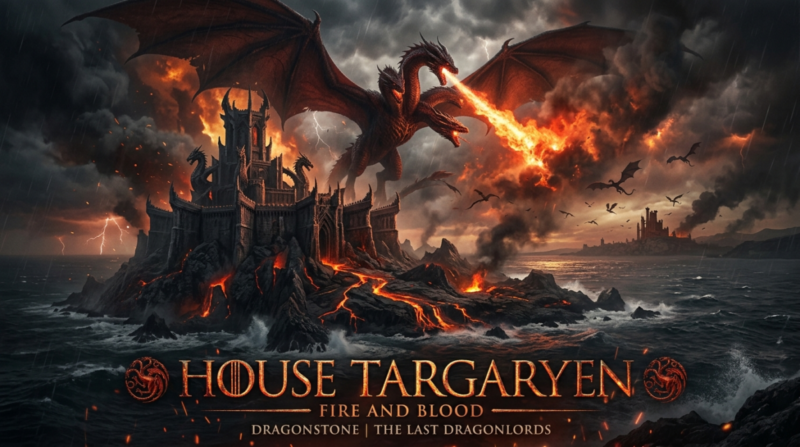
House Targaryen is a noble house of dragonlords descended from the ancient Valyrian Freehold. They survived the Doom of Valyria in 114 BC by retreating to their island fortress of Dragonstone. In 2 BC, Aegon the Conqueror and his sister-wives Visenya and Rhaenys launched their conquest of Westeros, forging six of the Seven Kingdoms into one realm with dragon fire. The Targaryens ruled as kings of Westeros for nearly three centuries until the Mad King Aerys II was overthrown in Robert’s Rebellion (283 AC). Their words are Fire and Blood. Their sigil: a three-headed red dragon on a field of black.
Origins & Identity
House Targaryen stands apart from every other noble house in Westeros — not merely in power or lineage, but in nature. They are not simply conquerors who happened to have dragons. They are dragonlords, heirs to a Valyrian magical tradition that bound human and dragon through blood, dream, and fire. When the Valyrian Freehold was annihilated in the catastrophic Doom of 114 BC, only the Targaryens survived — already removed to their island redoubt of Dragonstone at the mouth of Blackwater Bay.
For over a century they watched the world fracture. Then, in 2 BC, Aegon Targaryen — riding the dragon Balerion the Black Dread, the largest dragon the world had ever seen — landed on the eastern shore of Westeros with two sister-wives and two more dragons. Six of the Seven Kingdoms fell. Only Dorne resisted through guerrilla warfare and the murder of Queen Rhaenys. Aegon forged the conquered swords of his enemies into the Iron Throne — a seat that cuts its occupants, designed to remind kings that rule is no true comfort.
The Targaryen dynasty that followed was one of the most consequential in the history of the Known World: brilliant builders, terrible destroyers, visionaries and lunatics, often simultaneously. Their practice of incest — wedding brother to sister, generation after generation — preserved the dragonriding gene but at a psychological cost that would eventually doom the line. “The gods flip a coin,” as the saying goes. “Targaryen madness or Targaryen greatness.”
Targaryen Geographic Footprint
House Targaryen — Notable Members
From conquerors and dreamers to madmen and mothers of dragons — the defining Targaryens of Westerosi history.
Rider of Balerion the Black Dread. Unified six kingdoms by conquest and one by treaty. Founded King’s Landing and had the Iron Throne forged from the swords of his enemies. The Targaryen dynasty begins with him.
Explore Aegon IBorn in exile on Dragonstone, she hatched three dragons from petrified eggs, freed the cities of Slaver’s Bay, and eventually invaded Westeros. Her conquest was undone by her own fire — and her grief.
Explore DaenerysNamed her father’s heir before the Dance of Dragons tore the dynasty apart. Rider of Syrax. Her claim against the Hightower faction ignited the bloodiest Targaryen civil war — and cost the family its dragons.
Explore RhaenyraHis paranoia and pyromaniac obsession with wildfire destroyed his court, alienated his greatest allies, and sparked Robert’s Rebellion. Slain by his own Kingsguard — Jaime Lannister — in the throne room.
Explore Aerys IIReigned during the last era of Targaryen peace. His failure to resolve the succession between Rhaenyra and Aegon II after his death planted the seeds for the Dance of Dragons and the doom of dragon-kind.
Explore Viserys IBorn Aegon Targaryen — son of Rhaegar and Lyanna Stark — he grew up believing himself a bastard of Winterfell. His legitimate claim made him the rightful king, and the greatest threat to Daenerys’s reign.
Explore Jon SnowMelancholic, brilliant, and catastrophically misunderstood. His secret marriage to Lyanna Stark — and the political fallout it triggered — set in motion the events that ended Targaryen rule forever.
Explore RhaegarRidden by Aegon the Conqueror. His fire melted the walls of Harrenhal into slag. His skull — massive as a small building — sat in the Red Keep’s catacombs for generations as a reminder of Targaryen supremacy.
Explore BalerionWitnessed his mother Rhaenyra’s death as a child and grew to despise dragons — even as the last of them died during his reign. Ruled a kingdom broken by civil war, presiding over the slow extinction of his family’s greatest weapon.
Explore Aegon IIIThe Targaryen World — By Cluster
King’s Landing
The capital city built by Aegon on the Blackwater Rush. Home of the Red Keep, the Iron Throne, and the Dragonpit. The seat of Targaryen power for nearly three centuries.
Dragonstone
The ancestral island fortress. Valyrian-built, dragon-carved, and soaked in magic. First Targaryen stronghold in Westeros and last redoubt of the dynasty in exile.
The Small Council
The ruling administrative body of the Seven Kingdoms, answerable to the Targaryen monarch. Its composition — Hands, Maesters, commanders — reflects who holds true power at court.
The Red Keep
The Targaryen royal palace on Aegon’s High Hill. Contains the Iron Throne room, the Small Council chamber, and the catacombs where dragon skulls are kept.
The Crownlands
The territory directly ruled by the Iron Throne, surrounding King’s Landing and Dragonstone. The heartland of Targaryen political authority after Aegon’s Conquest.
Old Valyria
The shattered peninsula of Essos from which House Targaryen sprang. Destroyed in the Doom of 114 BC, it remains a haunted ruin — the source of Valyrian steel and dragon magic.
Blackwater Bay
The strategic body of water separating Dragonstone from the mainland. Scene of the Battle of the Blackwater — the pivotal naval engagement that saved Joffrey’s throne.
Slaver’s Bay / Dragon’s Bay
The Essos region where Daenerys raised her armies, freed enslaved populations, and ruled from Meereen’s Great Pyramid before sailing for Westeros.
The Dragonpit
A vast domed structure on Visenya’s Hill in King’s Landing, built to house the Targaryen dragons. As the dragons grew smaller and less healthy in captivity, the Targaryens’ political power diminished in parallel.
The Dance of Dragons
The catastrophic Targaryen civil war of 129–131 AC. Rhaenyra vs. Aegon II. Dragon vs. dragon. By its end, nearly all Targaryen dragons were dead — and the dynasty never fully recovered.
Valyrian Steel & Magic
Targaryen bloodlines retained a hereditary connection to dragons and to the magical traditions of Old Valyria — including prophetic dreams. Many key Targaryens, including Daenys the Dreamer, used these gifts to escape catastrophe.
Aegon’s Conquest
The military campaign that united the Seven Kingdoms beginning in 2 BC. The Field of Fire — where Aegon’s three dragons killed four thousand men — became the defining moment of Targaryen military supremacy.
House Targaryen — Reference Table
| Name | Type | Era / Period | Known For | Significance |
|---|---|---|---|---|
| Dragonstone | Stronghold | Pre-Conquest onward | Targaryen ancestral seat; Valyrian construction | High — staging point for all Targaryen power plays |
| Aegon I (Conqueror) | King / Dragonlord | 2 BC – 37 AC | Unification of Westeros; Iron Throne; King’s Landing | Foundational — created the political order of the realm |
| Balerion the Black Dread | Dragon | Pre-Doom – 94 AC | Largest dragon ever recorded; melted Harrenhal | Supreme — symbol of Targaryen dominance |
| Dance of Dragons | Civil War | 129–131 AC | Dragon extinction; Targaryen dynastic fracture | Critical — permanently weakened the dynasty |
| Aerys II (Mad King) | King | 262–283 AC | Wildfire caches; Robert’s Rebellion; death of Starks | High — catalyzed the end of Targaryen rule |
| Daenerys Targaryen | Queen / Dragonlord | 284–305 AC | Three dragons; liberation of Slaver’s Bay; King’s Landing | Pivotal — final act of the Targaryen story |
| Old Valyria | Ruined City-State | Destroyed 114 BC | Origin of Targaryen bloodline; Doom of Valyria | Foundational — source of all dragonlord power |
| Jon Snow (Aegon VI) | Prince / Lord Commander | 281–305+ AC | True Targaryen heir; Battle for the Dawn; slayer of Daenerys | High — final chapter of the main Targaryen line |
House Targaryen — Frequently Asked Questions
Explore the Targaryen Topology
Fire & Blood Awaits
The Known World is vast. Explore every dragon, castle, kingdom, and conquest — mapped, annotated, and told through the lens of lore.