
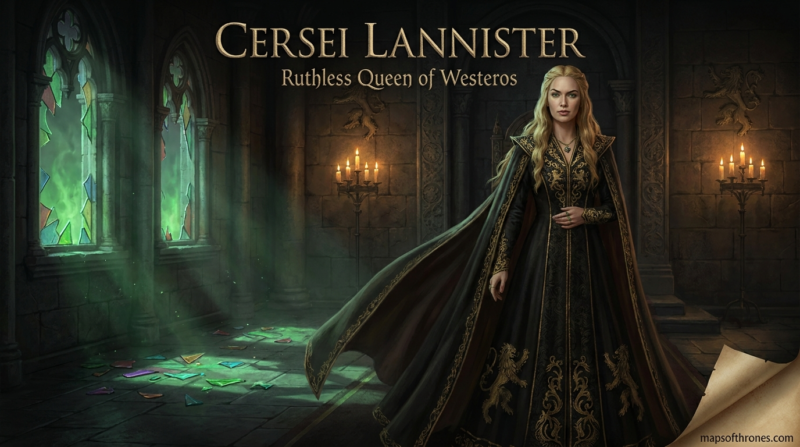
Cersei Lannister — Game of Thrones
Queen Consort of the Seven Kingdoms · Queen Regent · Queen of the Seven Kingdoms
House LannisterCharacter & Actor Data
Character Data
Neutral Evil rather than Lawful Evil because Cersei’s loyalty is to outcomes, not to institutions — she overthrows the Faith Militant she armed, dismantles Small Councils she built, and abandons laws whenever they stop serving her. The distinction matters because Lawful Evil characters are ultimately constrained by their own systems; Cersei’s deepest horror is that she constructs rules precisely so she can break them, which makes her far more dangerous and far more alone.
Actor Data
Character Overview
Cersei Lannister is not a villain who became cruel. She is someone who understood the game earlier and more completely than almost anyone else in the show — and whose primary failure was that she trusted the game more than she trusted people, including herself. Her fundamental contradiction is this: she was one of the most politically intelligent people in Westeros, raised in a world that refused to let her use that intelligence except through men, and her entire arc is a study in what happens when a brilliant strategist has to spend all of her energy circumventing the system rather than operating within it.
The tragedy is real and it lands. Her children are her only uncalculated love, and the prophecy of their deaths — delivered to her as a child by a woods witch — becomes the psychological engine for every decision she makes. She does not murder, manipulate, and endure because she is evil by nature. She does these things because she has decided, correctly, that the world will destroy her children unless she destroys it first.
Where the arc succeeds is in Seasons 1 through 6, particularly in the extraordinary Season 6 turn: the wildfire sequence that ends with her sitting the Iron Throne, alone and victorious, the show’s most purely ruthless protagonist at that moment. Where it fails is in Seasons 7 and 8, when the writers stripped her of agency to make her a narrative obstacle rather than a character. She spends her final season staring out windows. She is reduced to a set piece. A character who deserved to burn down the world on her own terms is killed by falling rocks — an ending the writers perhaps intended as ironic, but which reads more like abandonment.
Who Is Cersei Lannister in Game of Thrones?
Cersei Lannister is the eldest child of Tywin Lannister, Queen Consort to Robert Baratheon, and eventually self-proclaimed Queen of the Seven Kingdoms in HBO’s Game of Thrones. Born into the wealthiest house in Westeros, she spends eight seasons fighting for power in a system designed to deny it to her, using manipulation, wildfire, and ruthless political intelligence to outlast nearly every rival. Her arc is the show’s most sustained portrait of what ambition becomes when it has nowhere constructive to go. She is portrayed by Lena Headey across all eight seasons (2011–2019).
First appearance: S1E1 — “Winter Is Coming”Cersei Lannister’s Skills, Abilities & Political Arsenal — Complete Analysis
Cersei has no meaningful combat skills and the show never pretends otherwise — which is itself significant. She compensates through the Mountain (Ser Gregor Clegane) as personal weapon and the entire city of King’s Landing as a defensive instrument. Her “combat” is architectural: she deploys wildfire beneath streets, positions armies at gates, and uses Qyburn’s necromancy to create an unkillable bodyguard. The closest she comes to violence herself is threatening to have people executed, and even then she relies on others to hold the sword.
Best moment: The wildfire sequence in the Season 6 finale — she does not fight; she simply makes fighting irrelevant.
Failure: Her inability to personally act in a crisis means that when her information networks and proxies fail her in Season 8, she has nothing left.
This is Cersei’s extraordinary skill, and the show earns it. She reads people’s desires with clinical precision and deploys flattery, fear, and incentive in calibrated combinations. Her management of the Small Council across multiple kings is a masterclass — she eliminates advisors who become rivals, promotes loyal incompetents over talented threats, and uses marriage alliances as both reward and trap. Her arrangement of Joffrey’s betrothal to Margaery Tyrell is a good example: she understands that Margaery wants the crown more than Joffrey, and this knowledge becomes a weapon.
Best call: Arming the Faith Militant in Season 5 — a devastating play against the Tyrells, correctly predicted. Worst call: The same move, because she failed to predict that a fundamentalist religious movement cannot be controlled once empowered.
Peak: Dismantling the Tyrell-Sparrow alliance, S6Cersei understands before almost anyone else that information is the real currency in Westeros. Her network of informants and spies, later systematized by Qyburn after Varys’s removal, gives her an intelligence advantage that enables most of her political victories. She knows about Jon Arryn’s investigation before he can act on it. She knows about Ned Stark’s intentions early enough to neutralize them. The network degrades badly in Seasons 7–8, but this is a writing failure rather than a character failure — the plot required her not to know things.
Best: Exposing Ned Stark’s knowledge, S1Cersei builds alliances well in the short term and catastrophically in the long term. She correctly identifies that controlling institutions (the Gold Cloaks, the Small Council, the Faith) is more durable than controlling individuals, but she over-relies on loyalty bought with fear. Her alliance record has a structural flaw: everyone she needs eventually becomes someone she suspects, and she makes enemies of potential allies at a rate that exhausts her power base. By Season 7 she is genuinely isolated — her only real ally is Euron Greyjoy, whom she doesn’t trust and who is functionally a mercenary.
Best: Consolidating power after Joffrey’s death, S4This is arguably Cersei’s most refined weapon. She doesn’t just threaten people — she makes them complicit in their own destruction. Her conversations with Eddard Stark in Season 1, where she simultaneously warns and tests him, are a demonstration of this skill at its most precise. She can project absolute certainty even when uncertain, read the tells of interlocutors while revealing nothing herself, and frame capitulation as an act of wisdom rather than defeat. Lena Headey’s performance makes this work through micro-expression control — what Cersei withholds is always more threatening than what she says.
Best: Every scene with Ned Stark, S1Cersei’s survival through eight seasons requires some honest accounting of plot armor. She survives the Battle of the Blackwater primarily because Stannis’s assault fails for independent reasons — she deserves credit for the wildfire preparation but not for Tywin’s cavalry arriving at the crucial moment. Her survival of the Faith Militant’s imprisonment results partly from having prepared the wildfire option and partly from the High Sparrow’s strategic miscalculations. Where she genuinely earns her survival is in her psychological resilience: she does not break, ever, and the walk of shame sequence demonstrates this with striking clarity.
Earned: Walk of shame — psychological survivalAmong the show’s players, Cersei Lannister ranks as approximately the second-most effective political operator across the full run of the series, behind Littlefinger in pure tactical creativity but ahead of him in strategic patience and institutional permanence — because Cersei builds power into systems while Littlefinger builds it into himself.
Was Cersei a Hero, Villain, or Something the Show Couldn’t Name?
The strongest sympathetic case for Cersei is structural, not sentimental. She is a woman of exceptional intelligence born into a feudal patriarchy that valued her exclusively as a political marriage commodity. Her father Tywin — who claims to value competence above gender — gives his titles, his wars, and his legacy to sons who repeatedly prove themselves less capable than his daughter. Cersei sees this clearly and is never allowed to pretend otherwise. Every manipulative and violent act she commits is a workaround for a system she cannot reform. Her love for her children is the one place where her calculations entirely fail her, and it is the most human thing about her. The prophecy she receives as a child is not a character flaw — it is a life sentence handed to a ten-year-old, and watching her live inside it generates genuine sympathy.
The wildfire sequence in the Season 6 finale kills hundreds of innocent people — the High Sparrow and the Faith Militant deserve it, arguably; the Sept full of worshippers and the quarter of King’s Landing around it do not. Cersei knows this and does it anyway. She watches from a tower, drinking wine. There is no anguish, no aftermath, no reckoning — there is only the satisfaction. This cannot be excused by structural oppression. Plenty of characters in the show suffer unjust systems without committing mass murder. Her decision to allow Joffrey’s sadism to develop without meaningful correction is also damning — she is not ignorant of what he becomes, and her protective instinct repeatedly overrides the maternal duty to shape his character. The boy is monstrous partly because she raised him to be unchallengeable.
Cersei is the show’s finest example of a character whose moral condition the text is genuinely uncertain about — and that uncertainty is the point. She is not a villain the audience is meant to boo. She is not a tragic hero the audience is meant to weep for. She is a portrait of what political intelligence without ethical constraint actually looks like over a lifetime: enormously effective, deeply lonely, and ultimately self-annihilating. The fan debate over whether she is sympathetic reveals more about the audience than it does about the character. The text supports both readings. The writers, particularly in Seasons 7 and 8, stopped engaging with this ambiguity and reduced her to an obstacle. That is the real tragedy — not her death, but what the show stopped doing with her before she died.
Cersei Lannister vs. Daenerys Targaryen — Direct Comparison
| Category | Cersei | Daenerys | Winner |
|---|---|---|---|
| Political Intelligence | Institutional mastery; reads systems | Charismatic; poor at governing | Cersei |
| Combat Capability | None personal; excellent by proxy | Three dragons; overwhelming force | Daenerys |
| Alliance Building | Short-term brilliant; long-term ruinous | Broad early; collapses under pressure | Draw |
| Moral Consistency | Consistently self-interested; never surprised | Inconsistent; heel-turn poorly earned | Cersei |
| Narrative Role | Antagonist who earns it progressively | Protagonist whose turn is rushed | Cersei |
| Writing Quality of Arc | S1–S6 exceptional; S7–S8 abandoned | S1–S6 strong; S7–S8 catastrophically mishandled | Draw (both failed late) |
Cersei wins this comparison in every category except raw military power, and that asymmetry is the point. The Season 7–8 conflict between them should have been the show’s most interesting political drama — a woman who built power through institutions against a woman who built power through force. Instead the writers reduced Cersei to passivity and Daenerys to madness, collapsing both arcs in the same rushed finale. Cersei served the story better for six of eight seasons; Daenerys had a stronger early arc but was more completely betrayed by the writing in the final run.
Cersei Lannister Through Every Season
Season 1
The Architecture of Survival
Establishes Cersei as the most dangerous person in the most dangerous court in Westeros
A
Cersei meets Ned in the godswood and tells him, in essence, that in the game of thrones you either win or you die — no middle ground exists. This is not a villain’s speech. It is a genuine warning from someone who has lived inside this system for decades. It reveals that Cersei respects Ned’s honor even as she prepares to destroy him.
Cersei’s management of King Robert — keeping him drunk, keeping him occupied with hunting and tournaments, managing his rage and boredom — is never given a dedicated scene but is established through a dozen peripheral details. The show trusts the audience to understand what her domestic situation actually requires. This is the first season at its best.
Cersei attempts to broker a compromise that would spare Ned’s life — exile and taking the black. This moment is crucial and consistently missed by casual viewers. She does not want Ned dead. She wants him neutralized. The execution happens because Joffrey overrides her, and her expression as the sword falls reads as genuine horror at losing control of her creation.
Development: Season 1 Cersei gains the throne’s full power on her own terms after Robert’s death. She loses the fiction that she can manage Joffrey. Writing Grade A — every scene earns its place.
Alliances Formed: Lancel Lannister (as informant and lover). Broken: Conceptual alliance with Robert’s survival as political cover.
Season 2
The Siege of the Queen Mother
Demonstrates what genuine political siege looks like when the besieged is entirely aware of it
A
Cersei demonstrates that she has infiltrated Tyrion’s household when she has his lover — mistaking Ros for Shae — taken as leverage. The scene works because Tyrion’s horror is real, and Cersei’s cold satisfaction at having found a weakness is more frightening than any direct threat would be.
Cersei’s use of wildfire during the Battle of the Blackwater was largely pre-planned rather than improvised, and it nearly works. Her willingness to kill herself and her children rather than fall into Stannis’s hands — holding the poison vial in the throne room — is the season’s most revealing Cersei scene. The love for her children is real. The contingency planning is immediate.
During the siege, Cersei sits with Tommen and tells him dark stories while drinking wine, and the audience understands she is preparing herself to kill him if necessary. The scene is quietly horrifying without explaining itself. Season 2 trusts its audience this way consistently.
Development: Cersei loses ground to Tyrion as Hand of the King and begins to understand that her father’s return will further diminish her position. She gains nothing except proof of her own endurance. Writing Grade A.
Season 3
The Tywin Problem
Defines Cersei’s relationship with her father as her fundamental psychological trap
B
Cersei visits Tywin in his chambers to discuss intelligence about the Tyrells and is immediately outmaneuvered — he forces her to acknowledge that her information advantage is his information advantage. She leaves without having gained anything. The scene establishes that Cersei will never be her father’s equal in his own estimation, regardless of what she achieves.
Tywin’s announcement that Cersei will be married to Loras Tyrell is treated by the show as a comic scene for Tyrion and a humiliation for Cersei, and the humiliation is real. She is in her thirties, a widow, the Queen Mother — and her father is disposing of her in a political arrangement as if she were still seventeen. Her fury, expressed in perfectly controlled venom, is entirely earned.
Development: Season 3 Cersei learns that her father’s return has made her politically subordinate again. She gains clarity about the Tyrell threat. She loses the fiction that Tywin respects her. Writing Grade B — slightly less focused than S1–S2 but still character-specific.
Season 4
The Year Everything Breaks
Processes Joffrey’s death while managing the investigation into Tyrion — the season where paranoia becomes policy
A
Cersei’s grief over Joffrey is the season’s most important Cersei scene precisely because it resists being read as ambiguous. She loved this boy. She knew what he was. She loved him anyway. Her grief is not complicated — it is total, and it obliterates her political functionality for the rest of the season. The show wisely gives her this space rather than making her instantly tactical.
Cersei and Oberyn Martell meet in the gardens and discuss their children — Cersei’s Myrcella, Oberyn’s daughters — and there is a moment of genuine mutual recognition between two parents who love their children and fear for them in a hostile world. It’s the season’s most unexpected humanizing scene for Cersei, and the show earns it by not making it soft.
Cersei’s absolute refusal to accept any outcome other than Tyrion’s execution — despite knowing, on some level, that he is probably innocent — reveals something important: she does not want justice. She wants a sacrifice. Joffrey is dead; someone must pay for that. Tyrion is the most convenient candidate and the most satisfying one.
Development: Cersei loses Joffrey, loses the trial, and loses Tywin (killed by Tyrion at season’s end). She enters Season 5 as the most powerful Lannister by default. Writing Grade A.
Season 5
The Trap She Built Herself
The season Cersei’s greatest strategic success becomes her most catastrophic failure
A
This is Cersei at both her best and worst simultaneously. Arming the Faith Militant is a genuinely brilliant tactical move against the Tyrells — it gets Margaery’s brother arrested on sodomy charges, demonstrates Cersei’s piety, and simultaneously destabilizes her primary rival. The failure is that she creates a fundamentalist paramilitary force and gives it teeth before she has figured out how to pull them. The tool turns on its maker by season’s end.
When the High Sparrow arrests Cersei herself for fornication and incest — based partly on Lancel’s confession — the scene is structured as a reversal but it is really a logical conclusion. She empowered him. She handed him legitimacy. She is not trapped by an external adversary; she is trapped by the consequences of her own move.
The walk of atonement through King’s Landing — naked, head shaved, preceded by a septa ringing a bell and calling “shame” — is the series’ most brutal humiliation scene and Lena Headey’s finest performance in the role. The camera stays with her face. The face does not break. What Cersei is building, with every step, is not endurance but future violence. The audience watching understands this. The crowd does not.
Development: Cersei loses freedom, dignity, and her hair. She gains something more durable: the absolute clarity of a person who has nothing left to lose. Writing Grade A.
Season 6
The Wildfire Solution
The season Cersei burns down half a city and sits the throne — her apex and her final coherent arc
A
When Tommen bans trial by combat — eliminating the Mountain as Cersei’s champion — the scene shows Cersei processing her son making her situation worse through his religious manipulation by the High Sparrow. It is also, notably, a preview of Tommen’s suicide: he is already lost to her before the wildfire goes off.
The sequence in “The Winds of Winter” is the show at the height of its craft. Cersei does not attend her trial. She watches from the Red Keep in full armor as the Great Sept explodes in green fire. The sequence is intercut with Tommen watching from a window, removing his crown, and stepping off the ledge. Cersei’s face, when she receives the news about Tommen, closes like a door. The prophecy has been fulfilled. She sits the throne. The score drops to a single piano note.
She is crowned in full Lannister black armor with no ceremony and no audience of allies — just the court, standing in silence, watching a woman take a throne no one gave her. It is the show’s single most satisfying Cersei moment and also its most ominous. She has nothing left to protect. This is when Cersei becomes, for the first time, genuinely frightening without any specific plan.
Development: Cersei loses Myrcella (S5 end), Tommen, and the High Sparrow. She gains the Iron Throne by default. She loses, permanently, any reason to do anything except retain power. Writing Grade A — the show’s peak Cersei writing.
Season 7
The Contractor
Positioned as primary antagonist while being progressively stripped of meaningful agency
C
Cersei agrees to a truce and to sending Lannister forces north — then immediately reveals to Jaime that she lied. The idea that Cersei would agree to fight the White Walkers is absurd on its face: she has never shown interest in anything north of the Neck, and she correctly perceives that sending her armies north depletes them. The plan to let enemies destroy each other is tactically coherent. What is incoherent is that the show presents this as villainy rather than policy.
Cersei’s deal with Euron Greyjoy to bring in the Golden Company — 20,000 sellswords from Essos — is her most significant Season 7 strategic move. It is also largely a Season 8 setup that the show never properly pays off.
Development: Season 7 Cersei is mostly static — she holds position while the plot moves around her. The revelation that she is pregnant is handled ambiguously, as the show never clearly confirms whether the pregnancy is real. She loses Jaime. Writing Grade C — the character is used as a plot device more than a person.
Season 8
Reduced to Rubble
Reduced to an architectural obstacle; spends most of the season staring out windows before being killed by falling rocks
F
Cersei uses the scorpion bolts (giant crossbows) to kill Rhaegal and ambush Daenerys’s fleet. This is her last genuinely tactical moment and the last time Season 8 treats her as a player rather than a prop.
After capturing Missandei, Cersei has her executed in front of Daenerys on the walls of King’s Landing. It is a sound tactical move — breaking Daenerys’s emotional restraint is precisely the wrong thing to do, but Cersei has always bet on her enemies’ emotional responses and has usually been right. The miscalculation here is about the magnitude of the response.
Cersei and Jaime, reunited, are crushed when the Red Keep collapses. She weeps and says she does not want to die. It is intended as a humanizing moment. It lands, instead, as a diminishment — a character who burned down a cathedral full of people and sat a throne unasked dies crying while leaning on a man she spent the whole season trying to kill. There is no agency in it. There is no Cersei in it.
Development: Cersei loses Jaime, the Mountain, Qyburn, and the Golden Company in rapid succession without being given dramatic space to process any of it. She loses the throne, the war, and her life without a single meaningful choice in the final episode. Writing Grade F — the most complete writing abandonment of any major character in the series.
Cersei Lannister’s Geographic Journey
Complete Alliance & Enemy Record
Complete Relationships Table
| Person | Type | Seasons | End Status |
|---|---|---|---|
| Jaime Lannister | Twin brother / lover / co-conspirator | S1–S8 | Died together in S8 |
| Tyrion Lannister | Brother / enemy | S1–S8 | Estranged; she tried to have him executed |
| Tywin Lannister | Father / political patron | S1–S4 | Murdered by Tyrion, S4 |
| Joffrey Baratheon | Son (by Jaime) | S1–S4 | Poisoned, S4 |
| Myrcella Baratheon | Daughter (by Jaime) | S1–S5 | Poisoned by Ellaria Sand, S5 |
| Tommen Baratheon | Son (by Jaime) | S1–S6 | Suicide after wildfire, S6 |
| Robert Baratheon | Husband (despised) | S1 | Arranged death via hunting accident, S1 |
| Sansa Stark | Hostage / enemy | S1–S4 | Sansa escaped |
| Margaery Tyrell | Rival / enemy | S2–S6 | Killed in wildfire, S6 |
| High Sparrow | Weapon / enemy | S5–S6 | Killed in wildfire, S6 |
| Qyburn | Spymaster / loyal servant | S4–S8 | Killed by the Mountain, S8 |
| Euron Greyjoy | Ally / lover (transactional) | S7–S8 | Killed by Jaime, S8 |
| Ned Stark | Enemy | S1 | Executed at Joffrey’s order, S1 |
| Daenerys Targaryen | Rival / enemy | S7–S8 | Cersei killed by falling debris, S8 |
What Most Fans Miss About Cersei Lannister
Cersei’s most commonly misread moment is in Season 1 when Joffrey orders Ned’s execution. Most viewers remember it as Cersei’s victory. Rewatch it: she physically moves to intervene. She had arranged — with Ned, privately — that he would confess to treason and take the black, and she intended to honor that arrangement. Joffrey overrules her, publicly, in front of the court. The execution is not Cersei’s plan succeeding; it is the first clear evidence that her creation has escaped her control. Understanding this changes how you read every Cersei-Joffrey scene thereafter.
The incestuous relationship is the detail that dominates discussion, but the more analytically interesting element is that Jaime is the only person in the show with whom Cersei does not perform. With everyone else — Tywin, Tommen, the Small Council, the High Sparrow — she is always calibrating effect. With Jaime she is simply herself. This is why his departure in Season 7 destroys her more than the loss of any army or political asset: he was not her lover so much as her only witness. When he leaves, she stops being knowable.
The valonqar prophecy — that she will be killed by the younger sibling — organizes Cersei’s entire relationship with Tyrion across eight seasons. She suspects Tyrion. She works to have him executed. The prophecy’s existence makes her paranoid; her paranoia drives her to cruelty; her cruelty manufactures the enemies who will eventually kill her. The show does not draw this connection explicitly, but it is the structural engine of her arc: her attempt to prevent the prophecy fulfilling it. The book version of this prophecy is more explicit; the show’s restraint in handling it is one of the few places the adaptation is subtler than Martin’s source.
Cersei runs King’s Landing across multiple regencies spanning roughly seven seasons. The city does not fall into starvation, plague, or mass civil unrest during her periods of direct control (the Faith Militant crisis excepted, and she manufactured that). Compare this to the Baratheon kings she served or the foreign-born conqueror who follows her: Robert bankrupted the realm, Joffrey destabilized it through sadism, Daenerys burned a quarter of it. Cersei’s governance record is actually functional by the show’s standards, and the narrative never gives her credit for this because her governance serves her own power rather than a principle.
The walk of atonement in the Season 5 finale is most often read as a humiliation scene. It is, but the more interesting element is what Cersei is doing internally during it. Lena Headey’s performance shows a face moving through phases: initial shock, pain, disorientation, and then — by the end of the walk — something that has closed. She arrives back at the Red Keep not broken but restructured. Every previous version of Cersei had something to lose. The Cersei who walks through those gates has decided she has nothing left to preserve except power itself. Season 6’s wildfire plan begins in that moment.
In George R.R. Martin’s novels, Cersei has POV chapters in A Feast for Crows, and they reveal something the show cannot replicate: she is not as intelligent as she thinks she is, and she knows it. Book Cersei is consumed by the fear that she is a lesser version of Tywin, and this insecurity drives her to overreach in ways that the TV version’s composed competence doesn’t quite explain. The show’s Cersei is more consistent and more visually effective; the book’s Cersei is more psychologically complex and more genuinely tragic. Neither is wrong; they are different portraits of the same proposition.
When Cersei is shown the wight in the Dragon Pit in Season 7 and agrees to send armies north, she is — unlike almost every other character — not surprised. She appears to assess the threat as real and then makes the rational calculation that other people defeating it serves her better than her participating in it. This is not evil; it is strategic. The show frames it as a betrayal, but from Cersei’s perspective she has spent her entire adult life fighting for survival in a world that wanted to consume her, and she is not about to spend her armies on a threat that is, literally, everyone else’s problem. Her refusal to engage the White Walker threat is the most coldly logical decision in the series.
Where the Writers Failed Cersei Lannister
The specific moment the writing stopped understanding Cersei is the opening of Season 7, Episode 1, when she stands on a map of Westeros and names her enemies. It is a strong scene visually, and it is the last time she is given a strategic plan. After that, she is reactive — she responds to Daenerys’s moves, she watches from windows, she makes speeches to Jaime about surviving. She goes from being a player who drives events to being a location that events happen near.
The abandoned storylines are numerous. Her pregnancy in Season 7 is introduced and then not meaningfully integrated into her psychology or her decisions. The Golden Company — 20,000 experienced soldiers she paid Euron to fetch — arrive in Season 8, lose to a single dragon off-screen, and disappear from the narrative without Cersei being given a scene that processes this. The elephants she requested do not arrive; she makes a dry joke about it; the moment is played for dark comedy when it should be the beginning of her endgame collapse.
The book version does something the show abandoned: A Feast for Crows Cersei is a character whose intelligence is deteriorating under paranoia, who is making strategic errors she would never have made in earlier books, and whose fall is self-generated rather than externally imposed. The show’s Cersei is too competent for too long and is then too passive too quickly. A better version of her arc has her making a catastrophically wrong decision in Season 8 — not staring out windows, but actively engineering her own destruction through overreach. The character deserved to fail on her own terms. She was failed by her writers instead.
Complete Stats Block
Lena Headey — Performance Analysis
Lena Headey’s achievement in this role is worth stating precisely: she made a character who does comprehensively terrible things into one of the most watched and discussed presences on television for nearly a decade, without ever asking for sympathy she hadn’t earned. The technique is almost entirely gestural and micro-expressive. Headey rarely overplays Cersei’s emotions; she underplays them, and the audience does the interpretive work — which is harder to do well and far more effective when it works.
Her strongest sequence is the Season 5 walk of shame, in which she appears without a body double for much of the scene (she confirmed production details about this publicly) and delivers a performance composed entirely of micro-expressions over an extended, dialogue-free duration. The camera simply stays with her face. It is a technical and emotional achievement of the first order.
Her strongest single episode is arguably the Season 4 episode after Joffrey’s death, where she processes grief in a throne room scene with Jaime that is simultaneously tender and horrifying. The second strongest candidate is “The Winds of Winter” (the Season 6 finale), where Headey conveys triumph, grief, and the closing of a door on something human — in that order, across a few minutes of screen time, without dialogue that explicitly names any of these states.
The honest critique is that Headey could do nothing with the material given to her in Seasons 7 and 8, and her performance in those seasons reflects the deteriorating writing rather than any decline in her craft. She was given fewer and fewer scenes in which Cersei was actually doing something, and Headey’s performance is built on behavior rather than soliloquy.
Cersei — Book vs. Show
The most significant difference between book and show Cersei is interior: George R.R. Martin’s A Feast for Crows gives Cersei POV chapters that reveal a character whose self-image and actual competence have quietly diverged. She believes she is as intelligent as Tywin. She is not, quite, and she is terrified of this gap. This insecurity drives her to make decisions — elevating obviously unqualified loyalists over capable potential rivals, issuing orders that her advisors privately consider disastrous — that the show cannot fully replicate because television Cersei is shown being right too often for us to doubt her judgment until Season 8.
Key book moments absent from the show include Cersei’s more elaborate mismanagement of the small council in her sole regency period, and the full scope of her surveillance network — the books establish Qyburn’s intelligence apparatus in more detail and make its later failures more meaningful. The show also cuts Cersei’s relationship with her uncle Kevan Lannister, who in the books represents the Lannister tradition she is betraying through incompetence, not just malice.
Where the show is stronger: Lena Headey’s performance in the walk of shame sequence exceeds anything the written equivalent could achieve. The visual medium does justice to this particular scene in ways the novels, narrating from inside Cersei’s fractured perspective, cannot quite manage. The show’s Cersei is also more consistently sympathetic than the book version because she lacks the interior monologue that reveals her self-deception — which means the audience has to work harder to identify her flaws, and the show is content to let them miss some of them. This is arguably a flaw in the adaptation, but it produces a character some readers find more watchable.