
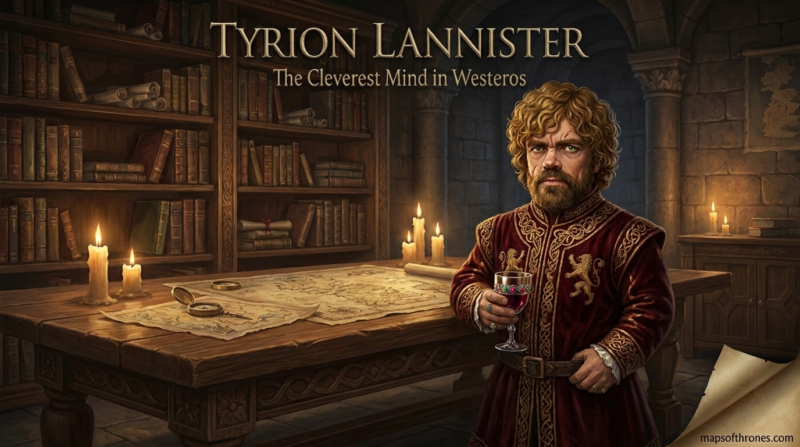
Tyrion Lannister — Complete Game of Thrones Character Guide
Lord of Casterly Rock · Hand of the King · Hand of the Queen · Lord Paramount of the Westerlands
🦁 House LannisterCharacter & Actor Data
Character Data
Actor Data
Character Overview — Critical Thesis
Tyrion Lannister is the show’s argument that intelligence, without the power to enforce it, is merely a more sophisticated form of suffering. He is perhaps the only character in Game of Thrones who understands the game in its entirety — its rules, its costs, its fundamental absurdity — and whose reward for that understanding is to watch it destroy everyone he loves, repeatedly, while he survives.
His fundamental contradiction is this: he is built for a world that should value what he offers, and he lives in one that cannot. Westeros does not need another sword. It needs administrators, strategists, diplomats — and Tyrion is all three at the highest level. But Westeros is a world that measures worth in blood, in purity, in appearance. Everything he represents is what the culture he serves refuses to acknowledge.
Where his arc succeeds: Seasons 1 through 4 are among the finest television character writing in the prestige drama era. Every choice has texture. Every alliance has cost. His trial in Season 4 — where he finally stops performing gratitude for a world that hates him — is one of the great dramatic monologues in the medium’s history. The show earns that moment across four seasons of accumulated indignity.
Where it fails: from Season 5 onward, Tyrion’s intelligence becomes a costume rather than an active force. He is repeatedly written into positions where his supposed genius produces catastrophically wrong results — and the show, unable to commit to that reading, refuses to examine what it means. His Season 8 arc, in which he engineers Daenerys’s downfall and is rewarded with the position of Hand, represents the show’s most dishonest resolution: a character whose every Seasons 6–8 political decision was a failure is given a happy ending predicated on the idea that he is still the right man for political office. The show wants us to accept this without earning it. It asks for the respect it established in Season 1 to cover the deficit of Seasons 7 and 8.
What his ending actually reveals: Game of Thrones ultimately believes that clever, well-meaning men should govern — regardless of recent track record. That is not a subversive thesis. It is a very conventional one.
Who Is Tyrion Lannister in Game of Thrones?
Tyrion Lannister is the youngest son of House Lannister and the most politically gifted mind in Westeros, serving as Hand of the King, Master of Coin, and ultimately Hand to Bran Stark. Born a dwarf and blamed by his family for his mother’s death in childbirth, he survived contempt, two murder trials, exile, and a war he advised against losing — and ended the series alive, governing a kingdom he never sought. Peter Dinklage portrayed him across all eight seasons, winning four Emmy Awards for the role.
First appearance: S1E1 “Winter Is Coming”Tyrion Lannister’s Skills, Abilities & Fighting Style — Complete Analysis
Combat & Physical
Tyrion is not a fighter — and the show is, for the most part, honest about this. His most significant combat moment is the Battle of Blackwater, where he leads a sortie against Stannis Baratheon’s forces after Joffrey abandons the walls. What is striking about the scene is that Tyrion’s courage is genuine, not martial. He fights because there is no one else. He takes an axe blow to the face because Ser Meryn Trant, on Cersei’s orders, tries to have him killed mid-battle. He wins nothing at Blackwater through physical prowess. He survives through preparation — the wildfire chain, the trap — which is consistent with who he is.
Best combat moment: Not the fight itself, but the pre-battle speech to the Lannister soldiers — a moment where his words functioned as weapons, perhaps the only time the show explicitly showed his verbal and strategic abilities as literal battlefield tools.
Most overrated: His survival instinct is sometimes framed as cunning in combat situations where it is simply luck. His escape from the Eyrie’s sky cells was clever; his continued survival in Season 5’s Essos scenes was almost entirely circumstantial.
Ranking vs. other fighters: Among the show’s named combatants, Tyrion ranks near the bottom in pure martial ability — below Brienne, Jaime, the Hound, and even Joffrey’s kingsguard. This is correct. The show should never have needed him to fight at all.
Political Intelligence
In Seasons 1–4, Tyrion’s political intelligence is the most precisely written ability in the show. He reads people faster than they read him. He assembles coalitions from incompatible parts — marrying Sansa to protect her from worse men, placing Shae in the Lannister household while managing Cersei’s suspicion, using Pycelle and Littlefinger as tests for his own counterintelligence. His tenure as Hand of the King under Joffrey is the show’s clearest demonstration that institutional competence is meaningless when the institution’s head is psychologically incapable of being advised.
Best call: The wildfire trap at Blackwater — conceived, planned, and executed against the active resistance of Cersei, Joffrey, and the small council. He did it anyway. It worked.
Worst call: His Season 7 advice to Daenerys to allow the Lannisters to take Casterly Rock unopposed — a strategic miscalculation that cost the Unsullied their fleet and gave Cersei Highgarden’s gold. The show frames this as bad luck. It was bad strategy.
Verbal Persuasion & Rhetoric
This is where Tyrion genuinely operates without peer in Westeros. His ability to reframe a situation, find the leverage point in a conversation, and deliver a killing verbal blow is unmatched in the show. The trial scene in Season 4 — where he abandons his careful defense and simply detonates the entire pretence of Lannister justice — is the apex of this ability. It is a moment of extraordinary rhetorical violence: he uses the truth as a weapon not to save himself but to make absolutely clear to everyone in that room what they have chosen to be.
Failure moment: His repeated attempts to verbally reach Daenerys in Seasons 7 and 8. The show frames his failure to prevent the burning of King’s Landing as tragic; it is also the most complete demonstration that persuasion has limits when the person being persuaded has already decided.
Survival Skills
Tyrion stays alive past several logical survival points — and the show deserves partial credit for acknowledging that some of this is luck. He survives: capture by Catelyn Stark (through a combination of manipulation and Bronn’s blade); his trial at the Eyrie (through trial by combat, with Bronn as his champion); the Battle of Blackwater (through Podrick Payne’s timely intervention when Ser Meryn Trant tries to kill him); his murder trial in King’s Landing (through Jaime’s negotiation and, ultimately, his own demand for combat); and multiple near-death moments in Essos.
Honest luck vs. skill assessment: Approximately 60% skill, 40% the proximity of people who are fond of him at the exact moment he needs them. Bronn, Jaime, Pod, and Varys collectively provide more of Tyrion’s survival than his own decisions.
Plot armor instances: His survival of the Blackwater axe wound (which should have been immediately fatal), his ability to wander Essos for an entire season without serious consequence, and his imprisonment under Daenerys in Season 8 — which, given what she had just done to King’s Landing, required extraordinary restraint on her part.
Strategic & Administrative
As Master of Coin and acting Hand under Joffrey, Tyrion demonstrates a grasp of institutional governance that no other character in the show approaches. He understands supply chains, debt, morale, and the mechanics of keeping a city functioning under siege. He understands that wars are won or lost in counting houses as much as on battlefields. His administrative intelligence is the show’s most underappreciated element — because it is expressed in conversations about logistics rather than dramatic confrontations, it registers less than it should.
Leadership style: Quietly inclusive — he builds small teams of people he trusts and gives them authority. He is not a charismatic leader in the traditional sense; he earns loyalty by being competent and treating people as intelligent. What fails: he has no ability to manage upward against genuinely irrational superiors (Joffrey, later Daenerys).
Alliance Building
Successes: Bronn (turns a mercenary into a genuine ally through consistent respect and fair dealing — the relationship works because Tyrion never pretends it’s more than it is); Pod (earns absolute loyalty through small acts of dignity); Varys (a coalition of shared pragmatism that functions for years); Oberyn Martell (briefly — Oberyn’s agreement to champion Tyrion comes from recognising a shared enemy).
Failures: His alliance with Daenerys, which he never manages to convert from employer/employee into genuine partnership. Every significant Daenerys decision in Seasons 6–8 is made against his counsel. He is her Hand in title only. His failure to prevent or predict her turn at King’s Landing is both his greatest strategic failure and the most honest thing the show does with his character in those seasons.
Was Tyrion Lannister a Hero, Villain, or Something the Show Couldn’t Name?
✦ The Case for Hero
The strongest case for a heroic reading of Tyrion rests on what he refuses rather than what he achieves. He refuses to become his family. He refuses to endorse Joffrey’s cruelty when every other figure in his position complies. He protects Sansa from Joffrey’s public humiliations — not because there is political advantage, but because he finds cruelty contemptible. He warns Cersei that her approach to governance will cost them everything. He is consistently, doggedly right about the right things at the wrong moments — and pays for it each time.
The liberation of the slaves in Meereen, his agreement to serve Daenerys, his role in the Great Council’s decision at the end — all of these are decisions shaped by a genuine commitment to a more humane world. He is not performing goodness. He is constitutionally unable to operate in pure cynicism.
✦ The Case for Villain
The strongest case against a heroic reading begins with the deaths he causes. Shae is his most damning act — he strangled a woman who had loved him, who he had loved, who was cornered and frightened and chose the only survival option available to her. The show frames this as tragedy with Tyrion as the wounded party. The reading that sits uncomfortably is simpler: he killed her because she had humiliated him in front of his father, and he called it something else.
He kills Tywin immediately after — which the show frames as liberation. Both men in that scene were acting on injury. Neither was acting on justice. Tyrion’s murder of his father is personally understandable and politically consequential in ways the show never fully reckons with: Tywin’s death destabilises Lannister power in ways that directly enable Cersei’s worst decisions.
Critical Verdict
Tyrion is neither hero nor villain — and the show does know this, at its best. What it cannot commit to is the corollary: that a character can be genuinely admirable and genuinely flawed in consequential ways simultaneously, without the flaws being excused and without the admirable qualities being negated. Seasons 1–4 hold this balance. The trial scene is the apex: a man who is simultaneously right, furious, self-destructive, and petty — all of it true at once.
The fan perception — which largely reads Tyrion as straight protagonist — is not entirely wrong, but it flattens him. The text that most rewards analysis is the version where his intelligence is his wound as much as his gift: a man who can see exactly what needs to happen and who is structurally unable to make it happen, because the world will not place him where his abilities actually matter. His Season 8 ending, where he is given exactly the position his abilities warrant, should feel like vindication. It mostly feels like the show forgetting what made him interesting.
Tyrion Lannister vs Cersei Lannister — Direct Comparison
Tyrion Lannister Through Every Season
S1
The Education of a Misfit
A
Role: Establishment of Tyrion as the show’s primary POV intelligence — the character through whom the audience understands how Westerosi power actually operates.
Captured by Catelyn Stark and brought to the Eyrie, Tyrion demands a trial. When offered only the moon door, he talks Lysa Arryn into granting trial by combat. He then finds Bronn in the crowd. It establishes the essential Tyrion playbook: no conventional options, improvise with what’s available, find someone whose interests align with yours. Earned.
At Castle Black, early Season 1, Tyrion tells Jon Snow something along the lines of: all dwarfs are bastards in their fathers’ eyes. The scene quietly establishes that Tyrion’s self-awareness is not a defence mechanism — it is a survival tool that has become indistinguishable from his personality.
Tyrion arrives at court and immediately begins mapping who is useful, who is loyal, and who is playing a game they don’t understand. His read of the situation — that Ned Stark is doomed because he refuses to understand the rules — is correct. Nobody listens.
Development: Season 1 establishes that Tyrion is not a cynic — he is a disappointed idealist who has built cynicism as armour. What he gained: Bronn, a genuine ally. What he lost: any remaining belief that family loyalty is mutual.
S2
The Competent Man in an Incompetent Court
A
Role: Tyrion as acting Hand of the King — the show’s most complete portrait of what governance looks like when the person doing it is actually capable.
Tyrion identifies that Pycelle has been feeding Cersei information. He gives three different councillors three different stories about marriage alliances, then waits to see which one Cersei confronts him about. When it’s Pycelle, he has him arrested. This is counterintelligence executed under pressure. Earned at every level.
Against the resistance of an entire council and a king who wants glory, Tyrion plans the destruction of Stannis’s fleet using the existing wildfire stores — supplemented with a chain he has constructed across the bay mouth. The plan works. Then Joffrey abandons the wall, and Tyrion has to lead men personally into the breach. It is the show’s clearest statement about the relationship between planning and execution.
Development: Gained: temporary institutional authority and demonstrated proof of his abilities. Lost: Tywin’s gratitude (who arrives to take credit at the battle’s end), and the left side of his nose.
S3
The Cost of Being Right
B
Role: Tyrion navigating diminished power, an unwanted marriage, and the Red Wedding’s aftermath — a season about watching a capable man stripped of authority and asked to manage the consequences of other people’s decisions.
Forced into the marriage by Tywin — who understands that Casterly Rock is more valuable with Sansa’s claim attached — Tyrion treats Sansa with more basic dignity than anyone else at court. He tells her, in the scene before the bedding ceremony, that he will not force anything she is not willing to give. He means it. The show does not fully resolve what this means for either character.
Tyrion is not present at the Twins, but his reaction to the news — and his argument with Joffrey in the throne room immediately after — establishes his moral position precisely. He is revolted. Joffrey is thrilled. The scene is a catalogue of everything wrong with Lannister governance expressed through two men at the same table.
Grade justification: A solid season for the character but less dramatically concentrated than S1–2 or S4. His storylines feel transitional. Still sharply written; just not the peak.
S4
The Trial That Was Never About Justice
A
Role: The culmination of the Lannister family’s internal war — everything the show has built about Tyrion’s position in his family resolves in a trial that has nothing to do with who killed Joffrey and everything to do with who Tywin has decided his son is.
When Shae takes the stand and lies about their relationship in the most public, most humiliating terms possible, Tyrion abandons his defence. His monologue — directed at the entire court — abandons legal strategy entirely and becomes something else: a public confession that he has spent his entire life being grateful for surviving in a family that hated him, and that he refuses to perform that gratitude anymore. He demands trial by combat. It is the most dramatically earned moment in his arc. Peter Dinklage’s performance makes it one of the great scenes in the series.
After his champion Oberyn is killed and his death sentence is passed, Jaime frees him. Tyrion, before escaping, finds Shae in Tywin’s bed. He strangles her — in grief, in shock, in rage that is only partially aimed at her. He then finds Tywin on the privy and shoots him twice with a crossbow. The act is comprehensible. The show does not adequately interrogate what it costs him, because it needs him to survive and function for four more seasons.
Development: Gained: freedom. Lost: everything else — his home, his family, his identity as a Lannister who survived through wit. He leaves Westeros without a self to replace the one he destroyed.
S5
A Man Without a Country
B
Role: Exile arc — Tyrion travels from Pentos through Essos toward Meereen, encounters Jorah Mormont, is sold into slavery, and eventually reaches Daenerys’s court. A transitional season that serves the plot but not quite the character.
Tyrion’s audition for Daenerys’s service — where he immediately demonstrates that he understands her situation better than her actual advisors do — establishes the Hand of the Queen dynamic. His argument that she needs a Westerosi ally with his knowledge is correct. His estimate of what kind of queen she is takes considerably longer to update.
Grade justification: The Essos wandering is loosely plotted by the show’s standards. The character remains consistent; the writing around him is thinner than it should be. The Jorah partnership is underwritten.
S6
Governing in the Absence of the Governor
B
Role: Tyrion holds Meereen together while Daenerys is missing — his most complete administrative challenge since Blackwater, and the last time his governance is written with real respect for his abilities.
Tyrion’s deal with the slave masters of Yunkai, Astapor, and Volantis — a transitional agreement to phase out slavery over seven years — is deeply controversial in-universe. Missandei and Grey Worm disagree, loudly. Tyrion’s reasoning is pragmatic: he cannot hold Meereen through pure idealism while Daenerys is absent. The deal fails when the masters attack anyway. Whether this is bad strategy or bad faith on the masters’ part, the show never quite decides.
Tyrion descends into the catacombs and releases Daenerys’s two chained dragons — Rhaegal and Viserion. His explanation to them, delivered conversationally to creatures that could eat him instantly, is among the show’s most charming scenes. It also establishes that Tyrion has some quality the dragons respond to — the show deliberately leaves this unexplained, which in retrospect may have been a mistake.
Grade justification: Strong administrative storyline but the slave master negotiation is never resolved in a way that reflects well or badly on Tyrion’s judgment — the plot simply moves past it.
S7
The Advisor Who Stopped Being Believed
D
Role: Officially Hand of the Queen; functionally, a character whose advice is ignored for plot purposes and whose strategic failures are treated as bad luck rather than bad judgment.
Tyrion’s plan — take Casterly Rock as a symbolic victory — turns out to be precisely what Cersei expected. The Unsullied take an empty rock; Euron destroys their fleet; Jaime takes Highgarden. This is not a plan that failed. It is a plan that should never have been made. The show does not make Tyrion account for it.
The plan to capture a White Walker and bring it south to convince Cersei to stand down is Tyrion’s most strategically confused moment. He knows Cersei. He should know this will not work. The season needs the plot to happen, so it happens. Tyrion’s endorsement of the scheme requires the viewer to forgive more than the show earns.
Grade justification: Writing grade D — the show begins sacrificing Tyrion’s intelligence to serve plot functions. His Westerosi knowledge is used only when convenient; his actual strategic judgment is suspended for most of the season.
S8
The Failure That Won Anyway
F
Role: Tyrion spends Season 8 being wrong about almost everything — and is ultimately rewarded with the most powerful advisory position in Westeros. The show cannot reconcile these two facts and does not try.
After Daenerys burns King’s Landing, Tyrion frees Jaime from captivity to attempt a rescue of Cersei. Jaime dies with Cersei under the Red Keep. Daenerys imprisons Tyrion for treason. His argument for releasing him — delivered to Jon Snow through a prison wall — is the season’s most coherent piece of character writing, and it functions primarily by making him articulate the show’s thesis rather than his own survival.
Tyrion proposes Bran Stark as king — a choice presented as wisdom. His reasoning (stories are what bind communities together) is the show trying to articulate a theme rather than a political argument. It is accepted unanimously. Tyrion is named Hand. The show ends. The question of why this man — who has been strategically wrong for two seasons — is the right person to advise a king is left entirely unaddressed.
Grade justification: Writing grade F — the show fails Tyrion completely, using him as a mouthpiece for themes while stripping him of the intelligence that justified his centrality. His ending is philosophically unearned.
Tyrion Lannister’s Geographic Journey
Born here; begins S1 already elsewhere — defined by an absence from home.
Acting Hand of the King; Battle of Blackwater; trial and escape.
Visits with Stark party; tells Jon Snow: “All dwarfs are bastards.”
Captured by Catelyn; survives moon door by demanding trial by combat.
Arrives in exile; despairing; drinking; persuaded by Varys to ride east.
Captured with Jorah; sold as a slave; witnesses the fighting pits.
Becomes Hand of the Queen; governs in Daenerys’s absence; unchains dragons.
Plans the Westeros invasion; strategic failures begin accumulating.
Reunites with Sansa; council of war; watches the Battle of Winterfell from the crypts.
Imprisoned; proposes Bran as king; named Hand. The series ends here.
Complete Alliance & Enemy Record
| Person | Type | Seasons | End Status |
|---|---|---|---|
| Jaime Lannister | Brother / Protector | S1–S8 | Jaime: Dead |
| Cersei Lannister | Sister / Enemy | S1–S8 | Cersei: Dead |
| Tywin Lannister | Father / Nemesis | S1–S4 | Tywin: Dead (killed by Tyrion) |
| Bronn | Ally / Champion | S1–S8 | Alive; Lord of Highgarden |
| Varys | Ally / Counterpart | S1–S8 | Varys: Executed by Daenerys |
| Shae | Lover | S1–S4 | Dead (killed by Tyrion) |
| Sansa Stark | Forced Wife / Eventual Ally | S2–S8 | Alive; Queen in the North |
| Podrick Payne | Squire / Loyal Servant | S2–S4, S8 | Alive; knighted |
| Jorah Mormont | Reluctant Travel Companion | S5–S6 | Jorah: Dead (Battle of Winterfell) |
| Daenerys Targaryen | Queen / Employer | S5–S8 | Daenerys: Dead (killed by Jon Snow) |
| Bran Stark | King / Employer (Series End) | S8 | Alive; King of the Six Kingdoms |
| Oberyn Martell | Ally / Champion | S4 | Oberyn: Dead (trial by combat) |
What Most Fans Miss About Tyrion Lannister
1 His survival is not primarily his doing
The popular reading frames Tyrion as a survivor through wit. The more accurate reading is that he is a survivor through proximity to people who act for him at critical moments. Bronn wins the Eyrie trial. Pod kills Ser Mandon Moore at Blackwater. Jaime arranges his escape from execution. Varys physically removes him from Westeros. Jorah Mormont protects him through Essos. Without these five people acting on his behalf, Tyrion dies in at least four separate scenes. His intelligence identifies the people worth having around him — that is the real skill. Not survival. Alliance curation.
2 He is more conservative than he appears
Tyrion presents himself as a cynic who sees through the game — which fans often interpret as radicalism. He is, in fact, deeply conservative in his political instincts. He works within institutions. He defends the existing power structure even when that structure has personally victimised him. His advice to Daenerys is almost uniformly cautious, slow, and deferential to existing Westerosi power arrangements. The one time in four seasons he advocates for aggressive action — the wight-capture mission — it is precisely wrong. His intelligence is conservative intelligence: very good at managing existing systems, very bad at navigating systems in collapse.
3 The Shae killing is not tragic — it is revealing
The show frames the Shae scene as tragedy: a man killing someone he loved because he was betrayed. The scene that rewards close rewatching is harder than that. Tyrion’s primary emotion in that room, before grief, is shame. He is ashamed that she saw him brought so low. He is ashamed that she had the power to humiliate him in public. When he strangles her, he is not performing a necessary act or acting in grief — he is restoring his sense of himself. The show does not quite admit this. The book version of the scene — where Shae reaches for a knife and Tyrion acts in self-defence — is more comfortable. The show’s version is more honest about who Tyrion sometimes is under pressure.
4 His drinking is characterisation, not characterisation
Tyrion’s drinking is mentioned in virtually every review of the show as a character detail. What goes unexamined is its function. He drinks most heavily in scenes where he has the most power — the Hand tenure, the Blackwater aftermath. He drinks least in Essos, where he has no power at all and sobers up abruptly. His relationship with wine is not self-destructive escapism; it is a social performance of the cynicism he uses to avoid being hurt by expectations. When there are no expectations, there is no performance to maintain. This is more specific, and more interesting, than “Tyrion drinks because he has a sad life.”
5 His Season 8 ending is the show endorsing the wrong thesis
The show wants Tyrion’s appointment as Hand to Bran to read as redemption and as the right man finding the right role after great difficulty. What the sequence of events actually supports is a different thesis: that political failure has no consequences if you are well-connected, articulate, and survive long enough. Tyrion’s Seasons 7–8 strategic record is worse than almost any other advisor’s in the show’s run. He is named Hand anyway. The show does not notice the gap. Book readers who have followed the parallel plotlines note that GRRM’s Tyrion, as of A Dance with Dragons, has not been anywhere near this resolution — his arc in the books is darker, more degraded, and far more morally ambiguous. Whether GRRM’s ending matches the show’s remains unknown.
6 He and Cersei are more similar than the show acknowledges
The show positions Tyrion as the anti-Cersei: where she is cruel, he is kind; where she is short-sighted, he is strategic; where she trusts no one, he builds real alliances. This reading is not wrong, but it ignores the structural parallel. Both of them spent their lives being told they were worth less than the Lannister name assigned to them — Cersei because she was female, Tyrion because he was disabled. Both responded by becoming extremely good at the game Westeros forced them to play. The difference is in method, not in the damage that drove them. Rewatching their scenes with this frame active changes both characters.
7 He never actually wants power — which is why he is dangerous with it
Tyrion does not pursue power for its own sake — which is usually presented as his advantage over more ambitious figures. The less comfortable reading is that this makes him more dangerous, not less. A person who wants power will stop pursuing it when the costs exceed the returns. A person who does not want power will keep accepting it, will keep taking on responsibility out of obligation and competence rather than desire, and will never develop the ruthlessness that power sometimes requires. His inability to stop Daenerys in Season 8 is partly strategic failure and partly the failure of a man who keeps accepting a role — adviser to great power — that his temperament is not suited for.
Where the Writers Failed Tyrion Lannister
The most precise account of the show’s failure with Tyrion is not that it made him stupid — it is that it stopped paying attention to the cost of his decisions. In Seasons 1–4, every Tyrion choice has a specific consequence: the Pycelle gambit produces useful intelligence and a temporary political advantage; the wildfire plan wins Blackwater but earns him no credit; the marriage to Sansa creates protection and resentment in equal measure. The show is tracking what his intelligence costs him as it benefits others.
From Season 5 onward, that accounting stops. His bad advice to Daenerys produces plot complications, not character consequences. His failed negotiations in Meereen are forgotten when convenient. His endorsement of the wight-hunting mission — which directly results in the Night King gaining a dragon and destroying the Wall — is never laid at his feet. The show needs him to be the clever one, so it retroactively forgives his failures by not mentioning them.
The specific moment the writing stopped understanding him: the scene in Season 7 where he stands and watches Daenerys return from the Loot Train Attack — watching from the cliffs as she burns the Tarlys. His expression is troubled. Nothing follows from it. In Season 4, that kind of scene would have produced a confrontation, a political calculation, a revised strategy. In Season 7, it produces a worried look and is never mentioned again.
What a better version of his arc looks like: Tyrion should have been forced to account for his strategic failures. His arrival at the Great Council should have been contested — not because he is evil, but because his record as an advisor is poor. His appointment as Hand should cost him something he had to argue for, not a fait accompli delivered as reward. The books’ darker Tyrion — drunk, degraded, morally compromised — is harder to watch and more honest about what happens to intelligence when it is systematically disrespected for long enough.
Complete Stats Block
Peter Dinklage — Performance Analysis
Actor Vitals
Performance Analysis
What Peter Dinklage brought to Tyrion that no script could have provided is the quality of a man who has already worked out exactly how much contempt he is prepared to absorb and has calculated precisely when it becomes too much. His performance in the first four seasons is built on an extraordinarily disciplined restraint — Tyrion speaks quickly, moves efficiently, deploys charm as a tool rather than a character trait — that makes the moments where the restraint breaks genuinely alarming.
His strongest single sequence is the Season 4 trial in its entirety — not just the famous monologue but the scenes leading up to it. Watch the episode where he listens to Shae’s testimony and tracks what Dinklage is doing with his eyes. He is not performing grief; he is performing the suppression of grief, which is a harder and more specific thing. The moment the performance shifts — where he stops suppressing and starts converting — is one of the great pivots in television acting.
Where his performance after Season 5 is limited: he is working with progressively thinner material, and the most experienced actors are the first to show when writing fails them. In Season 7, his “worried look” scenes — standing at parapets, watching things he cannot affect — are well-executed but they are showing the audience that the character has become a witness rather than an agent. That is a writing problem Dinklage cannot solve, but he does not disguise it as well as he might.
His honest critique: he is best when given text that rewards precision. When the text becomes thematic instead of specific — as it does in Season 8’s prison monologue — he defaults to a kind of declamatory gravity that is impressive but less alive than his earlier, quieter performances.
Awards & Recognition
Four Primetime Emmy Awards for Outstanding Supporting Actor in a Drama Series (2011, 2015, 2018, 2019) — confirmed wins. Golden Globe Award for Best Supporting Actor – Series, Miniseries or Television Film (2012) — confirmed win. Screen Actors Guild Awards recognition as part of ensemble cast — confirmed.
Book vs Show — Tyrion Lannister
The book version of Tyrion, across A Game of Thrones, A Clash of Kings, A Storm of Swords, and A Dance with Dragons, is recognisably the same character in his intelligence and his verbal facility. The differences are significant and cluster around two areas: his interiority and his darkness.
In the books, Tyrion’s point-of-view chapters reveal a man who is considerably more conflicted about his actions than the show allows — and considerably less sympathetic, at intervals. His treatment of Shae in the books involves a more complex kind of self-deception: he knows, at some level, that what he feels for her is more about what she represents than who she is. The show’s Shae is a more fully realised character, which makes Tyrion’s killing of her more morally stark. The book’s Shae is less developed, and the act of killing her is more legible as a moment of cold rage. Whether the show’s version is more or less damning depends on the reader.
The most significant cut from book to show: Tyrion’s search for Tysha — his first wife, who Tywin revealed was not a prostitute but a real girl who actually loved him, and whose revelation Tywin forced Jaime to deliver. In the books, after Jaime frees him, Tyrion extracts this secret from Jaime and it permanently breaks their relationship. Jaime’s last exchange with Tyrion in the books is devastating. The show cut this storyline entirely, which meant Jaime and Tyrion’s farewell in Season 4 could remain warm. The cost: the books’ Tyrion goes into exile already broken in a way the show’s version does not. His Essos arc in A Dance with Dragons is darker, more self-destructive, and more honest about what sustained humiliation does to even the most resilient intelligence.
Where the show version is stronger: Tyrion’s relationship with Podrick, with Bronn, and with Sansa are all better written in the show than on the page. The show also handles the Blackwater sequence with more clarity. For pure emotional legibility, the show’s Tyrion in Seasons 1–4 is the stronger version. For psychological complexity, the books are more demanding and more rewarding.