
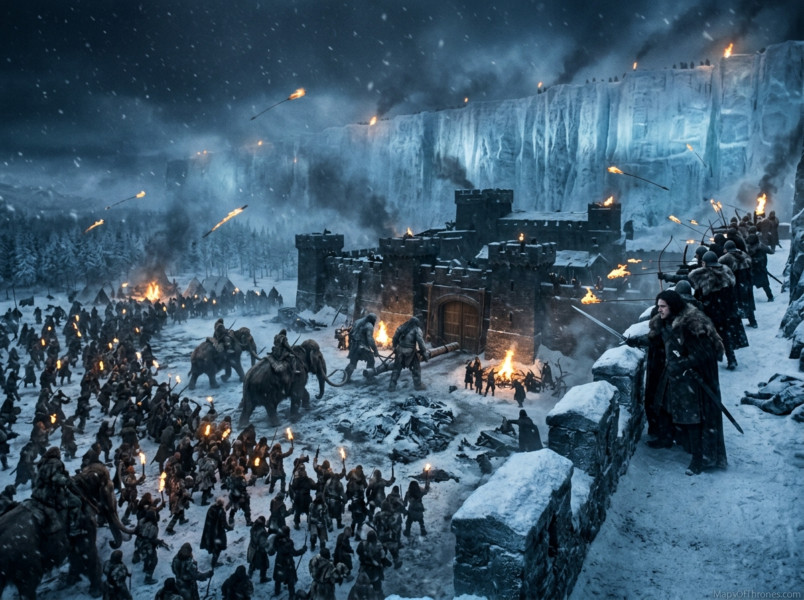
Battle of Castle Black
The Night’s Watch against a hundred thousand Free Folk — a siege on the last great barrier between the living and the dead, where Jon Snow forged himself into a commander and the fate of the realm hung on fewer than a hundred black brothers.
The Battle of Castle Black was a siege fought in 300 AC at Castle Black, the primary garrison of the Night’s Watch along the Wall. Mance Rayder, self-styled King-Beyond-the-Wall, led an army of over 100,000 Free Folk against the Wall’s southern gate while a secondary force scaled the Wall from the north. The Night’s Watch — fewer than 100 active defenders — repelled both assaults under the de facto command of Jon Snow. The battle ended when Stannis Baratheon‘s cavalry arrived at dawn, routing the wildling host. The Night’s Watch won.
The Wall’s Darkest Hour
Castle Black and the Wall at dawn, the epicenter of the siege of 300 AC.
The Battle of Castle Black stands apart from every other military engagement in the history of Westeros — not because of dynastic ambition or the glory of a conquering king, but because it was fought for survival at the edge of the known world. While the War of the Five Kings consumed the realm’s great houses in fratricidal carnage, the true existential threat massed in the frozen north. The Free Folk were not invading for plunder. They were running.
Castle Black, situated at the midpoint of the 700-foot Wall of ice that stretches 300 miles across the continent’s northern frontier, served as the administrative headquarters of the Night’s Watch. By 300 AC, the Watch had fallen to a shadow of its ancient strength — fewer than a thousand brothers total, barely a hundred capable of bearing arms at any single garrison. Against them: a coalition of Free Folk clans numbering over 100,000 souls, unified for the first time in living memory under Mance Rayder, the King-Beyond-the-Wall.
This was not merely a border skirmish. It was a collision of two civilizations — one ancient and failing, one desperate and vast — at the last man-made barrier between the warmth of the south and the advancing cold of the Long Night. The battle’s outcome shaped the politics of the Watch, elevated Jon Snow from bastard recruit to reluctant commander, and forced Westeros to begin — however slowly — reckoning with the true nature of the threat from beyond the Wall.
Battlefield Disposition
Key Participants & Factions
The battle drew together commanders of radically different origins — a king’s bastard, a King-Beyond-the-Wall, a legendary spearwife, and a legitimate claimant to the Iron Throne. Each left an indelible mark on the outcome.
Jon Snow
De facto Field Commander, Night’s WatchWith Lord Commander Mormont dead and Alliser Thorne wounded, Snow assumed field command of Castle Black’s courtyard defense. He slew Styr, the Magnar of Thenn, in brutal single combat and subsequently rode beyond the Wall to treat — and attempt to assassinate — Mance Rayder.
View Character ProfileMance Rayder
King-Beyond-the-Wall, Supreme CommanderA former brother of the Night’s Watch who abandoned his vows to live among the Free Folk, Mance united over ninety clans into the largest wildling host in history. His strategic objective was passage through the Wall — not conquest — driven by the terror of the White Walkers advancing from the Lands of Always Winter.
View Character ProfileYgritte
Wildling Archer & SpearwifeA supremely skilled archer who led the southern assault force through Mole’s Town before reaching Castle Black. Ygritte’s history with Jon Snow made her a figure of tragic inevitability — she hesitated at the critical moment, and was struck by an arrow fired by young Olly, dying in Jon Snow’s arms in the castle courtyard.
View Character ProfileTormund Giantsbane
Wildling War Chief, Southern Assault CommanderMance’s most trusted lieutenant, Tormund led the southern strike force through the tunnel to attack Castle Black from below the Wall. Captured after the battle by the arriving forces of Stannis Baratheon, his survival would eventually make him a pivotal ally in the war against the Night King.
View Character ProfileAlliser Thorne
First Ranger, Acting CommanderDespite his long-standing antagonism toward Jon Snow, Thorne fought with genuine valor at Castle Black, engaging in brutal melee on the courtyard’s battlements before being wounded. His courage in the battle was undeniable, though his political maneuvering afterward would define his darker legacy.
View Character ProfileStannis Baratheon
King (Claimant), Commander of the Relief ForceHeeding the counsel of Melisandre and acting on Jon Snow’s raven requesting aid, Stannis sailed to Eastwatch and marched overland through the Gift. His cavalry swept in at dawn, flanking the wildling host in a devastating charge that shattered Mance’s army and ended the siege. It was his finest strategic moment.
View Character ProfileGrenn
Brother of the Night’s WatchSent by Jon Snow to seal and hold the inner gate against a giant who had breached the tunnel, Grenn led five brothers in a suicidal last stand, reciting their vows as the giant approached. All six died, but the gate held. It was one of the battle’s most quietly heroic moments.
Characters IndexStyr, Magnar of Thenn
Thenn Warg, Southern Force Co-CommanderThe fearsome leader of the cannibal Thenn warriors, Styr co-led the southern assault. He engaged Jon Snow in savage hand-to-hand combat inside Castle Black’s forge, wielding superior strength until Snow improvised, driving Styr’s skull into an anvil. His death broke the southern assault’s command structure.
Characters IndexMelisandre
Red Woman, Advisor to StannisThough not a combatant, Melisandre’s influence on Stannis Baratheon was decisive in redirecting his campaign northward. She saw in the Wall and the Night’s Watch the fulcrum of the war she believed her god R’hllor had called Stannis to fight. Her gaze fell upon Jon Snow at the battle’s conclusion with unmistakable interest.
View Character ProfileBattle of Castle Black — Full Strategic Breakdown
The King-Beyond-the-Wall Unites the Clans
The strategic buildup to the Battle of Castle Black began years before the first arrow flew. Mance Rayder, a former sworn brother of the Night’s Watch, spent years beyond the Wall earning the trust of clan after clan — a feat unprecedented in the history of the Free Folk, who fiercely resisted all forms of authority. By 300 AC, he had assembled perhaps the largest army ever seen in the north of Westeros, driven not by conquest but by the existential horror of the White Walkers, whose Wights were already culling wildling settlements.
Meanwhile, Castle Black’s garrison collapsed through neglect and attrition. The Fist of the First Men disaster — where a Night’s Watch ranging party was annihilated by White Walkers north of the Wall — stripped the Watch of hundreds of its most experienced rangers. Jon Snow returned from his time among the wildlings having witnessed Mance’s full army and the supernatural threat driving them, but his warnings were received with political suspicion rather than urgency.
The Two-Pronged Assault Begins
Mance Rayder’s strategy was classically sound given his forces: simultaneous pressure from both sides of the Wall. His main host, including giants riding mammoths, would attack the Wall’s face from the north — an assault designed to test whether the structure itself could be breached. Meanwhile, Tormund Giantsbane and Styr’s Thenns led a strike force of several hundred south through the Mole’s Town tunnel, emerging to attack Castle Black’s south gate from below the Wall.
Ygritte’s spearwife archers devastated Mole’s Town before converging on Castle Black itself, moving silently through darkness. The tunnel assault forced the Night’s Watch to fight a two-front battle with no reinforcements and no margin for error. The fire atop the Wall — massive scythe-like weapons, burning tar, and the Wall’s own trebuchets — inflicted terrifying casualties on the northern host, but the sheer numbers pressing forward made the attrition irrelevant to Mance’s calculation.
Jon Snow Takes Command
When Alliser Thorne descended from the Wall’s top to engage the melee in the courtyard — and was subsequently wounded — field command effectively devolved to Jon Snow, the most recent arrival with actual combat intelligence about the wildling host. Snow made the pivotal tactical decision of the battle: sealing the inner tunnel gate, buying time by sacrificing Grenn and five brothers in a final stand against the giant that had breached it.
The death of Ygritte — struck by young Olly’s arrow as she hesitated with her bow aimed at Jon — marked the emotional turning point of the battle. Her death crystallized for Snow that the war between the Watch and the Free Folk was grinding up people who should have been fighting together. He defeated Styr in single combat in the forge, then made the audacious decision to ride out beyond the gate to find Mance Rayder personally — an assassination attempt disguised as parley.
Stannis Baratheon’s Cavalry Charge
As Jon Snow parleyed with Mance Rayder in the King-Beyond-the-Wall’s tent — both men measuring each other’s resolve, Mance about to signal the final dawn assault — the thunder of cavalry swept out of the forest treeline. Stannis Baratheon’s horsemen, riding in perfect disciplined formation, crashed into the wildling flanks like a hammer. The Free Folk, exhausted from the night’s fighting and lacking cavalry of their own, had no answer.
Mance was captured. His host shattered and retreated into the landscape. What had been the largest gathering of Free Folk in recorded history dissolved in minutes of hard riding. Stannis rode to Castle Black’s gate in full armor, demanding to know which of the survivors was Jon Snow — and who his father was. The relief of Castle Black was complete, though its political aftermath was only beginning.
Victory Purchased at Great Cost
The Night’s Watch won, but barely. Dozens of brothers were dead, including Pyp and Grenn — irreplaceable veterans. Castle Black’s garrison was further diminished at exactly the moment when the greater threat — the Army of the Dead — was drawing nearer. Jon Snow had Mance Rayder held prisoner, an arrangement that would eventually lead to controversial decisions about the future of the wildling people.
Politically, the battle elevated Stannis from desperate claimant to the savior of the Wall — a position he leveraged in his subsequent campaign in the north, eventually destroying Mance’s army formally and marching on Winterfell. For Jon Snow, the battle was a crucible: it cost him Ygritte and two of his closest companions, but proved beyond doubt that he was the leader the Night’s Watch — and eventually the realm — needed.
Forces & Commanders — Reference Table
| Force | Commander | Strength | Casualties | Objective | Outcome | Significance |
|---|---|---|---|---|---|---|
| Free Folk — Northern Host | Mance Rayder | ~100,000 | Thousands (cavalry rout) | Breach/scale the Wall | Routed by Stannis; Mance captured | Largest wildling army ever assembled; driven by White Walker threat |
| Free Folk — Southern Strike Force | Tormund Giantsbane, Styr (Thenn) | ~400–600 | Heavy; Styr slain, Tormund captured | Breach Castle Black’s south gate | Repelled; commanders captured or killed | Two-front assault strategy; nearly overwhelmed the courtyard defense |
| Night’s Watch — Wall Garrison | Alliser Thorne (wounded), Jon Snow (de facto) | < 100 | Dozens (Pyp, Grenn, others) | Defend Castle Black and the Wall | Victory; held until relief | Outnumbered ~1,000 to 1; defined Jon Snow as a commander |
| Night’s Watch — Wall Top Defenders | Jon Snow, Edd Tollett | ~40 | Moderate | Repel climbers; defend Wall top | Successful; all climbers killed or repelled | Demonstrated the Wall’s defensive advantages when properly manned |
| Stannis Baratheon’s Relief Force | Stannis Baratheon, Ser Davos Seaworth | ~2,000 (cavalry-heavy) | Minimal | Relieve the Wall; destroy wildling host | Decisive victory; wildling army routed | Turned the tide; altered Stannis’s entire northern campaign |
Battle of Castle Black — Frequently Asked Questions
Explore the Wider Lore
Every battle is a node in a larger web of war, politics, and prophecy. Follow the links below to build your full understanding of Westerosi military history.
Explore the Wars That Forged the Realm
Every battle tells a story of power, desperation, and consequence. From the fields of the Blackwater to the frozen wastes of the far north, the military history of Westeros is written in blood and fire.