
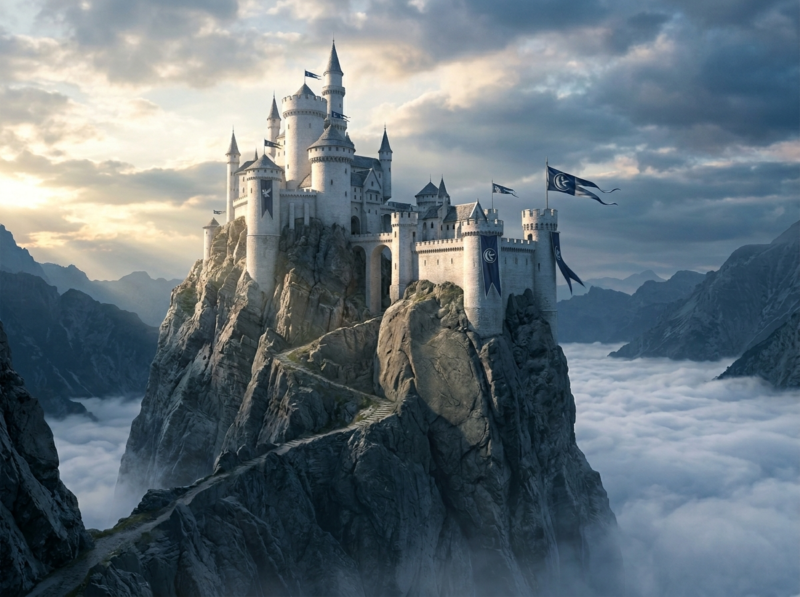
The Eyrie
The impenetrable sky castle of House Arryn, perched upon the Giant’s Lance — where judgment falls from heights no army has ever conquered.
The Eyrie is the ancestral castle and seat of House Arryn, the rulers of the Vale of Arryn. Built of pale white stone, it crowns the summit of the Giant’s Lance — the tallest peak in the Mountains of the Moon — standing over 600 feet above the valley floor. Accessible only via a treacherous mountain path guarded by three waycastles, the Eyrie is universally regarded as the most impregnable fortress in all of Westeros. Its most notorious feature is the Moon Door — a floor-mounted trapdoor in the great hall that opens to a sheer drop of hundreds of feet, used as a method of execution. In winter, the castle is abandoned and House Arryn retreats to the Gates of the Moon below.
What Is The Eyrie — and Why Does It Matter?
Vale of Arryn
In a continent of fearsome castles — from the volcanic walls of Dragonstone to the ancient battlements of Harrenhal — the Eyrie stands apart by virtue of one simple, terrifying truth: no force has ever taken it. Perched atop the Giant’s Lance in the Mountains of the Moon, this compact castle of white stone does not derive its power from thick walls or broad moats. Its walls are the mountain itself.
The Eyrie serves as the seat of House Arryn, whose words — “As High as Honor” — find their most literal expression in this dwelling above the clouds. Positioned at the eastern edge of Westeros, the Vale of Arryn has long been a realm unto itself — prosperous, isolated, and proudly self-sufficient. The Eyrie is both the symbol and the instrument of that isolation.
Strategically, the Eyrie’s importance transcends its impregnability. It controls the High Road — the most direct mountain crossing into the Vale — and by extension, any army seeking to enter or subdue the region must contend with the castle’s shadow. In the events of A Game of Thrones and the television series, it becomes a critical node: the destination of Catelyn Stark‘s reckless journey with prisoner Tyrion Lannister, and the stage for one of the series’ most dramatic trial scenes.
“Hard to attack, easy to defend, impossible to starve out — the Eyrie is not merely a castle. It is a declaration.”
— MapsOfThrones Editorial AnalysisFrom a lore perspective, the Eyrie predates the Andal invasion and stands as one of the oldest continuously inhabited strongholds in the Known World. Its history is woven into the founding myths of the Vale, and its chambers have witnessed councils, executions, betrayals, and — under Lysa Arryn — a peculiar, grief-poisoned isolation from the wider political chaos of the realm.
The Eyrie — Ascent & Layout
The path to the Eyrie is as much a fortress as the castle itself. From the Gates of the Moon at the foot of the Giant’s Lance, travelers ascend via a narrow, switchbacking mountain path, passing through three waycastles before reaching the summit.
The Giant’s Lance · Ascent to the Eyrie · Vale of Arryn, Westeros
The Eyrie — Key Locations, People & Features
Every element that defines the Eyrie — its architecture, its defenders, its rulers, and the path to its gates — is intertwined with the larger story of the Vale and the game of thrones itself.
The Moon Door
The Eyrie’s infamous execution chamber — a trapdoor in the great hall floor that opens to a sheer drop of hundreds of feet. Lysa Arryn’s preferred method of justice; the stage for Tyrion Lannister’s memorable demand for trial by combat.
Explore Feature →Jon Arryn
The former Lord of the Eyrie, Hand of King Robert Baratheon, and foster father to both Ned Stark and Robert himself. His mysterious death sets the entire War of the Five Kings in motion.
View Character →Lysa Arryn
Catelyn Stark’s sister and widow of Jon Arryn, who sealed the Eyrie off from the War of the Five Kings, retreating into paranoia and obsession. Her reign defined the castle’s Season 1 identity.
View Character →Robin Arryn
Lysa’s sickly young son and Lord of the Eyrie following his father’s death. His unusual upbringing — including the famous breastfeeding scene — signaled the dysfunction at the heart of the Vale’s court.
View Character →Castle Stone, Snow & Sky
Three fortified waycastles guard the mountain path to the Eyrie, each serving as a checkpoint and defensive barrier. Together they make siege virtually impossible — an army cannot bring war engines up such terrain.
Explore Path →The Gates of the Moon
The castle at the base of the Giant’s Lance that serves as House Arryn’s winter seat when the high mountain pass becomes impassable. It functions as the lower gateway to the entire mountain approach.
View Location →House Arryn
One of the oldest and most noble houses of Westeros — descended from the First Men, elevated by the Andals. Their words, “As High as Honor,” resonate literally in the Eyrie’s impossible elevation.
View House →The Vale of Arryn
A fertile, well-defended valley realm encircled by the Mountains of the Moon. The Vale remained isolated during most of the War of the Five Kings, its armies — the Knights of the Vale — eventually becoming a decisive force at the Battle of the Bastards.
Explore Region →Petyr Baelish
Lord Petyr Baelish — Littlefinger — becomes Lord Protector of the Vale after Lysa’s death. His manipulation of Robin Arryn and the Knights of the Vale makes the Eyrie a crucial chess piece in his long game.
View Character →Zones of Power — The Eyrie’s Strategic Architecture
Understanding the Eyrie requires examining it across four distinct lenses: its physical geography, its political significance, its cultural identity, and its military function within the broader map of Westeros.
- The Giant’s Lance — the tallest peak in the Mountains of the Moon, foundation of the castle
- The Mountain Path — a single-file ascent passable only on foot or horseback, not by armies
- The Snow Gate — final gatehouse before the summit plateau
- The Eyrie Courtyard — small, wind-lashed, above the treeline
- The Valley Below — the fertile bowl of the Vale of Arryn
- Seat of the Lord of the Eyrie — paramount ruler of the Vale
- Great Hall & Moon Door — center of justice and execution
- Council Chambers — where Vale politics are decided
- Sky Cells — open-air prison cells on the mountain face, one wall open to the void
- Lord Protector’s Chambers — occupied by Littlefinger during his regency
- “As High as Honor” — House Arryn’s words embodied architecturally
- Vale isolation — the Eyrie represents a deliberate retreat from Westerosi politics
- White stone construction — symbolic of purity and ancient Andal craftsmanship
- The Sky Cells — a cultural expression of justice through terror and psychological torment
- Winter departure — seasonal humility before the mountain’s power
- Three waycastle system — Stone, Snow, Sky create layered mountain defense
- No siege record — never successfully besieged in recorded history
- Control of the High Road — sole mountain crossing into the Vale
- Knights of the Vale staging ground — the army that turns the tide at the Battle of the Bastards
- Natural keep — mountain face replaces walls; wind and altitude replace moats
The Eyrie — Complete Location Reference
A structured breakdown of every significant location, feature, and character entity associated with the Eyrie and its surrounding geography.
| Location / Entity | Type | Position | Known For | Importance |
|---|---|---|---|---|
| The Eyrie | Castle / Seat | Summit of Giant’s Lance | Most impregnable fortress in Westeros; Moon Door executions | Critical |
| Moon Door | Architectural Feature | Great Hall, Eyrie | Execution trapdoor; Tyrion’s trial; Lysa’s death | Critical |
| Sky Cells | Prison | Mountain face, Eyrie | Open-air cells designed to induce despair and suicide | High |
| Giant’s Lance | Mountain Peak | Mountains of the Moon | Tallest peak in the range; foundation of the Eyrie | Critical |
| Castle Stone | Waycastle | Lower mountain path | First waycastle on ascent; primary outer defense | Medium |
| Castle Snow | Waycastle | Mid-mountain path | Second waycastle; impassable in winter | Medium |
| Castle Sky | Waycastle | Upper mountain path | Final waycastle before summit; last defense before the Eyrie | High |
| Gates of the Moon | Castle / Winter Seat | Base of Giant’s Lance | House Arryn’s winter seat; lower gateway to the mountain | High |
| Vale of Arryn | Region | Eastern Westeros | Fertile, isolated realm; home of the Knights of the Vale | Critical |
| Jon Arryn | Character | Historical Lord of the Eyrie | Catalyst death; foster father to Ned Stark and Robert Baratheon | Critical |
| Lysa Arryn | Character | Lady of the Eyrie, Season 1–4 | Isolation of the Vale; Moon Door justice; death by Littlefinger | Critical |
| Petyr Baelish | Character | Lord Protector of the Vale | Manipulation of Robin Arryn; deployment of Knights of the Vale | Critical |
Frequently Asked Questions — The Eyrie
The most-searched questions about the Eyrie, answered with lore precision.
Explore the Known World
The Realm Awaits Exploration
From the frozen North to the sunbaked shores of Essos — every castle, city, and shadow has its story.