
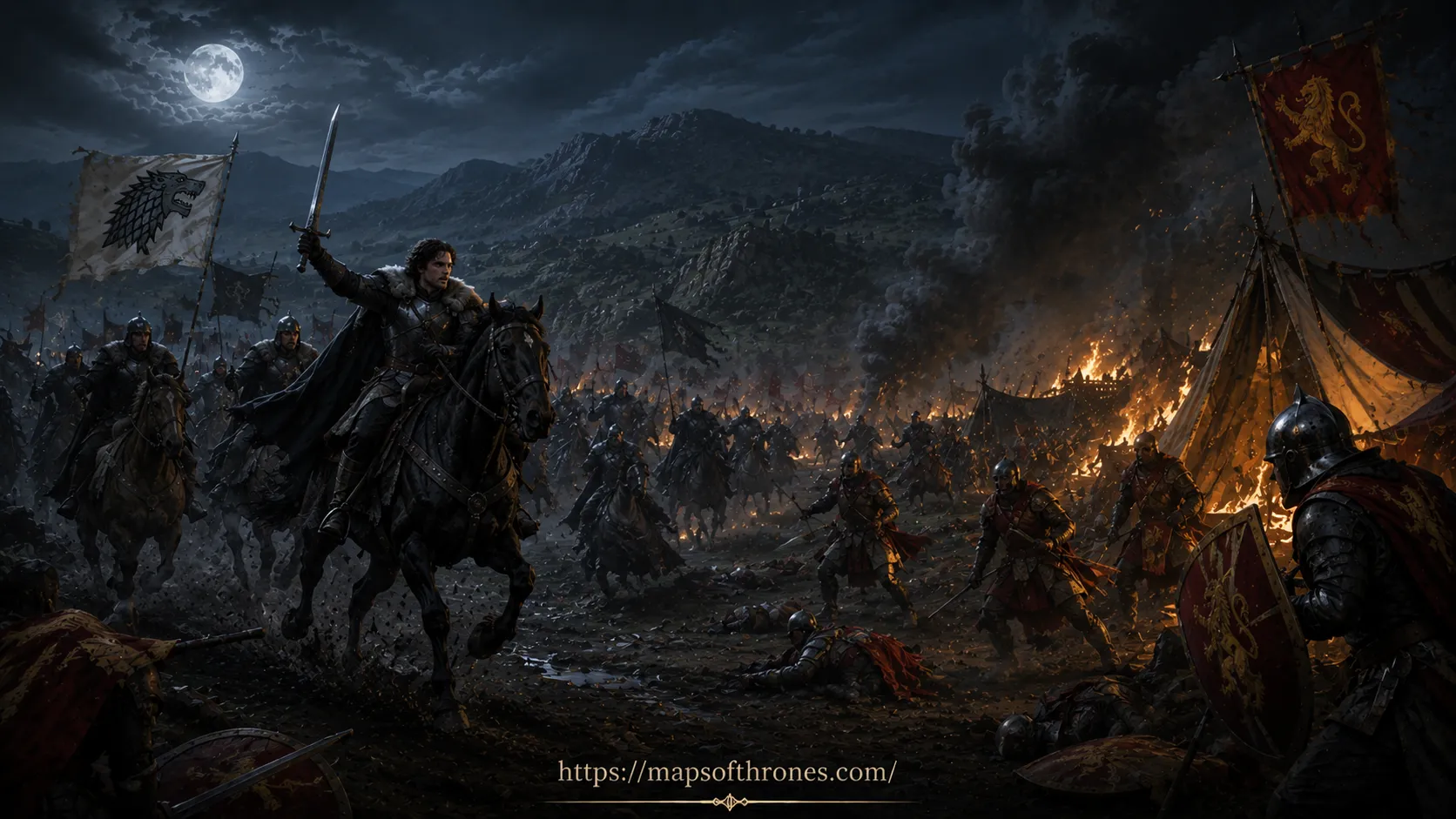
Battle of Oxcross
Robb Stark carried the war into the lion’s den — and the lion was still asleep when the wolves arrived.
The Battle of Oxcross was a devastating Stark victory fought in 299 AC near Oxcross in the Westerlands — the heartland of House Lannister. Robb Stark led his cavalry through the mountain passes in a surprise night assault on the sleeping camp of Ser Stafford Lannister, the commander tasked with building a new Lannister army following Jaime’s capture at the Whispering Wood. Stafford was killed, his army shattered, and Robb Stark — the undefeated King in the North — had now struck inside the Lannister heartland, a feat no enemy had accomplished in living memory.
Into the Lion’s Den — What Was the Battle of Oxcross?
To understand the Battle of Oxcross, you must first understand what made it possible — and what made it unprecedented. For generations, the Westerlands had been inviolable. Casterly Rock, the seat of House Lannister, was the most impregnable fortress in Westeros. The mountain passes that separated the Westerlands from the Riverlands were natural fortifications. No enemy army had marched through those passes in living memory.
Robb Stark was willing to try. Following his proclamation as King in the North and of the Trident after the twin victories at the Whispering Wood and the Camps, Robb faced a strategic situation that was paradoxically dangerous in its success. Tywin Lannister sat at Harrenhal, too powerful to directly engage. And in the Westerlands, Tywin’s cousin Ser Stafford Lannister was quietly assembling a fresh army — a force designed to replace Jaime’s shattered host.
Robb’s strategic logic was cold and clear: destroy Stafford’s army before it could mature, and destroy it inside Lannister territory.
By invading the Westerlands, Robb Stark accomplished two things simultaneously: he destroyed a forming Lannister army and forced Tywin to respond to a threat in his own lands, stretching the Old Lion’s strategic attention across two fronts.
The passage through the mountain passes was itself a logistical and military achievement. That Robb navigated them successfully, preserved the element of surprise, and arrived on Stafford’s position before the alarm could be raised speaks to both the quality of his intelligence and the discipline of his cavalry.
Tactical Diagram — The Battle of Oxcross
Schematic showing Robb’s cavalry approach through the mountain passes, Stafford Lannister’s camp dispositions, and the subsequent Stark sweep through the Westerlands.
Assault
Zone
Key Participants & Factions — Battle of Oxcross
The commanders, lords, and forces whose actions shaped the midnight assault at Oxcross and its sweeping consequences across the Westerlands.
Robb personally designed and led the Oxcross campaign — the audacious decision to pass through mountain terrain in the night and fall upon an unsuspecting camp. His genius lay not just in the tactical execution but in the choice of target: Stafford’s forming army was the Lannister strategic reserve, and destroying it before it could mature was worth more than any open-field victory in the Riverlands.
Explore Character →Ser Stafford Lannister, cousin to Tywin, had been entrusted with raising and training a fresh Lannister army in the Westerlands. His army was still forming — recruits not yet tested — when Robb’s cavalry fell upon the camp in darkness. Stafford was killed in the assault, depriving the Lannisters of an experienced commander and eliminating months of recruitment and training in a single night.
Explore House →Tywin was at Harrenhal when Oxcross fell. The battle demonstrated the limits of his strategic position: his main army could not be everywhere. The news that Robb had penetrated the Westerlands forced him to recalibrate his entire approach, accelerating his eventual alliance with the Tyrells.
Explore Character →Robb’s cavalry was the instrument of the Oxcross campaign — fast enough to pass through mountain terrain before the alarm was raised, shock-capable enough to destroy a camp of raw recruits in the dark. The northern horsemen had now fought at the Whispering Wood, the Camps, and Oxcross without a single defeat.
Explore House →The men in Stafford’s camp were largely raw recruits — Westerlands levies still being drilled and equipped. Fighting in the dark against experienced cavalry who had been winning battles all summer, their collapse was both predictable and complete.
Explore House →The campaign’s continuation to the Crag — where Robb was wounded storming House Westerling’s castle — brought him into contact with Jeyne. The relationship that followed, and the marriage Robb contracted in violation of his Frey oath, is the direct consequence of the Oxcross campaign’s success.
Explore Character →Catelyn Stark accompanied Robb’s campaign and counselled him on the political implications of the Westerlands invasion. Her subsequent unilateral release of Jaime Lannister would crack the coalition Oxcross and its predecessor battles had built.
Explore Character →The Westerlands — the gold-rich domain of House Lannister centred on Casterly Rock — had been effectively inviolable for generations. After Oxcross, Robb’s forces swept through the region capturing Ashemark and demonstrating that even the Lannister heartland was not safe from the King in the North.
View Location →Battle Breakdown — The Battle of Oxcross in Full
A War at a Crossroads — The Lannister Reserve Takes Shape
By 299 AC, the War of the Five Kings had entered a complex second phase. Robb Stark was undefeated but strategically constrained: Tywin Lannister at Harrenhal was too large to confront directly.
Intelligence reached Robb that Ser Stafford Lannister had been tasked with building a new western army — levies being drilled to replace the force Jaime had lost at the Whispering Wood. This army was not yet ready for the field — but left undisturbed, it would be within months. Robb’s window was now, not later.
Robb Enters the Westerlands — Silence as a Weapon
The mountain passes separating the Riverlands from the Westerlands were narrow, difficult, and believed by the Lannisters to be natural barriers no enemy would attempt at pace. Stafford’s sentries were not watching for cavalry arriving from a direction no army had come from in living memory, in darkness, moving quietly.
Robb led his cavalry through the passes on intelligence provided by local guides. The march demanded absolute discipline — a single alarm and the surprise evaporated. His men gave him what he needed.
Stafford’s Camp Awoken by Steel, Not Trumpets
Stafford Lannister’s camp held a force of raw recruits — men who had signed the muster rolls weeks earlier, received their first weapons, drilled in formation, and gone to sleep fully confident that no enemy was within a hundred miles.
Robb’s cavalry came out of the darkness at a gallop, driving into the camp before the sentries could raise more than a scattered alarm. Raw recruits, shocked from sleep, facing trained cavalry in the dark, have one instinct: to run. Many ran. Many more did not get the chance. Stafford Lannister died in the chaos, killed before he could mount any meaningful command response. The Lannister force ceased to exist as a military formation in the span of a single hour of darkness.
The Sweep Through Lannister Lands — Robb’s Reach Extends
With Stafford’s army destroyed, the Westerlands lay open. Robb’s forces spread through the region, capturing Ashemark, raiding villages, and striking at the economic foundations of Lannister power.
The campaign culminated at the Crag, the seat of House Westerling. Robb was wounded storming the castle. It was here, while recovering, that Jeyne Westerling nursed him — and Robb, moved by grief over news of Bran and Rickon’s supposed deaths, married her. The political consequences of that marriage would eventually undo everything Oxcross had built.
The Undefeated King and the Cost of Winning
The Battle of Oxcross was Robb Stark’s fourth consecutive military victory. He had never lost a battle. By every military measure, he was the most formidable commander in Westeros.
But Oxcross’s success deepened the contradiction at the heart of Robb’s campaign: the more he won militarily, the more isolated he became politically. Tywin Lannister, unable to defeat him on the field, turned to other instruments. The marriage to Jeyne broke the Frey alliance. Catelyn’s release of Jaime alienated the northern lords. And in the shadows, Roose Bolton was watching and corresponding.
Oxcross stands as the apex of Robb Stark’s military arc — the moment when the King in the North was most feared, most dangerous, and most entirely alone. The road from this midnight triumph led, with terrible inevitability, toward the Twins.
Forces & Commanders — Reference Table
| Force | Commander | Strength | Casualties | Objective | Outcome | Significance |
|---|---|---|---|---|---|---|
| Stark Cavalry | Robb Stark | Several thousand horse | Minimal — total surprise achieved | Strike Stafford’s forming army before it could mature; penetrate Westerlands | Decisive Victory | Stafford killed; Lannister reserve army destroyed; Westerlands invaded; Robb remains undefeated |
| Lannister Reserve Army (forming) | Ser Stafford Lannister† | ~10,000–15,000 (largely raw recruits) | Catastrophic — army disbanded; commander killed | Form and train a new western army to replace Jaime’s captured force | Total Defeat | Months of recruitment destroyed overnight; Stafford killed; no reserve remained |
Frequently Asked Questions — Battle of Oxcross
-
What was the Battle of Oxcross?
The Battle of Oxcross was a decisive Stark victory in 299 AC in which Robb Stark led his cavalry through mountain passes into the Westerlands and launched a surprise night assault on the sleeping camp of Ser Stafford Lannister. Stafford was killed, his forming army was shattered, and Robb Stark became the first enemy commander to successfully strike inside the Lannister heartland in living memory.
-
Who won the Battle of Oxcross?
House Stark won a complete victory at the Battle of Oxcross. Ser Stafford Lannister was killed, his army of raw recruits was destroyed in the night assault, and Robb Stark extended his unbeaten record while successfully occupying and raiding the Westerlands.
-
Why did Robb Stark invade the Westerlands?
Robb Stark invaded the Westerlands to destroy Ser Stafford Lannister’s forming army before it could mature into a functional fighting force. He also sought to carry the war into Lannister territory — compelling Tywin to respond to threats in his own heartland — and to demonstrate the strategic reach of the North’s military power.
-
Why was the Battle of Oxcross significant?
The Battle of Oxcross was significant for four reasons: it destroyed the Lannister strategic reserve army; it killed Ser Stafford Lannister; it proved Robb Stark could project force into the Lannister heartland; and it extended his unbeaten military record. It was arguably the peak of Stark military dominance in the war.
-
What happened after the Battle of Oxcross?
After Oxcross, Robb Stark’s forces swept through the Westerlands, capturing Ashemark and raiding Lannister lands. Robb was wounded at the Crag and during his recovery married Jeyne Westerling, violating his oath to the Freys. This marriage was the political misstep that began the unravelling of his coalition and led ultimately to the Red Wedding.
-
Who was Ser Stafford Lannister?
Ser Stafford Lannister was a cousin of Lord Tywin Lannister, tasked with raising a new Lannister army in the Westerlands following Jaime’s capture at the Whispering Wood. He was killed during Robb Stark’s night assault at Oxcross.
-
How does the Battle of Oxcross connect to the Red Wedding?
Oxcross led directly to the Red Wedding through a chain of consequences: the Westerlands campaign brought Robb to the Crag, where he was wounded and met Jeyne Westerling; grief and proximity led to marriage; the marriage violated his oath to Walder Frey; the broken oath gave Tywin Lannister the political opening he needed; and the conspiracy that followed ended with Robb Stark dead at the Twins.
Explore the Topical Cluster
Oxcross was the high tide of the King in the North. Follow every victory, every betrayal, and every battle that turned triumph toward tragedy — all mapped across Westeros.