
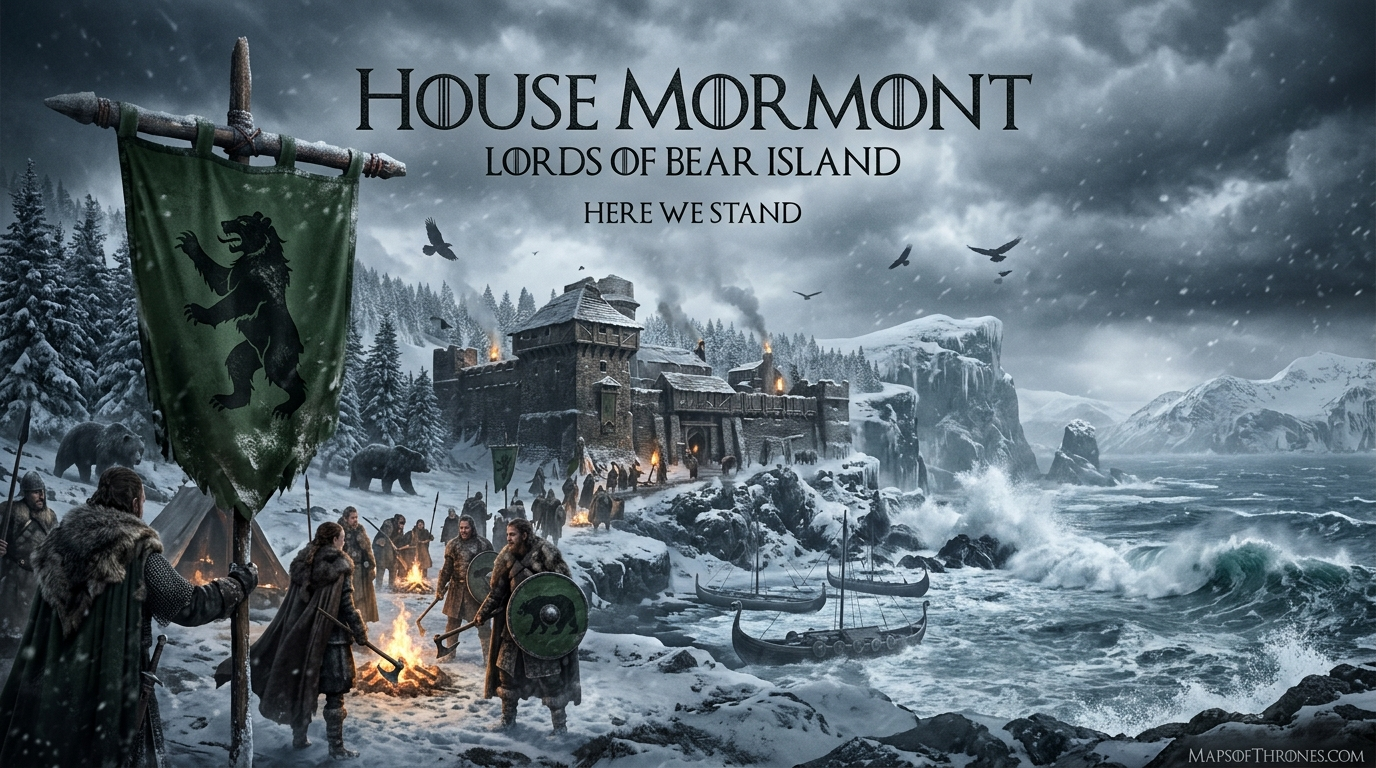
House Mormont
The Bears of Bear Island — small in number, immovable in conviction. Sworn swords to the Starks for a thousand years, and the fiercest voices the North has ever raised.
House Mormont of Bear Island is a noble house in the North, sworn to House Stark of Winterfell. Their seat is on Bear Island in the Bay of Ice, a remote and rugged island that has been raided by ironborn for centuries. Their sigil is a black bear on a green field, and their words are “Here We Stand” — a phrase that defines them completely. Though House Mormont commands far fewer men and lands than the great northern houses, they are renowned for producing warriors of extraordinary courage and leaders of remarkable conviction. Jeor Mormont served as Lord Commander of the Night’s Watch; Jorah Mormont became one of the most complex figures in the known world; and Lyanna Mormont, a child lord, delivered some of the most powerful declarations in all of Westeros.

The Bears Who Stand
In the landscape of Westeros, where power is measured in gold mines, dragon skulls, and armies of tens of thousands, House Mormont occupies a singular position: a small house with an outsized legacy. Their domain, Bear Island, is a wind-scoured island in the Bay of Ice — cold, forested, and perpetually under threat from ironborn raiders crossing the Sunset Sea. It is not a place that breeds comfort. It breeds something far more valuable.
The Mormonts have been loyal bannermen to House Stark for longer than most northern histories record. According to lore, Bear Island was given to the Mormonts by the King in the North after a member of the family defeated a bear in single combat — though the truth, as with most northern legend, is likely more complex. What is certain is that the Mormonts have never wavered in that oath. When the North declared independence, when Robb Stark marched to war, and when Jon Snow called the banners before the Battle of the Bastards, the Mormonts answered.
What makes House Mormont exceptional in the context of the Known World is not their size, wealth, or strategic position. It is their moral clarity. In a world saturated with betrayal, opportunism, and shifting loyalty, the Mormonts have remained a fixed point. Jeor Mormont gave up his lordship to serve the realm at the Wall. Jorah Mormont spent a decade of exile trying to earn back his honor. And Lyanna Mormont, barely a teenager, dressed down rooms full of lords with a composure that shamed men three times her age.
They are also a house defined by its women. Bear Island women learn to fight alongside the men, because when the men march to war or take the black, it is the women — and the old, and the children — who must defend the island from raiders. This produces a particular kind of Mormont: fierce, practical, and unbothered by traditional hierarchies of gender or age.
House Profile

Notable Mormonts
From the Old Bear who commanded the Wall to the twelve-year-old who silenced a hall full of lords — the Mormonts who left their mark on the realm.
Known as the Old Bear, Jeor Mormont gave up lordship of Bear Island — passing it to his son Jorah — to take the black and serve the realm. He commanded the Night’s Watch with iron discipline and was Jon Snow’s greatest mentor at Castle Black, before his death in the mutiny at Craster’s Keep.
Explore Jeor →Once Lord of Bear Island, Jorah was caught selling poachers into slavery and fled Westeros rather than face Eddard Stark’s justice. His exile led him to Daenerys Targaryen, whom he served with absolute devotion for years. His arc — from disgraced lord to redeemed knight — is one of the series’ most emotionally complete journeys.
Explore Jorah →Perhaps the most electrifying figure House Mormont has produced. At perhaps ten or eleven years old, Lyanna Mormont governed Bear Island, refused to yield to a Boltons-backed letter, pledged 62 men with a speech that shamed grown lords, declared Jon Snow King in the North, and ultimately died fighting a reanimated giant beyond the Wall. She became a cultural icon — the small person who stands tallest.
Explore Lyanna →Lady of Bear Island during the War of the Five Kings, Maege Mormont rode with Robb Stark’s army and fought in the Battle of the Whispering Wood. She survived to return to Bear Island, though her fate in the chaos of the war is left ambiguous in the books. She is the mother of Lyanna and represents the Mormont tradition of women as leaders and warriors.
Explore Maege →Maege’s eldest daughter and a skilled fighter in her own right. Dacey Mormont attended Robb Stark’s court and fought alongside his forces, meeting her end at the Red Wedding — one of the first to die in the Freys’ betrayal. Her death is among the most emblematic of the war’s savage toll on those who fought with honor.
Explore Dacey →Not a Mormont by blood, but among those who served most directly under Jeor Mormont at the Night’s Watch, Dolorous Edd represents the generation of black brothers shaped by Mormont’s command. He survived the Long Night to serve as the Watch’s final known Lord Commander during the series’ events.
Explore Edd →Jon Snow served directly under Jeor Mormont at Castle Black and received Mormont’s ancestral Valyrian steel sword, Longclaw, after saving the Lord Commander’s life from a wight. The Mormont-Snow connection runs deep: Jeor shaped Jon into the leader he became, and Lyanna Mormont was among his loudest champions as King in the North.
Explore Jon →Longclaw is the ancestral sword of House Mormont — a Valyrian steel greatsword whose original pommel bore a bear’s head. Jeor Mormont gave the sword to Jon Snow after Jon saved his life, replacing the pommel with a direwolf to suit its new bearer. The blade became one of the most storied weapons in the War for the Dawn.
Explore Longclaw →One of Maege Mormont’s daughters, Alysane fought with Stannis Baratheon’s forces in the assault on the Bolton-held North and was among the northern forces who aided Jon Snow’s reclamation of Winterfell. In the books, she is described as particularly fierce and is known to have had children without a formal husband — true to the Mormont tradition of independent women.
Explore Alysane →House Mormont — Political, Geographic, Cultural & Strategic Breakdown

Political Zones
Bear Island Lordship
Though one of the smaller lordships in the North, Bear Island operates with near-complete autonomy. Its remoteness means its lord — or lady — makes most decisions without direct intervention from Winterfell. This has shaped the Mormont culture of self-reliance and independent leadership.
Loyalty to House Stark
The Mormonts’ fealty to the Starks is absolute and ancient. When the North declared for Robb Stark, the Mormonts pledged without hesitation. When Lyanna declared for Jon Snow at the Northern lords’ council, she triggered a cascade that made him King in the North.
Night’s Watch Connection
Jeor Mormont’s decision to take the black gave House Mormont a unique presence at the Wall. The Old Bear’s command of Castle Black during the critical years preceding the War of the Five Kings shaped the entire defense of the realm against White Walkers.
Bolton Resistance
When the Boltons usurped control of the North, Bear Island refused to bend the knee. Lyanna Mormont’s famous letter rejecting Ramsay Bolton’s authority — sent when she was not yet twelve — demonstrated that Mormont loyalty could not be bought or intimidated.
Geographic Zones
Bear Island
A rugged, forested island in the Bay of Ice. Cold winters, dense woodland, and isolation define daily life here. The island has no great wealth — no gold, no rich farmland — which may explain why its people are defined by endurance rather than ambition.
Bay of Ice
The body of water surrounding Bear Island, and the route that ironborn raiders have used for centuries to attack its shores. Mormont women learned to fight because their men were so often away — and the sea brought enemies regardless of who was home.
The Western North
Bear Island sits in the furthest western reach of the North, closer to the Sunset Sea than to Winterfell. This geographic isolation shapes the Mormont character: they are self-sufficient, wary of outsiders, and capable of operating without the support of the wider realm.
Connection to Castle Black
Jeor Mormont’s tenure as Lord Commander at Castle Black made the Night’s Watch a symbolic extension of Bear Island values: duty without reward, standing one’s post regardless of the cold or the cost. The two locations are thematically linked throughout the series.
Cultural & Strategic Identity
Women Warriors of Bear Island
Bear Island women have been fighters since before the series begins. Forced to defend the island when ironborn raided, generations of Mormont women developed a martial tradition almost unique in Westeros. Maege, Dacey, Alysane — all fighters. Lyanna — a different kind of weapon entirely.
Honor as Strategy
In ASOIAF’s world of chess-board politics, the Mormonts’ refusal to compromise their honor looks, at times, like naivety. But it is also a strategy: houses that know you will not betray them trust you completely. That unconditional trust made the Mormonts invaluable to the Stark cause at critical moments.
Small House, Large Legacy
House Mormont commands 62 fighting men, a small castle, and one island. Yet their cultural footprint in Game of Thrones is immense. Lyanna Mormont’s speeches were some of the most-watched scenes in the show’s history, demonstrating how moral authority can outweigh material power.
Ironborn Threat History
The ironborn have raided Bear Island repeatedly over the centuries. House Greyjoy, whose Iron Islands sit across the Sunset Sea, remains the eternal external threat to Mormont territory. This constant pressure has forged the island’s culture of defensive readiness and distrust of coastal powers.
House Mormont — Key Locations & Entities Reference
| Entity / Location | Type | Region / Role | Known For | Importance to House Mormont |
|---|---|---|---|---|
| Bear Island | Seat of Power | The North, Bay of Ice | Remote island seat; women warriors; ironborn raids; ancestral home | Highest — identity, lordship, and culture all derive from this island |
| Castle Black | Night’s Watch Fort | The Wall, far North | Jeor Mormont’s command; Jon Snow’s training; defense of the realm | High — Jeor Mormont shaped the Watch here; Longclaw passed to Jon Snow here |
| Winterfell | Liege Seat | The North | Seat of House Stark; Mormont oath center; Jon Snow crowned King in the North here | High — Mormont loyalty begins and ends with Winterfell |
| Longclaw | Valyrian Steel Sword | Mormont Heirloom | Ancestral greatsword; bear-pommel; gifted to Jon Snow; used against White Walkers | Foundational — the house’s most famous object; embodies its honor |
| Bay of Ice | Waterway | Western North coast | Surrounds Bear Island; ironborn raiding route; strategic isolation | High — shapes Mormont culture, creates isolation and martial necessity |
| Craster’s Keep | Wildling Holdfast | Beyond the Wall | Site of the mutiny in which Jeor Mormont was killed by his own men | Moderate — site of Jeor’s death; turning point for Jon Snow’s leadership |
| Iron Islands | Enemy Territory | Western Westeros | Home of House Greyjoy; source of ironborn raiders who repeatedly attacked Bear Island | High — the ironborn threat is woven into Mormont history and identity |
| The Red Wedding | Historical Event | Riverlands | Dacey Mormont killed; Mormont forces decimated; blow to the Stark cause | Severe — among the heaviest costs House Mormont paid for Stark loyalty |
House Mormont — Common Questions Answered
The words of House Mormont are “Here We Stand.” Three words that say everything: no retreat, no negotiation, no betrayal. The phrase captures the house’s entire philosophy — a refusal to yield ground whether on Bear Island against ironborn raiders, at the Wall against White Walkers, or in a Great Hall against lords who question their loyalty. Of all the house words in Westeros, few match the Mormonts’ for sheer, compact conviction.
Bear Island lies in the Bay of Ice, off the western coast of the North in Westeros. It is a remote, heavily forested island that sits far closer to the Iron Islands than to Winterfell, making it the most vulnerable northern territory to ironborn raiding. Its significance is not strategic or economic — it is cultural. Bear Island is the forge that produced the Mormont character: isolated, self-sufficient, and utterly unwilling to bow.
Jorah Mormont was exiled after Eddard Stark discovered that he had sold poachers captured on Bear Island into slavery — a crime punishable by death in the North. Rather than face execution, Jorah fled to Essos with his then-wife Lynesse Hightower. The exile was the pivot point of his life: he lost his title, his home, his wife, and his honor. The entirety of his story in Game of Thrones is, in essence, a long attempt to recover what he surrendered in that moment.
House Mormont pledged 62 fighting men to Jon Snow’s cause before the Battle of the Bastards, as stated by Lyanna Mormont in Season 6 of Game of Thrones. The number became famous precisely because of how small it was — and how large Lyanna’s declaration made it feel. In ASOIAF lore, Bear Island has always been described as a small holding, with its military strength defined more by quality and courage than quantity. Lyanna’s proclamation that “every last one of them will stand for House Stark” remains one of the most-quoted speeches in the show.
Longclaw is a Valyrian steel greatsword that served as the ancestral weapon of House Mormont. Jeor Mormont gifted it to Jon Snow after Jon saved his life from a wight attack at Castle Black, replacing the original bear-head pommel with a direwolf to honor its new bearer. Jon carried Longclaw throughout the series, using it to fight White Walkers and in the Battle of the Bastards. After Jon’s exile beyond the Wall in the series finale, the fate of Longclaw is left open — one of Game of Thrones’ deliberately unresolved endings.
Lyanna Mormont died during the Battle of Winterfell in Season 8 of Game of Thrones. She was killed by a reanimated giant — a wight — that crushed her in its grip during the chaos of the undead assault. Before dying, she drove a dragonglass blade into the giant’s eye, destroying it. The scene was designed as a final, definitive statement of Mormont character: even in death, even against an impossible opponent, a Mormont does not yield without taking the enemy with them.
Yes — Jeor Mormont and Jorah Mormont are father and son. Jeor abdicated lordship of Bear Island to his son Jorah before taking the black and joining the Night’s Watch. When Jorah’s crimes were discovered and he fled into exile, Bear Island passed to the female line of the family — eventually reaching Jeor’s niece Maege Mormont, whose daughter Lyanna later assumed leadership. The irony of Jeor’s sacrifice — giving up his seat for his son, only to have that son disgrace the family — is one of the more poignant backstories in the world of ASOIAF.
Related Pages & Connections
From Bear Island to the Shivering Sea — every house, holdfast, and frozen shore, mapped and annotated.