
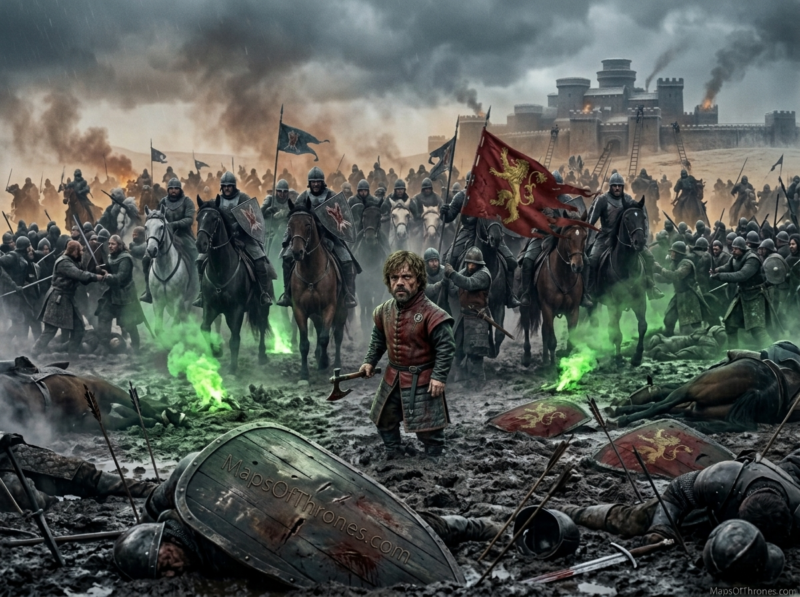
Battle of the Blackwater
The night the realm burned green — Stannis Baratheon’s bid for the Iron Throne met wildfire, chain, and the golden might of a kingdom united against him.
The Battle of the Blackwater (299 AC) was the decisive naval and land siege of King’s Landing during the War of the Five Kings. Stannis Baratheon led his fleet and army against King Joffrey I Baratheon‘s forces on the Blackwater Rush. The defenders, masterminded by Tyrion Lannister, destroyed much of Stannis’s fleet with a single ship packed with wildfire, then repelled the land assault. The battle ended when Tywin Lannister and the House Tyrell host arrived at dawn, routing Stannis’s army and saving the city. The Lannisters and their Tyrell allies won decisively; Stannis retreated to Dragonstone, his cause crippled.
The Siege That Shaped a Kingdom
Of all the battles fought in the War of the Five Kings, none was more consequential than the Battle of the Blackwater. This was not a skirmish over a river crossing or a castle keep — it was a direct assault on King’s Landing, the seat of the Iron Throne itself. Had Stannis Baratheon succeeded, the entire political landscape of Westeros would have been redrawn in a single night.
The battle unfolded on the mouth of the Blackwater Rush, the great tidal river that splits the capital and opens to Blackwater Bay. Stannis, the elder surviving brother of the late King Robert and arguably the most legitimate claimant to the throne, arrived with a formidable fleet of some two hundred ships and a substantial land army. Against him stood the contested boy-king Joffrey I, propped up by the Lannister machine — but with his chief military genius, Tyrion Lannister, serving as Hand of the King.
The stakes were absolute. A Stannis victory would mean the execution of the Lannister leadership, the bastardisation of Joffrey, and a new regime built on iron legitimacy and the shadow faith of R’hllor. The defeat that followed instead forged the Lannister–Tyrell alliance that would define the next era of Westerosi politics.
“The river was green as far as the eye could see, burning and churning, ships exploding into showers of cinders and ash.” — A Clash of Kings
No battle in the War of the Five Kings received more logistical preparation, more strategic creativity, or more raw brutality. The wildfire trap alone — a single vessel packed with alchemical fire steered into an enemy fleet — ranks among the most decisive tactical gambits in all of Westerosi military history. That it was conceived not by a seasoned general but by a stunted, bookish lord with a fondness for wine makes it all the more remarkable.

The Battlefield — Blackwater Rush
The geography of the Blackwater Rush dictated every strategic decision made by both sides. The narrow river mouth created a killing field — wide enough for a fleet, constrained enough for a chain.
Key Commanders & Participants
Tyrion Lannister
Hand of the King · Master Tactician
The architect of King’s Landing’s defense. Tyrion devised the wildfire trap, deployed the iron chain, organized the sortie at the Mud Gate, and personally led troops into battle before suffering a near-fatal slash across the face. Without him, the city falls.
Explore Tyrion LannisterStannis Baratheon
Claimant to the Iron Throne · Attacker
The most legally legitimate claimant, Stannis arrived with two hundred ships and a seasoned host. A brilliant siege commander undone by Tyrion’s ingenuity and the catastrophic timing of the Tyrell reinforcements. He reached the walls of King’s Landing before being broken.
Explore Stannis BaratheonTywin Lannister
Lord of Casterly Rock · Relief Commander
Though absent from the initial defense, Tywin delivered the victory that mattered. He marched through the night with the Lannister host, combined forces with the Tyrells, and struck Stannis’s exhausted army at first light from the King’s Gate. The timing was absolute devastation.
Explore Tywin LannisterSer Loras Tyrell
Knight of Flowers · Vanguard Commander
Riding in Renly Baratheon’s armor to sow confusion and inspire terror, Loras Tyrell led the Tyrell vanguard that shattered Stannis’s lines at dawn. The psychological impact of the ghostly appearance — “Renly returned” — caused as much rout as the steel itself.
Explore Ser Loras TyrellSer Jacelyn Bywater
Commander of the Gold Cloaks
The one-handed commander of the City Watch held the walls and gates while Tyrion organized the mobile defense. His discipline kept the goldcloaks from breaking — a genuine military achievement given the carnage unfolding around them.
Explore Ser JacelynLord Imry Florent
Commander of Stannis’s Fleet
Stannis’s naval commander and a Florent by birth, Imry led the fleet into the Blackwater Rush and directly into Tyrion’s trap. His eagerness to engage without adequate reconnaissance sealed the fate of the armada. He did not survive the wildfire.
Explore Lord ImryMelisandre of Asshai
Shadowbinder · Advisor to Stannis
Melisandre was notably absent from the battle itself — kept behind by Stannis’s command — yet her shadow sorcery had already eliminated one rival: Renly Baratheon. Her counsel shaped Stannis’s confidence before the assault, and her failure to provide a battlefield miracle accelerated the rout.
Explore MelisandreSandor “The Hound” Clegane
Kingsguard · Shield of Joffrey
One of the most feared warriors in the realm, the Hound fought brilliantly in the early defense — until the wildfire’s uncontrolled spread triggered his paralyzing fear of flame. He abandoned the battle mid-siege, refused Tyrion’s command, and departed King’s Landing permanently.
Explore Sandor CleganeKing Joffrey I Baratheon
King of the Andals and the First Men
The titular defender of the realm played a coward’s role. Joffrey was present at the ramparts briefly before Cersei summoned him inside on the pretense of protecting his life. His premature departure nearly caused a total collapse of defender morale — only Tyrion’s impassioned rally prevented rout.
Explore Joffrey BaratheonBattle of the Blackwater — Full Military Breakdown
The Battle of the Blackwater unfolded across five brutal phases, each shifting momentum between attacker and defender in ways that no simple chronology can fully capture.
Prelude — The Claim and the Preparation
Following the death of Renly Baratheon — killed by one of Melisandre’s shadow creatures — Stannis absorbed much of the Stormlands and Reach lords into his host, swelling his numbers considerably. He commanded a fleet of approximately two hundred warships and an army of perhaps thirty thousand. Meanwhile in King’s Landing, Tyrion Lannister had spent weeks secretly ordering the Alchemists’ Guild to prepare tens of thousands of clay pots of wildfire. He commandeered a single large vessel and had its hull, hold, and deck packed floor to ceiling with the unstable green substance — and told no one of the plan except the captain. He also ordered iron chains of enormous scale to be forged and rigged between two galleys that could be winched taut across the river mouth from positions hidden by darkness.
Opening Moves — Fleet on Fleet in the Dark
Stannis’s fleet entered Blackwater Bay at dusk, pressing upriver toward the city’s harbor. Tyrion sent out a single unmanned ship — the wildfire vessel — drifting with the current into the advancing armada, crewed by a skeleton handful who leapt off as she cleared the harbor chains. Bronn of the Blackwater loosed a flaming arrow. What followed was not simply an explosion — it was an apocalyptic conflagration. The wildfire propagated instantaneously through the packed fleet, ship to ship, catching wood, sail, and flesh alike with emerald fire that water could not extinguish. Hundreds of Stannis’s men died in seconds. The iron chain was then raised, trapping the surviving ships within the bay before they could reverse.
Turning Point — The Mud Gate & the Sally
Despite the catastrophic fleet losses, Stannis did not retreat. His ground forces reached the walls, and his surviving sailors beached their vessels and fought their way to the Mud Gate — King’s Landing’s most vulnerable river-facing entrance. With the defenders pinned and morale collapsing (accelerated by Joffrey’s cowardly withdrawal from the ramparts), Tyrion made a decision that defined the battle. He led a sortie out of the Mud Gate personally, rallying the defenders with a blistering speech and charging into Stannis’s ranks. The move was reckless and likely suicidal — and it worked. The defenders held the gate. Ser Mandon Moore, possibly acting under orders from Cersei, took the opportunity to slash Tyrion across the face, nearly killing him. Tyrion’s squire Podrick Payne killed Moore and saved his life.
Climax — The Dawn Hammer of Tywin and the Tyrells
As Stannis’s exhausted troops finally began scaling the walls, as the Mud Gate seemed on the verge of breaking, the horns of a new army sounded from the King’s Gate. Tywin Lannister and Lord Mace Tyrell‘s combined host — fresh from the Roseroad, numbering in the tens of thousands — crashed into Stannis’s flank. Leading the vanguard was Loras Tyrell, deliberately wearing the armor of the slain Renly Baratheon. The sight of the “ghost king” caused genuine panic among the many Stormlands soldiers who had fought under Renly. The Stannis host, already depleted by wildfire, exhausted by the assault, and now flanked by a far larger fresh force, broke completely. Stannis himself had to be physically dragged from the walls by his own guard as the rout consumed his army.
Aftermath — The Political Reordering of Westeros
The cost to Stannis was catastrophic: a majority of his fleet destroyed, thousands of men lost, his political credibility shattered among the lords of Westeros. He retreated to Dragonstone with a rump force. For the victors, the political dividend was equally seismic. Tywin Lannister was named Hand of the King, replacing the wounded Tyrion — who was stripped of his position in the chaos despite being the battle’s true architect. A betrothal was arranged between Joffrey and Margaery Tyrell, cementing the most powerful political alliance in the south. The Lannister–Tyrell bloc would govern Westeros until the deaths of their respective patriarchs. Tyrion, paradoxically, received almost no recognition — a slight he never forgave.
Battle of the Blackwater — Order of Battle Reference
| Force | Commander | Strength | Casualties | Objective | Outcome |
|---|---|---|---|---|---|
| Stannis Baratheon’s Fleet | Lord Imry Florent | ~200 warships | Catastrophic — majority destroyed by wildfire | Breach harbor; land troops at city walls | Destroyed / Routed |
| Stannis’s Land Host | Stannis Baratheon | ~30,000 men | Heavy — broken by Tywin + Tyrell flank | Storm the Mud Gate; take King’s Landing | Routed — retreat to Dragonstone |
| King’s Landing Garrison | Tyrion Lannister / Jacelyn Bywater | ~6,000 (inc. Gold Cloaks) | Significant — Tyrion gravely wounded | Deny the city; hold the Mud Gate | Held until relief arrived |
| Lannister Relief Host | Tywin Lannister | ~20,000+ | Minimal | Relieve siege; destroy Stannis’s army | Total Victory — Stannis routed |
| Tyrell Host | Lord Mace Tyrell / Ser Loras Tyrell | ~20,000+ | Minimal | Secure Lannister alliance; destroy Stannis | Total Victory — political rewards secured |
| Wildfire Stratagem | Tyrion Lannister (planner) / Bronn (igniter) | 1 ship, ~7,800 pots | N/A | Destroy enemy fleet; chain traps survivors | Decisive — fleet annihilated |
Battle of the Blackwater — Frequently Asked Questions
Who won the Battle of the Blackwater?
When did the Battle of the Blackwater take place?
What was wildfire and how was it used at the Blackwater?
Why did Stannis Baratheon lose the Battle of the Blackwater?
What was the iron chain at the Battle of the Blackwater?
What were the political consequences of the Battle of the Blackwater?
Did Tyrion Lannister get credit for winning the Battle of the Blackwater?
Continue Exploring — Battles, Houses & War
Explore the Wars That Forged the Realm
Every battle. Every house. Every turning point — mapped and chronicled in full.