
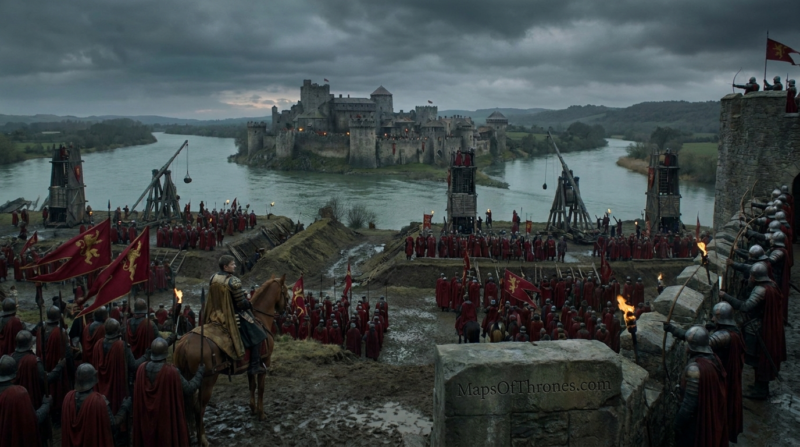
Siege of Riverrun
Where the rivers meet and the fish banner flew — and fell. A castle besieged twice, relieved once, and surrendered to a lion without a sword drawn.
The Siege of Riverrun unfolded across two distinct phases during the War of the Five Kings. First siege (298 AC): Following the Battle of the Golden Tooth, Jaime Lannister’s army invested Riverrun — seat of House Tully — holding it until Robb Stark broke the siege at the Battle of the Camps. Second siege (299 AC): After the Red Wedding destroyed Robb’s coalition, Frey and Lannister forces returned. Jaime Lannister arrived to take personal command and negotiated Edmure Tully’s surrender — delivering the castle to the Lannisters without assault, and ending the Tully hold on the Riverlands.
The Castle at the Confluence — What Was the Siege of Riverrun?
Riverrun is not merely a castle. It is a statement — an architectural declaration of House Tully’s dominance over the heart of Westeros. Positioned at the confluence of the Tumblestone and the Red Fork, its moat filled by channels connecting to both rivers, it is a fortress that cannot simply be stormed: the water would rise, the walls would stand, and the garrison would wait behind stone and current for as long as their lord commanded. Its strength is passive — the siege-breaker’s despair and the garrison commander’s comfort.
Because of this, the Siege of Riverrun is one of the defining through-lines of the War of the Five Kings. It began almost with the war itself, when Jaime Lannister swept east from the Westerlands following his victory at the Battle of the Golden Tooth and placed Riverrun under siege in 298 AC. The ailing Lord Hoster Tully lay inside; his son Edmure commanded the garrison. The castle held. Then Robb Stark arrived, broke the siege at the Battle of the Camps, and the Tully banner flew again over the confluence.
Riverrun sits at the meeting of the Tumblestone and the Red Fork. Its designers built sluice gates into the castle’s foundations: when the gates are opened, the entire area around the castle floods — creating an island fortress accessible only by boat. Any attacker must not merely besiege the walls; they must first accept that direct assault is impossible, and commit to the slow, grinding work of starvation or negotiation.
What makes the siege unique in the war’s history is the second act — the return. After the Red Wedding shattered Robb Stark’s coalition and eliminated the military power that had protected Riverrun, the Lannisters came back. This time there was no relief force coming. This time the castle was truly alone. And this time, Jaime Lannister resolved it not with battering rams or siege engines, but with a conversation — a deal offered to a man who loved his family more than his honour, and who accepted the terms of his own captivity to spare the lives of his garrison.
The two sieges of Riverrun bracket the arc of Tully power in the War of the Five Kings. The first ends in Tully triumph — Robb Stark’s arrival, the lifting of the siege, the proclamation of the King in the North. The second ends in Tully extinction as a political force — Edmure’s surrender, Riverrun in Lannister hands, the Riverlands subdued at last. Between these two events lies the entire dramatic arc of the northern alliance — from its peak at the Camps to its destruction at the Twins.
Tactical Diagram — The Siege of Riverrun
CSS schematic of Riverrun’s position at the river confluence, the surrounding siege camps, and the approach routes of both besieging and relief forces.
Key Participants & Factions — Siege of Riverrun
The lords, commanders, and houses whose decisions across two sieges determined the fate of Riverrun and the Tully dynasty.
Edmure commanded Riverrun’s garrison through both sieges. In the first, he held the castle under desperate conditions until Robb Stark’s relief. In the second, he faced a harder choice: hold indefinitely or accept Jaime Lannister’s terms — his life, his wife’s safety, and captivity in exchange for opening the gates and sparing his men. He accepted. The castle fell without a stone thrown. His decision was rational, humane, and heartbreaking.
Explore Character →Jaime set the first siege in motion following his conquest of the Golden Tooth before being captured at the Whispering Wood. He returned to command the second siege and brought it to a bloodless resolution through direct negotiation with Edmure. His ability to identify Edmure’s pressure point — his pregnant wife Roslin Frey — and deploy it as a diplomatic lever rather than a siege weapon demonstrated a maturity of command that was new to the Kingslayer.
Explore Character →Lord Hoster Tully endured the first siege gravely ill, confined to his chambers, unable to command. His presence inside Riverrun — the symbol of Tully authority — gave the garrison its reason to hold. He died during the war, never seeing the second siege or the ultimate fall of his house’s seat. His death passed the burden to Edmure, who faced it alone.
Explore Character →Robb Stark broke the first siege at the Battle of the Camps — arriving from the east while the Tully garrison sortied from within. His victory at Riverrun cemented the Stark-Tully alliance and was the occasion of his proclamation as King in the North. His subsequent death at the Red Wedding left Riverrun permanently isolated, unable to survive the second siege that followed.
Explore Character →Frey forces held the second siege lines around Riverrun before Jaime’s arrival, but had been unable to make any progress against the castle’s formidable water defences. Their siege was characterised by frustration, incompetence, and the kind of bluster that substitutes for strategy when strategy is absent. Jaime arrived to find them making threatening speeches at the walls. He replaced speeches with results.
Explore House →The Blackfish — Ser Brynden Tully, Hoster’s younger brother — commanded the garrison’s actual military defence during the second siege. A legendary commander of fierce independence, he refused to surrender even after Edmure agreed to Jaime’s terms. When Edmure entered and opened the gates, the Blackfish slipped away into the river under cover of darkness rather than yield — an exit as characteristically stubborn as the man himself.
Explore Character →Tywin directed the broader Riverlands strategy that gave the sieges their context. His post-Red Wedding instructions to Jaime — take Riverrun, consolidate the Riverlands, eliminate Tully resistance — reflected his characteristically efficient approach to power: remove the military problem cleanly, create political facts on the ground, and move on to the next crisis before opponents can regroup.
Explore Character →The castle’s unique defensive design — positioned at the confluence of two rivers, with sluice gates that could flood the surrounding land on command — made it one of the most naturally formidable fortresses in the realm. Its strength was not in its walls but in its water. No attacker could escalade across a flooded moat. No siege tower could cross a river. Riverrun’s weakness was political, not military: it could be surrendered, even if it could not be taken.
View Location →Siege Breakdown — The Two Sieges of Riverrun
The Golden Tooth Falls — Riverrun Cut Off
Following his swift victory at the Battle of the Golden Tooth, Jaime Lannister drove his army east through the Riverlands, burning and pillaging as he advanced. Riverrun — seat of the ailing Lord Hoster Tully — was his primary target. By cutting off the Tully seat and investing it with siege forces, Jaime would remove the Riverlands’ political and military command structure, forcing the region’s lords to choose between resistance without leadership or submission to Lannister power.
The Lannister siege camps were established on both banks of the river approaches to Riverrun, cutting off the castle’s land connections while the rivers provided it water and some degree of interior communication. Edmure Tully, commanding in his father’s incapacity, ordered the sluice gates opened and settled in to wait.
Robb Stark Arrives — The Camps Fall
The first siege was broken by Robb Stark’s coordinated twin assault — the Battle of the Camps outside Riverrun and the Battle of the Whispering Wood to the north, on the same night. Robb’s infantry struck the Lannister siege camps while the Tully garrison sortied from within. The camps were destroyed, the siege was lifted, and Riverrun opened its gates — not to surrender, but to welcome its liberators.
The relief of Riverrun was the occasion of Robb Stark’s proclamation as King in the North and of the Trident. The Riverlands lords, watching the young northerner destroy two Lannister armies in a single night, bent the knee. The fish banner flew again over the confluence. The first siege was over.
The Alliance Is Dead — Riverrun Stands Alone
The Red Wedding did not merely kill Robb Stark. It killed the political structure that had kept Riverrun viable as a point of resistance. With Robb dead, the Stark alliance shattered, and the Riverlands lords submitting to Lannister authority one by one, Riverrun was left isolated — a single Tully castle in a Lannister sea. The Frey forces invested it and settled in, expecting a quick surrender from a garrison without hope of relief.
They were wrong. Inside Riverrun, Ser Brynden Tully — the Blackfish — commanded the military defence with the inflexibility of a man who had spent a lifetime refusing to bend. The Freys blustered. The Blackfish waited. The siege dragged on, embarrassingly static, until Tywin Lannister sent Jaime to resolve it.
The Kingslayer Takes Command — And Sets Down His Sword
Jaime Lannister arrived at the second siege as a changed man. The warrior who had set the first siege in motion with cavalry and fire returned to end the second with patience and intelligence. He assessed the situation immediately: the Frey siege was incompetent, the castle impregnable by assault, and the Blackfish immovable by intimidation. A conventional siege could last years.
Jaime’s solution was Edmure Tully. Edmure was a prisoner held by the Freys since the Red Wedding — the heir to Riverrun, husband of Roslin Frey, father of an unborn child he had never met. Jaime met with him privately and made his offer: Edmure’s life, his wife’s safety, comfortable captivity, and eventually a modest lordship — in exchange for entering Riverrun, commanding the garrison to stand down, and opening the gates.
A Lord Surrenders to Save His People
Edmure Tully accepted the terms. He was rowed to Riverrun’s water gate and entered the castle. The garrison — shocked, angry, and then resigned — received their lord’s command to surrender. The Blackfish refused, slipping into the river under cover of the confusion and disappearing into the night rather than yield to the Lannisters. He was never recaptured.
The gates opened. Lannister men-at-arms entered Riverrun for the first time without having fought for it. The fish banners came down. The lion ascended over the confluence. The Tully hold on the Riverlands — which had endured for generations and survived one of the most dramatic sieges of the war — ended not with a battle but with a quiet conversation and a man’s reluctant acceptance of his own captivity.
The aftermath was the consolidation of Lannister control over the Riverlands. Edmure was taken captive and eventually imprisoned at Casterly Rock. The Frey lords received their Riverlands rewards. The Blackfish remained at large, a symbol of Tully defiance that the realm had not entirely forgotten. And Jaime Lannister rode away from Riverrun having accomplished through negotiation what no amount of battering rams could have achieved — a lesson in the limits of force that the Kingslayer had been a long time learning.
Forces & Commanders — Reference Table
| Force | Commander | Phase | Casualties | Objective | Outcome | Significance |
|---|---|---|---|---|---|---|
| Lannister Siege Army | Ser Stafford Lannister / subordinates | First Siege (298 AC) | Heavy — destroyed at Battle of the Camps | Invest and starve Riverrun; break Tully resistance | Defeat — siege lifted | Fall of the siege led to Robb Stark’s proclamation as King in the North |
| Tully Garrison | Edmure Tully | First Siege (298 AC) | Light — held until relief arrived | Hold Riverrun until relieved by Robb Stark | Victory — siege lifted; garrison intact | Riverrun held; Tully-Stark alliance consolidated at the Camps |
| Frey Siege Forces | Frey commanders | Second Siege (299 AC) | Minimal — no assault conducted | Invest Riverrun post-Red Wedding; force surrender | Stalemate until Jaime’s arrival | Incompetent siege required Jaime Lannister’s intervention |
| Lannister Command | Ser Jaime Lannister | Second Siege (299 AC) | None — resolved by negotiation | End the siege; deliver Riverrun to Lannister control | Victory — negotiated surrender | Bloodless resolution demonstrated Jaime’s political evolution; Riverlands secured |
| Tully Garrison | Ser Brynden Tully / Edmure Tully | Second Siege (299 AC) | None — surrendered without assault | Hold Riverrun; resist Lannister-Frey occupation | Defeat — surrender negotiated; Blackfish escaped | End of Tully political control of the Riverlands; Edmure taken captive |
Frequently Asked Questions — Siege of Riverrun
-
What was the Siege of Riverrun?
The Siege of Riverrun refers to two separate sieges of Riverrun — the ancestral seat of House Tully — during the War of the Five Kings. The first (298 AC) was conducted by Lannister forces and lifted by Robb Stark at the Battle of the Camps. The second (299 AC) followed the Red Wedding and was resolved when Jaime Lannister negotiated Edmure Tully’s surrender.
-
How did the second Siege of Riverrun end?
The second Siege of Riverrun ended through negotiation rather than assault. Jaime Lannister met privately with Edmure Tully and offered him his life, his wife’s safety, and comfortable captivity in exchange for entering Riverrun and ordering the garrison to surrender. Edmure accepted. He entered the castle, commanded the garrison to stand down, and opened the gates. The Blackfish escaped into the river rather than yield.
-
Why was Riverrun impossible to take by assault?
Riverrun sits at the confluence of the Tumblestone and the Red Fork, with sluice gates that flood the surrounding land when opened — turning the castle into an island fortress. No siege tower could cross the flooded moat, no escalade could cross running water, and no battering ram could reach walls surrounded by river current. The castle’s weakness was not military but political: it could be surrendered, but not stormed.
-
What happened to the Blackfish after the Siege of Riverrun?
Ser Brynden Tully — the Blackfish — refused to surrender when Edmure accepted Jaime’s terms. When the gates opened and Lannister men entered, the Blackfish slipped away into the river under cover of the resulting confusion and escaped into the Riverlands. He was never recaptured and remained at large — a symbol of continued Tully resistance even after the fall of Riverrun.
-
Why was Riverrun strategically important in the War of the Five Kings?
Riverrun was the seat of House Tully, the Lord Paramount of the Riverlands — the strategically central region of Westeros that every major faction fought through, over, and for during the War of the Five Kings. Holding Riverrun meant political and military command of the Riverlands. The alliance between the Tullys and the Starks was the backbone of the anti-Lannister coalition. Breaking that alliance by taking Riverrun was fundamental to Lannister victory.
-
What happened to Edmure Tully after surrendering Riverrun?
After surrendering Riverrun, Edmure Tully was taken captive by the Lannisters. He was held as a prisoner ensuring Riverlands compliance following the Red Wedding. His wife Roslin Frey was pregnant with his child. Edmure’s captivity represented the political extinction of the Tully dynasty as a power in the Riverlands — the end of a house that had governed the middle of Westeros for generations.
-
How did the Red Wedding make the second Siege of Riverrun possible?
The Red Wedding destroyed the Stark-Tully military coalition that had protected Riverrun during and after the first siege. With Robb Stark dead, the Stark armies disbanded, and the Riverlands lords submitting to Lannister authority, Riverrun had no prospect of relief. The second siege was possible precisely because the Red Wedding had eliminated the external military power that had made the first siege untenable. Without Robb, Riverrun could be contained, starved, and eventually negotiated into submission.
Explore the Topical Cluster
Riverrun held through one siege and surrendered through another. Every castle, every banner, every lord who bent the knee or refused — all documented across the realm.<