Essos Region Guide
Dothraki Sea Map
The complete map of the Dothraki Sea in Game of Thrones — Vaes Dothrak, the Womb of the World, the Lhazar borderlands, and every key location across the endless grass of Essos.
By Bia & Zhuni ◆ Updated Apr 2026 ◆ The Largest Grassland in the Known World
The Dothraki Sea is the vast, seemingly endless grassland at the centre of Essos — the largest landmass in the known world. It is the ancestral homeland and riding ground of the Dothraki, a fierce nomadic people organised into mounted warbands called khalasars. The region stretches from the Free Cities in the west to the Bone Mountains in the east, with the sacred city of Vaes Dothrak at its northern heart — the only permanent Dothraki settlement and the only place in the known world where bloodshed is forbidden. Daenerys Targaryen spends significant time here across Seasons 1, 2, and 6, and her experience in the Dothraki Sea — from her marriage to Khal Drogo to her burning of the khals — defines the arc that transforms her from exile into conqueror.
What Is the Dothraki Sea?
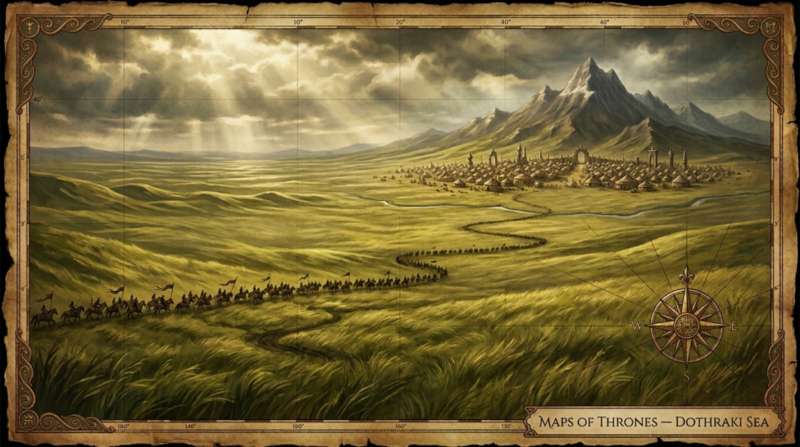
The Dothraki Sea is not named for water — it is named for grass. From the crests of the hills that mark its western boundary, the land rolls outward in every direction like an ocean of green and gold, cut only by rivers, the distant shadow of the Bone Mountains to the east, and the occasional dark line of a khal’s column moving somewhere across the plain. It is the largest unbroken grassland in the known world, and it belongs entirely to the Dothraki.
Unlike Westeros, which is carved into kingdoms with castles and roads and written laws, the Dothraki Sea has no borders that can be drawn on a map and enforced with soldiers. Its boundaries are wherever the grass ends and something else begins. To the west, beyond the hills, lie the Free Cities — Pentos, Qohor, Norvos — where merchants trade in Dothraki slaves and Dothraki horses. To the south, the land softens into Lhazar, the sheep-farming territory of the Lhazareen, a people the Dothraki raid and enslave with complete impunity. To the east, the Bone Mountains rise as a natural border, beyond which lies Slaver’s Bay and the far east of the known world. To the north, the sea of grass eventually fades into the steppes of the Jogos Nhai.
At its heart — northwest, in the sheltered cup of hills near the Mother of Mountains — sits Vaes Dothrak. It is the only city the Dothraki have ever built and the only place in their world where bloodshed is forbidden. Every khal must eventually come here to present his khalasar to the dosh khaleen, the council of widowed khals’ wives who govern the city and serve as its living memory. In *Game of Thrones*, it is where Daenerys Targaryen arrives as Khal Drogo’s new bride — and, years later, where she returns as a captive and leaves as a conqueror of all the Dothraki world.
S W E
The Essential Dothraki Sea Locations
The six places that define the geography, culture, and narrative map of the Dothraki Sea.
Browse the Dothraki Sea by Region
From the sacred city at the northern heart to the southern borderlands and the eastern mountain passes.
Major Locations in the Dothraki Sea at a Glance
| Location | Type | Position | Best Known For | Significance |
|---|---|---|---|---|
| Vaes Dothrak | City | North-central — base of Mother of Mountains | Only permanent Dothraki city; no bloodshed permitted; dosh khaleen | Sacred Capital |
| Mother of Mountains | Peak / Landmark | Above Vaes Dothrak, northern sea | Sacred peak; cannot be climbed by Dothraki; visible for hundreds of miles | Spiritual Anchor |
| Womb of the World | Sacred Lake | Near Vaes Dothrak | Prophecy ritual for new khals’ heirs; dosh khaleen ceremony | Ritual Site |
| Lhazar | Territory | South — Dothraki Sea border | Lhazareen people; raided by Dothraki; Mirri Maz Duur’s homeland | Southern Borderland |
| Bone Mountains | Mountain Range | East — geographic border | Eastern limit of the sea; passes toward Qarth and the Jade Sea | Eastern Limit |
| Pentos | Free City | West — beyond the hills | Where Daenerys first arrives; Illyrio Mopatis brokers the Drogo marriage | Gateway City |
| Qohor | Free City | West-central border | Annual slave tribute to the Dothraki; famous for steel working | Tribute City |
| Dosh Khaleen Temple | Religious Site | Within Vaes Dothrak | Governing seat of widowed khals’ wives; burned by Daenerys in Season 6 | Power Centre |
| Drogo’s Khalasar Route | Movement Path | West to east, Pentos → Lhazar | Season 1 journey arc; Drogo’s fatal wound; Dany’s first transformation | Narrative Arc |
| The Open Grassland | Terrain | Central — the entire sea | The riding ground of all khalasars; largest grassland in the known world | Core Territory |
The People Who Define the Dothraki Sea
No other region in Game of Thrones is as inseparable from its people as the Dothraki Sea is from the Dothraki — and from the characters shaped by their time inside it.
The Dothraki Sea in Game of Thrones — What Happens Where
The History of the Dothraki Sea and Its People
The Dothraki did not always dominate the sea of grass. In the histories recorded in the A Song of Ice and Fire source material, the Dothraki are a relatively recent force in Essos — rising to dominance within the last few hundred years as a people organised around the horse and the khalasar system. Before them, the great plains were contested by different nomadic peoples, several of whom the Dothraki absorbed or destroyed entirely.
The Dothraki social structure is built entirely around the khal — the mounted warlord who holds a khalasar together by force of personal dominance. There is no Dothraki nation in any conventional sense. There is no Dothraki law that applies across different khalasars. The only shared structure is the neutrality of Vaes Dothrak and the authority of the dosh khaleen — the council of widowed khals’ wives who maintain the city and its traditions.
The Dothraki religion centres on the Great Stallion — a god of speed, strength, and conquest — and the prophecy of the Stallion Who Mounts the World, a foretold khal who will unite all khalasars into one great horde and ride to the ends of the earth. This prophecy is what makes Daenerys’s son — briefly — so significant. And its death, along with Rhaego himself, is what breaks something fundamental in the Dothraki cosmology of Season 1.
What makes the Dothraki Sea uniquely significant in Essos is what it does not have. No cities other than Vaes Dothrak. No written law. No settled agriculture. No roads that anyone maintains. No borders that any army enforces. The sea of grass is genuinely open — and it is exactly that openness that makes the Dothraki ungovernable by any conventional empire. The Free Cities learned this. The Ghiscari learned this. Only Daenerys Targaryen found a way — not by governing the Dothraki, but by becoming something they had never encountered: a khaleesi who could not be killed by fire, and who had already killed every khal who stood before her.
Dothraki Sea Map FAQs
✦ Explore More Dothraki Sea Maps on Maps of Thrones
The Dothraki Sea is more than a backdrop for Game of Thrones — it is the crucible that makes its most significant transformation possible. Without the sea of grass, there is no Khal Drogo and no marriage. Without the marriage, there is no journey east and no pyre. Without the pyre, there are no dragons. And without the return to Vaes Dothrak in Season 6, there is no army to cross the Narrow Sea, no Loot Train Battle, and no war for Westeros as we know it. Everything that defines Daenerys Targaryen as a conqueror was forged on horseback, in grass, under a vast and indifferent sky.
From Vaes Dothrak’s stolen monuments to the sacred lake where prophecy was spoken over an unborn son, from the sacked villages of Lhazar to the rolling plain where tens of thousands of riders once knelt — the Dothraki Sea holds more narrative weight per square mile than almost anywhere else in the known world.
Maps of Thrones is a fan reference site. Game of Thrones, A Song of Ice and Fire, and all related names, characters, and places are the property of HBO and George R. R. Martin. This site is not affiliated with, endorsed by, or connected to HBO or Warner Bros. Discovery. All content is published for informational and editorial purposes under fair use.